
Panel by Panel
The Plymouth Tapestry presents the story of Plymouth Colony’s founding in a chronological series of handstitched needlework scenes.
Each embroidered panel represents a chapter in this consequential history, revealing deeper historical contexts as well as presenting information about specific people and events. Each individual panel measures six feet in length.
PANEL 1 WAMPANOAG BEGINNINGS & THE VILLAGE OF PATUXET
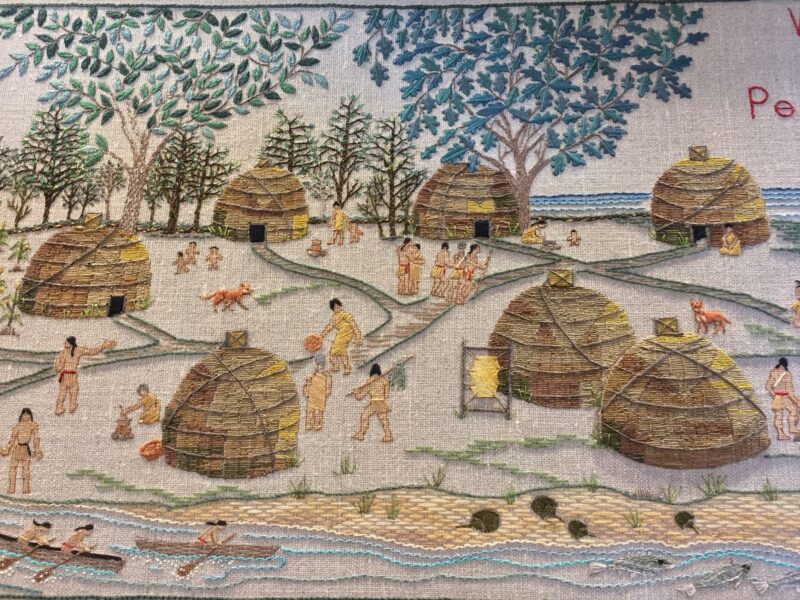
The People of the First Light, the Wampanoag, have lived for about 14,000 years on homelands encompassing the area of Plymouth Colony, Cape Cod and the Islands, and west into Rhode Island. On the panel, Wampanoag deep-time presence begins with Manit’s creation of the First People.
Scenes of the summer village of Patuxet (later Plymouth) before the arrival of Europeans show the Wampanoag living resourcefully, in close relation to land and environment. The village is on the coast with a freshwater brook running into the sea; Clark’s Island and Saquish are visible in the distance. There are many families, with wetus made of bent saplings and woven mats, tame dogs, and cornfields planted with beans and pumpkins.
PANEL 2 CREATION OF AQUINNAH & THE ISLANDS
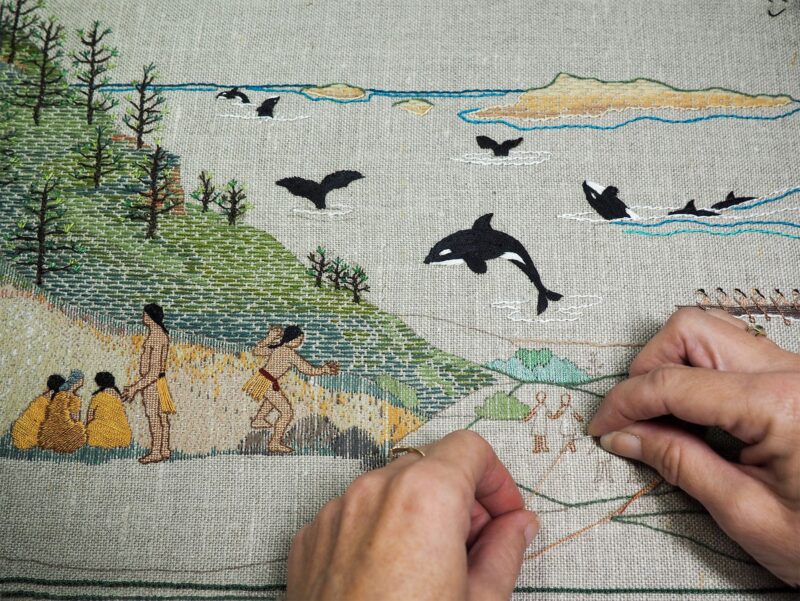
Stories of Moshup the Giant and his creation of places such as Cape Cod and the Islands are deeply rooted in Wampanoag culture. Moshup’s seat on the colored clay cliffs of Aquinnah (Martha’s Vineyard), is one of several places, including Mashpee and Herring Pond, where the Wampanoag presence has continued unbroken to today.
This panel includes a map of Indigenous territories from Wampanoag homelands along the eastern seaboard, north to Micmaq lands, and west as far as Muhhekunnutuk, showing the diversity and geographic scope of Native nations before European contact. Below the map, border designs point to contrasting events in Europe during the same period.
PANEL 3 RISE OF CHRISTIAN EUROPE

Over centuries, Europe and England participated in wars of the Crusades, which stimulated the rise of Christian Europe and introduced economic and cultural innovations. Influences on English society ranged from minting English coinage to tastes for luxury goods from the East. Along the top border are scenes of Wampanoag life at this time.
Monasteries expanded and flourished as centers of learning. The Church of Rome amassed wealth and influence. A powerful ecclesiastical hierarchy developed, raising concerns in many Christian lands about church bureaucracy and corrupt practices. In England, conflicts between papal and royal authority led to the eventual formation of its own state church.
PANEL 4 ROOTS OF PROTESTANT REFORMATION
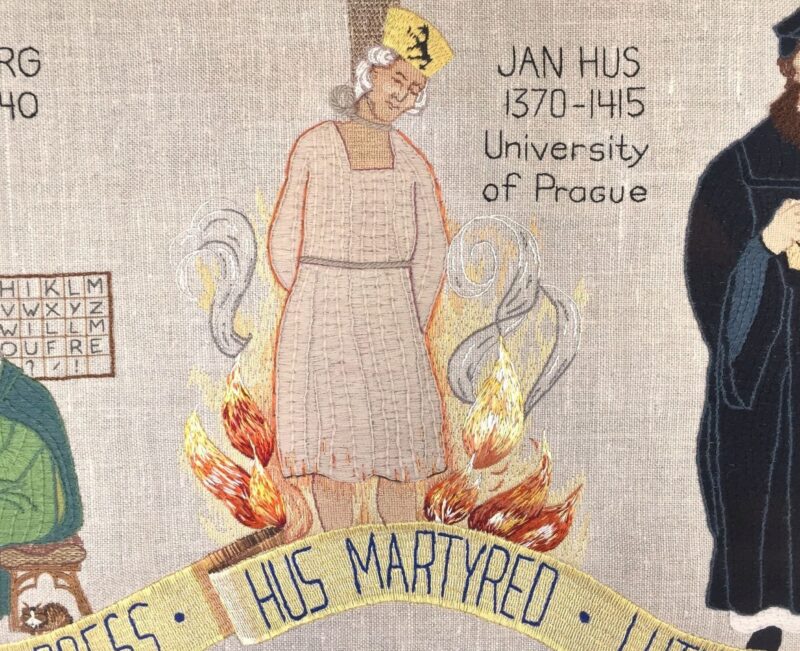
The English religious exiles who became known as the Pilgrims were influenced by a ferment of ideas during the Protestant Reformation. The invention of the printing press sparked a new age of communications, and the publication of the Bible into ordinary languages, including Wycliffe’s English version, reshaped religious thought throughout Europe.
Pilgrims William Brewster, William Bradford, and others in their circle knew the works of scholars and clerics who argued for church reform, including Calvin, Luther, and Hus, who was executed for his beliefs.
Henry VIII’s break with the Church of Rome, which gave hope to Protestant reformers, did not resolve religious differences. Non-conformist beliefs remained dangerous in England.
PANEL 5 KING JAMES, EARLY VOYAGES, WAMPANOAG CAPTURE
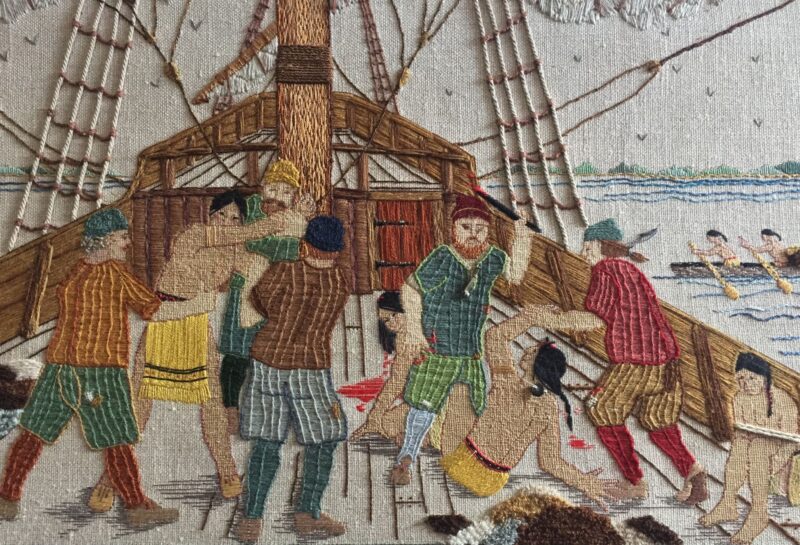
Puritan petitioners appealed to newly enthroned King James I to reform the established church but their hopes were disappointed. As religious tensions grew, a plot to blow up Parliament was prevented, heightening anti-Catholic feeling.
Europeans crisscross the Atlantic as the pace of New World exploration accelerated with voyages for fishing and trade, and early efforts to establish colonies. Indigenous people along New England’s eastern seaboard encountered frequent ships. In 1611, a group of Wampanoag men and boys, including Epanow of Aquinnah, were tricked by English captain Edward Harlow and brought against their will to England to be displayed as curiosities.
PANEL 6 THE SEPARATISTS
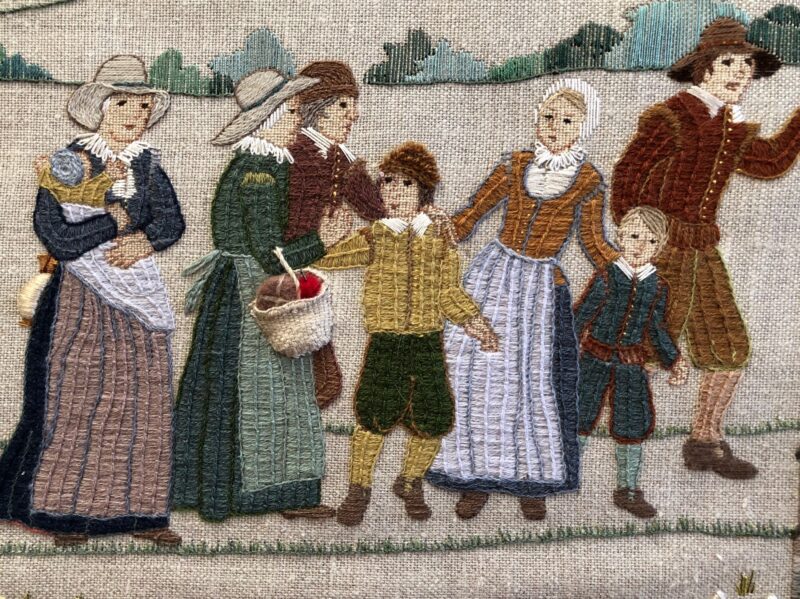
A group of religious reformers from a cluster of small farming villages at the border of Lincolnshire, Nottinghamshire and Yorkshire in the north of England began gathering to hear preachers who advocated for changes in church practice. Families walked miles to neighboring towns for worship. In 1603, they broke with the state-mandated Church of England and formed their own separate congregation. This was considered treasonous.
The Separatists’ home country is illustrated, a landscape of pasture, marshland, and woods along the River Trent. Three villages, each identified by its ancient church, were centers of Separatist activity: St. Helena’s, Austerfield, Yorkshire, home of William Bradford; St. Wilfred’s, Scrooby, Nottinghamshire, where William and Mary Brewster and other Pilgrim families resided; and All Souls, Babworth, Lincolnshire, where preacher Richard Clyfton helped fuel the radical breakaway. Across the river in Gainsborough, the first Separatist congregation was formed.
PANEL 7 ESCAPE TO THE LOW COUNTRIES, PART 1

A large group of Separatists began illegally meeting for worship in Scrooby, gathering secretly to avoid arrest. Under constant threat of persecution, they resolved to move to The Netherlands, where they would be able to worship freely. Without the express permission of the King, their emigration was unlawful.
In the fall of 1607, they hired a ship to transport some of the congregation. Families assembled at the “Wash,” an inlet of the North Sea near Boston in Lincolnshire, to board the vessel but were betrayed by the ship’s master. Members of the congregation were seized and arrested, taken by boat to Boston and jailed in the town’s medieval Guildhall. The prisoners included Elder William Brewster, who was held for a month before being released.
PANEL 8 ESCAPE TO THE LOW COUNTRIES, PART 2
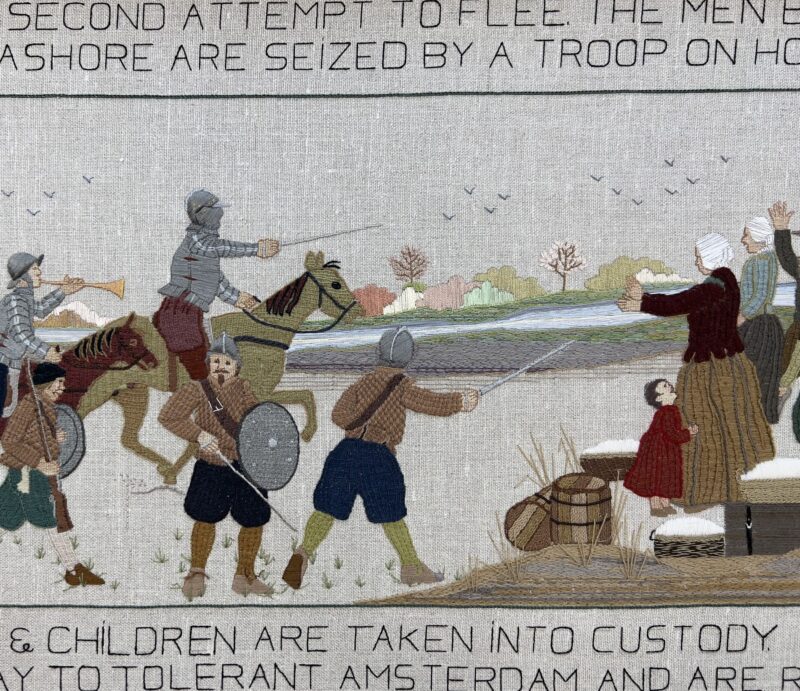
In 1608, the Scooby congregation again tried to leave England after their failed first attempt to seek religious refuge in The Netherlands. They hired a Dutch vessel and arranged an isolated point of departure along the marshy coast between Grimsby and Hull, hoping to evade detection.
After the Dutch ship’s master had ferried a boatload of the men aboard, a troop of mounted soldiers arrived to arrest the migrants. The Separatists had been stung once again! To the distress of those onboard, the hired ship sailed off at the master’s insistence, leaving behind stranded family members, mostly women and children, to be taken into custody. The departing ship encountered storms and nearly foundered before arriving in Amsterdam.
PANEL 9 TISQUANTUM’S STORY

Tisquantum was one of about twenty Wampanoag men and boys who were kidnapped from Patuxet, his home village, and Cape Cod in 1614 by English sea captain Thomas Hunt. Hunt sold them into slavery in Spain for profit. Some of the captives were freed with the aid of sympathetic Franciscan friars.
Tisquantum ended up in the London household of Puritan merchant John Slany, where he learned English and experienced a different culture from his own in the crowded metropolis. Through Slany, an investor in the Newfoundland Company, Tisquantum traveled across the Atlantic with Captain Thomas Dermer to serve as an interpreter and guide in Newfoundland, about 900 miles north of Patuxet, his childhood home.
PANEL 10 EXILE IN LEIDEN
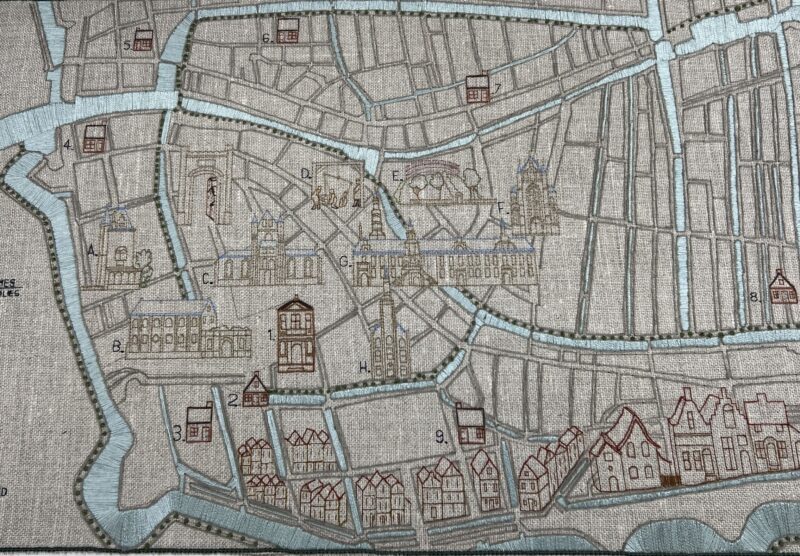
After about a year in Amsterdam, most of the Scrooby Separatists moved to Leiden, where they lived for twelve years. It was a beautiful and vibrant university city, with thriving markets and churches of many faiths, anchored by the ancient Pieterskerk. Here the Pilgrim exiles experienced a deeply rewarding religious society and a stimulating intellectual culture that engaged learned members including John Robinson and William Brewster.
Many found work in the low-paying cloth trades to support their families. Street scenes show daily life in Leiden with weavers, bricklayers, spinners, printers, and passersby. Living in poverty amid the city’s wealth, the Separatists struggled to overcome economic hardships and faced increasing concern for the welfare of their children.
PANEL 11 THE GREAT DYING
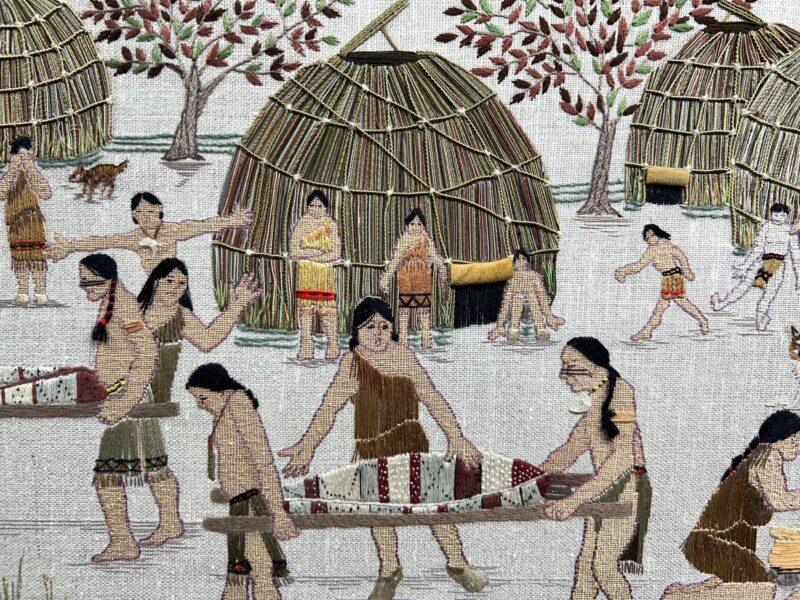
The Wampanoag people faced unimaginable challenges during the spread of a European-introduced contagion in the years from 1616 to about 1618-1619. The high rate of mortality was devasting to Indigenous communities along the coast, especially at Patuxet.
The panel, designed by the artist in consultation with Wampanoag advisors (also for the full series), shows Wampanoag families responding to the crisis, caring for ailing children, siblings, and parents, attending to the burials of the dead, helping one another, and mourning their devasting losses.
The first stitch on the panel was done by Aquinnah Wampanoag Tribal member Linda Coombs.
PANEL 12 REASONS FOR LEAVING HOLLAND/DEPARTURE FROM ENGLAND
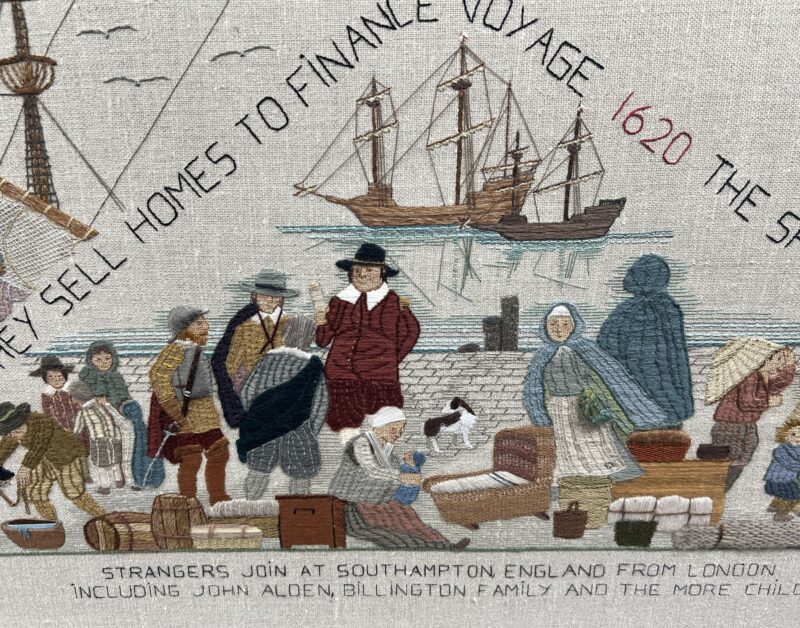
The English Separatists faced economic and other hardships in Leiden and worried about losing their own culture and heritage if they continued in Holland. After careful research and deliberation, they decided to seek a new home in America.
They purchased a small ship, the Speedwell, to transport them from Holland to England as one of two vessels for the Atlantic voyage, to be kept in the colony for fishing and trade. Securing investors, they hired a larger ship out of London, the Mayflower, and organized supplies. Others joined the venture. The ships met in Southampton. Speedwell leaked, causing delays for repairs at Portsmouth and Plymouth. It had to be left behind with members of the company and stores. Mayflower departed alone on September 6th with 102 passengers and two dogs.
PANEL 13 TISQUANTUM’S RETURN
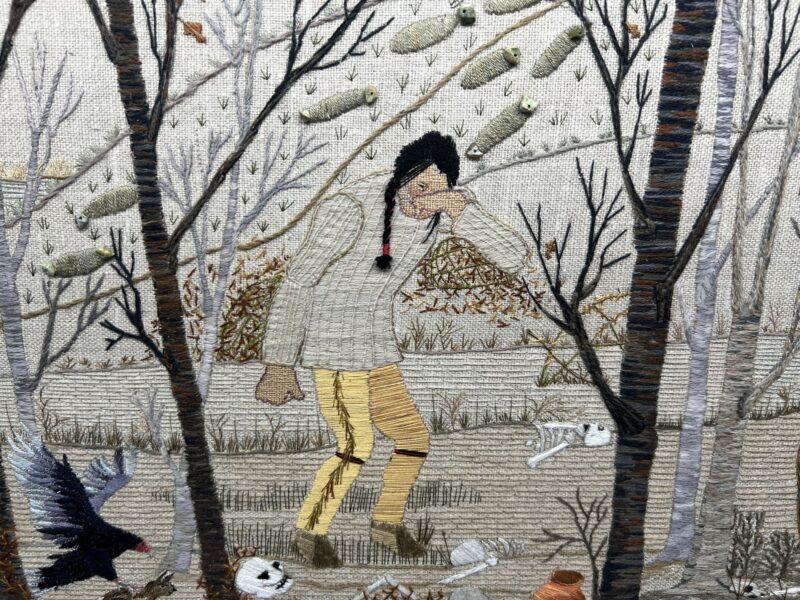
After being seized and taken from his homeland as a youth, Tisquantum returned as an adult to Wampanoag shores in 1619. It was a changed world. During his years of captivity abroad, European disease burned though Indigenous communities along the eastern seaboard, causing the death of thousands.
In company with English captain Thomas Dermer, Tisquantum journeyed from Newfoundland to his home at Patuxet. Greeted by empty homes, abandoned fields, and evidence of many lives lost, he learned that nearly all of his family and community has perished. He was the only known survivor of his village.
PANEL 14 MAYFLOWER VOYAGE/ARRIVAL AT CAPE COD
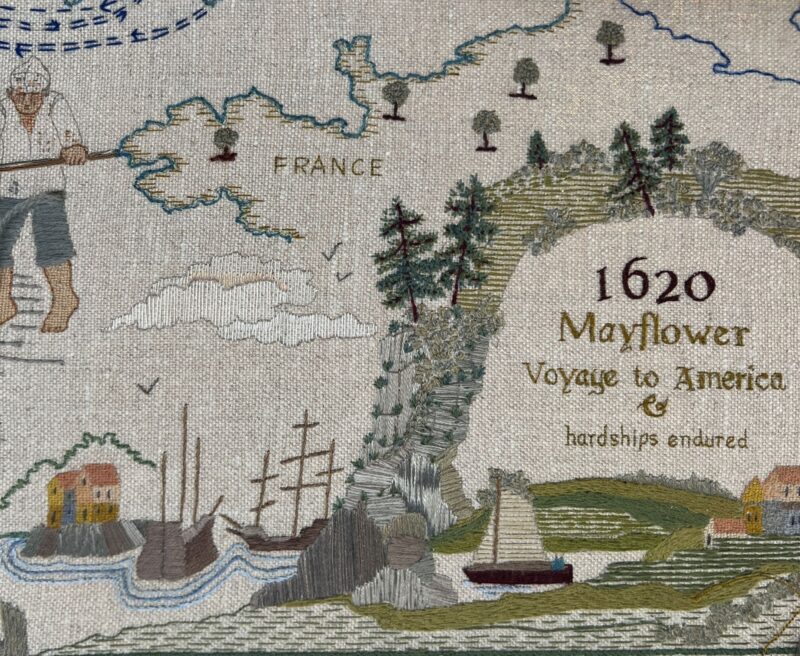
After abandoning the leaking Speedwell, Master Christopher Jones and crew of the Mayflower set sail alone with 102 passengers. The famed Mayflower voyage is illustrated in a series of cordage-bordered roundels with scenes of events that occurred during the dramatic crossing. A beam breaks. A sailor falls sick, dies, and is buried at sea. Halfway over, Mistress Hopkins gives birth to a boy. A young passenger perishes. John Howland falls overboard, but survives.
After two months at sea, land was sighted on November 9th, 1620. The ship headed south towards its original destination, the area of Hudson’s River, considered part of northern Virginia. Confronted by dangerous shoals and fierce weather, the ship turned back to anchor at Cape Cod, a region populated by many Indigenous people.
PANEL 15 MAYFLOWER COMPACT/EXPLORATIONS
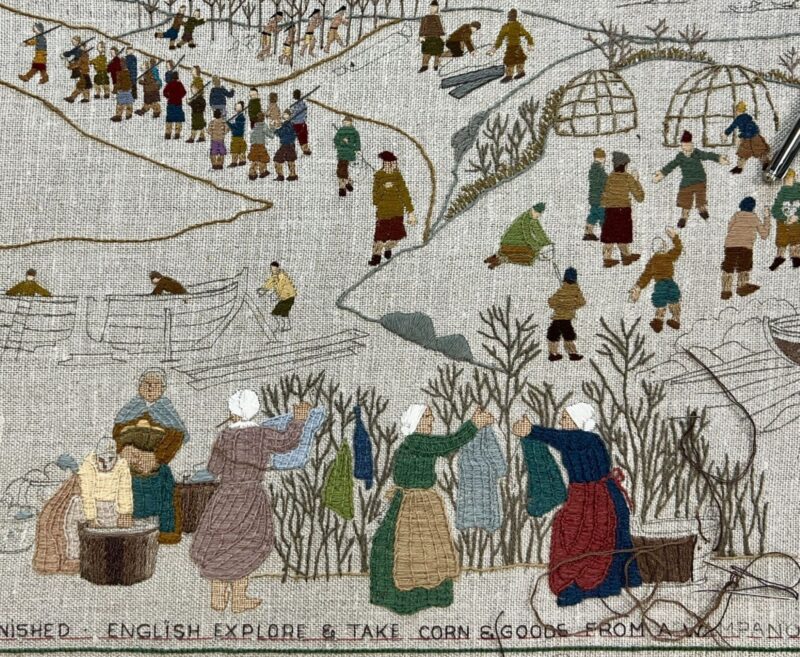
Hand-stitched lettering floats above bustling scenes of the Mayflower in Cape Cod harbor and early activities ashore: words from the compact signed aboard the ship on November 11th, 1620, establishing “just and equal laws” to govern the new colony.
A wintry exchange of arrows and musket fire between watchful Wampanoag men and the English newcomers ranging through their lands unfolds at the center of the panel. Along the borders, vignettes of historical events during the exploration of Cape Cod are detailed.
The December shallop excursion that brought a party of passengers and crew into Plymouth harbor is vividly worked with tiny white beading evoking the freezing conditions of their arrival during a snowstorm.
PANEL 16 PLYMOUTH COLONY BEGINS
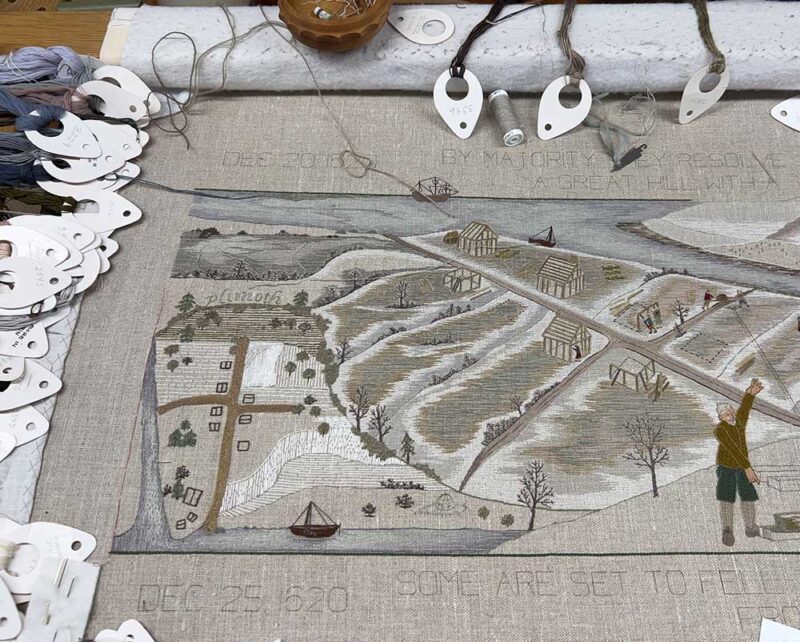
This panel is in the process of being stitched. The artist and the stitchers are creating the panel design together at the frame, a process that may take as long as eight months to a year. They experiment with different threads, colors, and stitches on every design element on the artist’s drawing to craft the final artwork. Some areas are left intentionally open for collaborative design.
The panel shows the newly arrived Mayflower passengers at Plymouth trying to ensure their immediate survival by building shelters during a bitter winter. Based on first published account of Plymouth, Mourt’s Relation (London, 1622), the scene shows groups of men laying out streets and house lots, chopping trees, hewing timbers, and gathering thatch for houses.
PANEL 17 FIRST WINTER AT PLYMOUTH
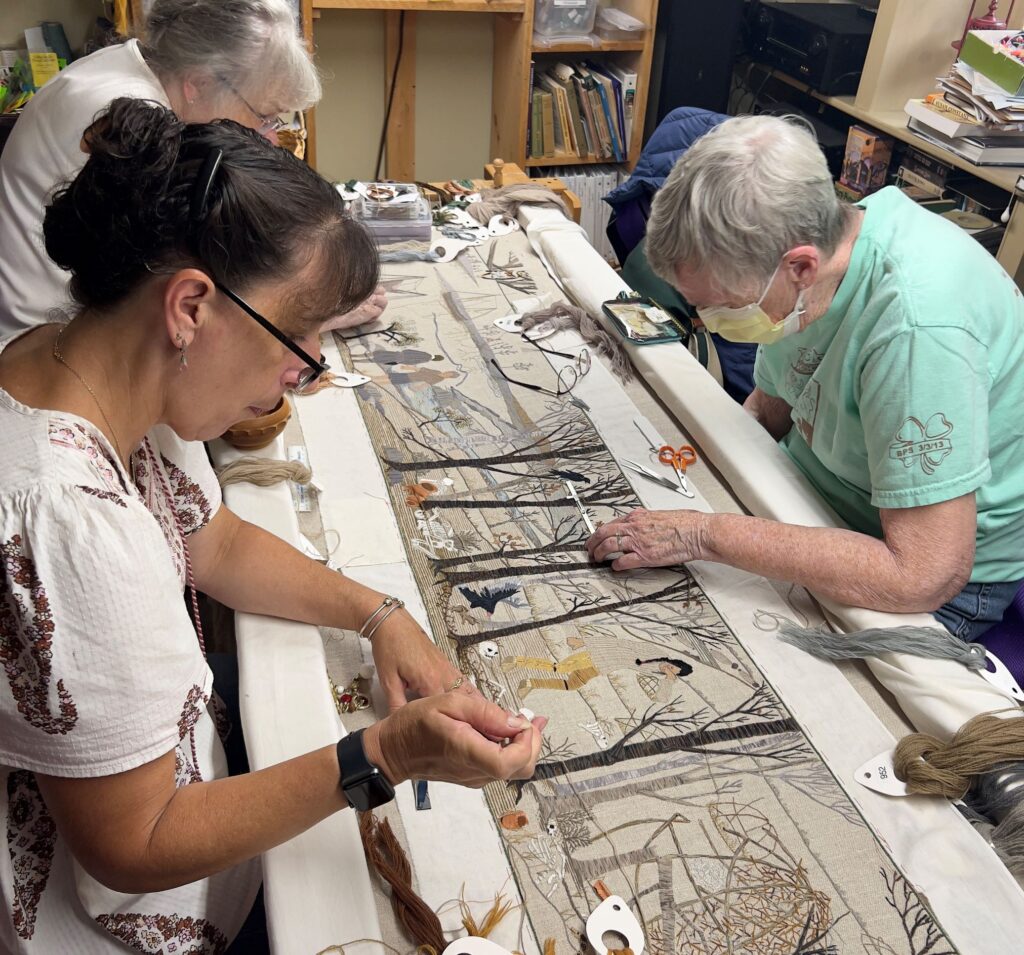
This panel is in design phase. Artist Elizabeth Creeden carefully researches events in early Plymouth and aspects of 17th-century English, European, and Wampanoag history and culture, experimenting with numerous possibilities to visualize her needlework narrative, before finalizing the panel design.
The artist will make a series of preliminary sketches to test her ideas, consulting with the stitchers, Wampanoag advisors and a range of historical consultants. When ready, she will finalize a line drawing for the panel artwork. Penciled by hand on a six-foot-plus sheet of paper, the final drawing will be scanned and printed onto linen by Trustworth Studio.
PANEL 18 SPRING ENCOUNTERS/AN ALLIANCE
This panel is in design phase. The artist carefully researches events in early Plymouth and aspects of 17th-century English, European, and Wampanoag history and culture, experimenting with numerous possibilities to visualize her needlework narrative, before finalizing the panel design.
PANEL 19 JOURNEY TO POKANOKET
This panel is in design phase. The artist carefully researches events in early Plymouth and aspects of 17th-century English, European, and Wampanoag history and culture, experimenting with numerous possibilities to visualize her needlework narrative, before finalizing the panel design.
PANEL 20 HARVEST GATHERING
This panel is in design phase. The artist carefully researches events in early Plymouth and aspects of 17th-century English, European, and Wampanoag history and culture, experimenting with numerous possibilities to visualize her needlework narrative, before finalizing the panel design.