It Came on the Mayflower
“Bring good store of clothes and bedding with you. Bring every man a musket… Bring paper and linseed oil for your windows, with cotton yard for your lamps.”
– Edward Winslow, A Letter Sent From New England, 1621
Most items brought on the Mayflower were practical. The ship was especially crowded because of the unanticipated circumstances of its departure from England and the need to abandon their second vessel, the Speedwell. There was little space for purely personal possessions.
Provisions for the voyage and to start the colony were arranged before the Mayflower was boarded. The Pilgrims relied on the advice in “provisions lists” written by earlier settlers to Virginia and other colonies, as well as on their own notes on how to prepare for their journey.
England, France and the Netherlands were new to establishing permanent colonies in the Americas in the early 1600s. Spain and Portugal already had a century of experience behind them by the time of Jamestown (1607), Quebec (1608), Newfoundland (1610), Bermuda (1612), Plymouth (1620), and New Netherland (1624). Experience taught early colonists what to recommend to other prospective and later settlers.
Provisions lists from the early seventeenth century detail what items were thought necessary to bring when emigrating to an American colony. These lists of “needfull things” included food, clothing, tools, weapons, household implements, and miscellaneous items that colonists would need to survive.
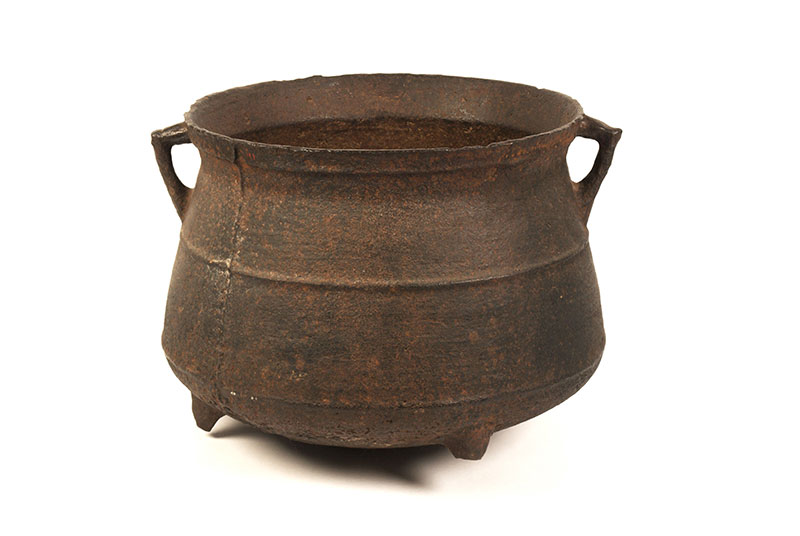
Cooking Pot, Iron
England, 17th century
PHM 0111 Gift of John Watson, 1824
Myles Standish Cooking Pot
This iron cooking pot was one of the first artifacts donated to Pilgrim Hall Museum. According to family tradition, it was owned by Myles Standish who brought it over on the Mayflower. Ironware and everyday cooking implements appear on early provisions lists. A sturdy iron pot like this one could be used to prepare a wide variety of food. It originally had a lid and three longer feet allowing the pot to be placed directly over the fire.
While still in the Netherlands, Edward Winslow of the Leiden Separatists carefully researched existing sources on provisioning and establishing a colony and recorded notes, which survive in a small manuscript volume known as the “Brewster Book”; see The Brewster Book Manuscript, edited Caleb H. Johnson (Caleb H. Johnson and The Massachusetts Mayflower Society, 2019).
After living a year in Plymouth Colony, Winslow added his own advice in “A Letter Sent from New England” to George Morton back
in England, written December 11, 1621 and published in Mourt’s Relation in 1622. Describing all the provisions obtainable locally, Winslow gave tips on items that passengers should bring with them: iron-bound casks of beer and water; meal (packed so tight in a barrel it needs to be chopped out with an axe); a long-barreled musket with powder and shot for hunting wildfowl; lemon juice, aniseed water, butter and salad oil; paper and linseed oil for makeshift windows, and cotton yarn for lamps.
Materials brought over on early ships like the Mayflower were primarily items that were of immediate use, though there were almost certainly some personal possessions carried over that were highly meaningful and valued by the colonists.

Cradle, Wicker
The Netherlands, c.1620
PHM 0945 Gift of Catherine Elliott Sever and Charles Sever, 1877
Peregrine White Cradle
Susanna (Jackson) White was five months pregnant when she sailed on the Mayflower with her husband William and son Resolved. Susanna and William White are believed to have brought this cradle from Holland in anticipation of the birth. Their son, named Peregrine, meaning “traveler” or “Pilgrim,” was born aboard the Mayflower as it lay at anchor in Provincetown Harbor in November of 1620.
Another child born at sea to Elizabeth (Fisher) and Stephen Hopkins, named Oceanus, survived the voyage and first winter but died before the age of seven. Because he was born after the ship’s arrival at Cape Cod and not at sea, Peregrine White (1620–1704) was noted during his own lifetime as the first child born to the Pilgrims in America.
The fragile cradle, made of willow osier, is identical to hooded wicker cradles that appear in numerous Dutch paintings of the 1600s and typical of those made in The Netherlands during the period. Scholars have found evidence that hooded cradles as well as other wicker products—chairs, fans, and baskets—were imported into Plymouth later in the 1600s. Whether carried on the Mayflower or possibly purchased later, the cradle serves to symbolize the Pilgrims’ commitment to staying and raising their families in America.
In evaluating whether a surviving object may have come on the Mayflower, its purpose and utility, as well as its age, materials, manufacture, and history of ownership, are closely considered.
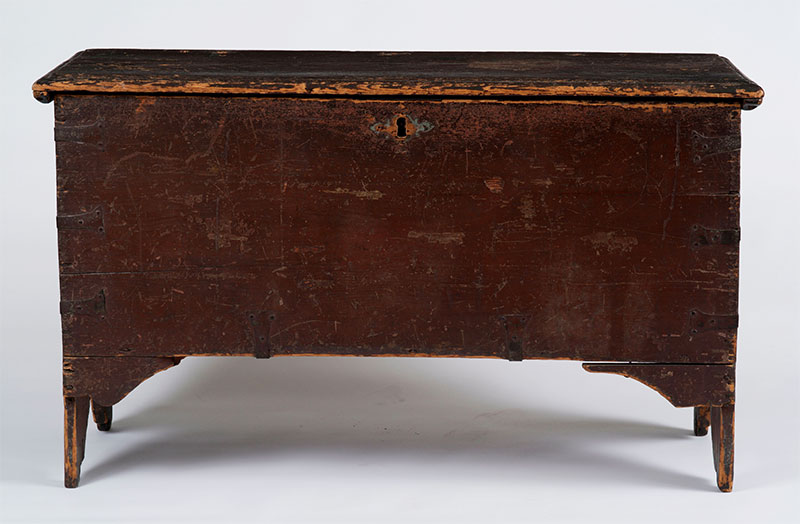
Six Board Chest, Norway Pine, Iron
The Netherlands, 1600-1620
PHM 1080 Museum Acquisition from Connecticut Historical Society, 2020
The Brewster Chest
Tradition holds that William and Mary Brewster brought this simple six-board pine chest from the Netherlands aboard the Mayflower in 1620. Norway pine was plentiful in the Netherlands from the extensive trade between the two nations. A board or “boarded” chest was a common form of storage chest with each side made from a single board.
The Brewster family lived in Leiden for over a decade where they probably acquired the chest, possibly in preparation for their voyage aboard the Mayflower. A portable chest could serve not only as storage space, but also as a table surface, bench, or even a bed. Whatever was needed during the Atlantic crossing would have been stored inside. The chest may also have carried some of William Brewster’s most prized possessions: his books.
This chest is thought to have descended from Mayflower passenger William Brewster through his descendants to Ruth Brewster Sampson who died without children. Her husband, Samuel Sampson, lived with the family of Pliny Day in West Springfield, who inherited the chest and then sold it for $25 to Dr. Thomas Robbins for the Connecticut Historical Society in 1844.
In 1950, the chest was placed on permanent loan to Pilgrim Hall Museum in exchange for a painting by the American artist John Trumbull (1756-1843). In 2020, the swap was made permanent. After seventy years on loan, the Brewster chest was deeded to Pilgrim Hall Museum, and Trumbull’s portrait of Connecticut Governor Joseph Trumbull (1737-1778) was gifted in turn to the Connecticut Historical Society.