John Robinson
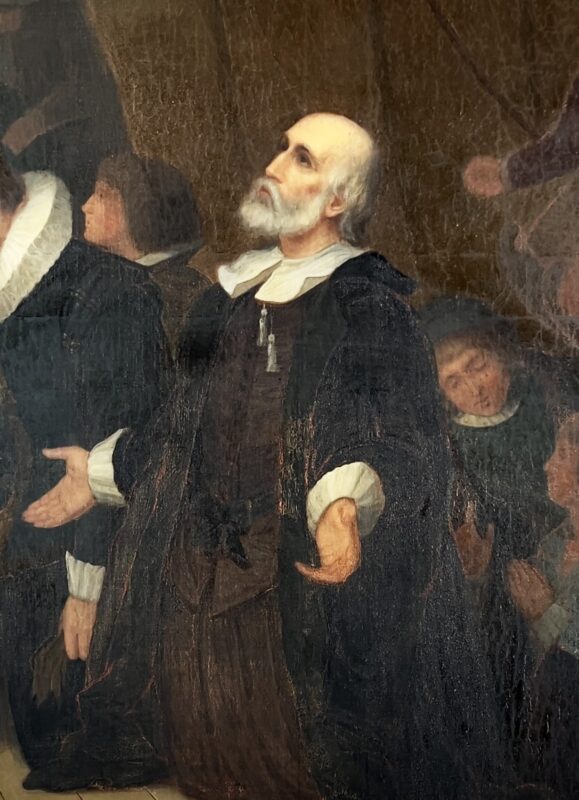
John Robinson was a spiritual leader of the early Separatist congregation in Scrooby. He became pastor of the Pilgrims’ congregation in Leiden, though he never joined the members of his flock who voyaged to America in 1620 to establish Plymouth Colony.
Born about 1575 in Sturton-le-Steeple, Nottinghamshire, Robinson was educated at Corpus Christi College in Cambridge. Ordained in 1599, he became a fellow of the College and served as dean for several years. As religious controversies simmered, Robinson grew increasingly disenchanted with the established church and drawn to more radical ideas of reform. He became assistant pastor at St. Andrew’s in Norwich in 1602 until dismissed for non-conformist views.
In 1604, Robinson married Bridget White, also of Sturton-le-Steeple. He began preaching to small groups in the Norwich area, at times without license, risking the ire of ecclesiastical authorities.
Returning to his hometown in Nottinghamshire, Robinson joined with other dissenters in nearby villages, including William Brewster of Scrooby, William Bradford of Austerfield, Richard Clifton at Babworth, and John Smyth at Gainsborough. Smyth formed a Separatist congregation in Gainsborough in 1605. The following year, the Scrooby group covenanted as a separate congregation, rejecting the practices of the established Church of England, which was illegal under English law. They met mainly at Scrooby Manor, home of William Brewster. Richard Clifton, who had been based at Babworth Church, became their minister with John Robinson as assistant pastor.
Facing repercussions if their unlawful worship was discovered, the group fled to Holland in 1608. Robinson was one of the last members of the Scrooby congregation to leave England.
After a short time in Amsterdam, where John Smyth’s congregation, the “Ancient Brethren,” had already settled and become embroiled in disputes, Robinson and Brewster, with about 100 other English refugees from Scrooby and Gainsborough, decided to move to Leiden in 1609. Robinson became pastor of the Leiden Separatist congregation.
Supported by the congregation, Robinson settled his family in a house at the Green Close (de Groene Poort) on the southwest corner of the churchyard of the Pieterskirk. Many other Pilgrims lived nearby in the dense neighborhood. As pastor, Robinson devoted himself to teaching, tending his spiritual flock, and writing. He preached to his followers three times weekly, twice on the Sabbath and once during the week. Over the next dozen years, his congregation grew to include as many as 500 members.
In 1615, at age 39, he began studying theology at the Leiden University. As a scholar, Robinson attended to heightened religious tensions that had begun to strain Dutch toleration, and participated in a public debate on the Arminian controversy. He authored several books during his years in Leiden, including A Justification of Separation from the Church of England (1610), Of Religious Communion, Private, and Public (1614), A Defence of the Doctrine Propounded By the Synod at Dort (1624), and the posthumous collection, New Essays Or Observations Divine and Moral (1625).
About a decade after relocating to Leiden, the English refugees began to discuss the possibility of finding a new home somewhere else. Their reasons included economic hardships, worries about the loss of their own language and customs, and an unraveling political and religious climate and threat of war in Europe.
They investigated possible New World destinations before deciding to plant a colony in Virginia. Only a small group could be supported to embark on such a costly venture. It was thought best for their pastor, Robinson, to remain with the majority of church members in Leiden and come over with the other families at a later time. Robinson led an emotional farewell with prayers for the departing emigrants as they boarded the Speedwell at Delfshaven in July 1620 to begin the journey to America, ultimately crossing the Atlantic on the Mayflower.
While one group ended up in early Plymouth (not Virginia!), those left behind in Leiden struggled to make arrangements to rejoin their families and reunite the congregation in New England. Over the next four years, Robinson exchanged letters with William Bradford and others, sharing news and pastoral advice. The emigration from Leiden continued, with about a dozen people leaving for Plymouth Colony on the Fortune in 1621 and more in 1623 aboard the Anne and Little James. Despite Robinson’s intention to join them, he died in Leiden on March 1, 1625.
“And if either prayers, tears, or means would have saved his life, he had not gone hence. But he having faithfully finished his course, and performed his work which the Lord had appointed him here to do, he now resteth with the Lord in eternal happiness.”
– Roger White, Leiden, April 28, 1625, in William Bradford, Of Plymouth Plantation
William Bradford described Reverend Robinson as a caring and thoughtful pastor, “much esteemed and reverenced of all that knew him, and his abilities both of friends and strangers.” In his “Dialogue” answering the questions of a younger generation, Bradford remembered Robinson as
“….a man learned and of solid judgment, and of a quick and sharp wit, so was he also of a tender conscience, and very sincere in all his ways, a hater of hypocrisy and dissimulation, and would be very plain with his best friends. He was very courteous, affable, and sociable in his conversation, and towards his own people especially. He was an acute and expert disputant, very quick and ready, and had much bickering with the Arminians, who stood more in fear of him than any of the University. He was never satisfied in himself until he had searched any cause of argument he had to deal in thoroughly and to the bottom; and we have heard him sometimes say to his familiars that many times, both in writing and disputation, he knew he had sufficiently answered others, but many times not himself; and was ever desirous of any light, and the more able, learned, and holy the persons were, the more he desired to confer and reason with them. He was very profitable in his ministry and comfortable to his people. He was much beloved of them, and as loving was he unto them, and entirely sought their good for soul and body.”
– William Bradford, A Dialogue, Or the Sum of a Conference Between Some Younge Men Born in New England and Sundry Ancient Men That Came Out of Holland and Old England [1648] (Old South Leaflets, Twelfth Series, 1894, No. 2), 19-20.