
Patriots & Pilgrims
Patriots and Pilgrims in the Revolution
Liberty Song
by John Dickinson
Our worthy forefathers –
let’s give them a cheer,
To climates unknown
did courageously steer.
Through oceans to deserts,
for freedom they came,
And dying, bequeathed us
their freedom and fame.
– The Boston Gazette, 18 July 1768
This is the story of a community in conflict.
The Plymouth experience in the Revolutionary era mirrored that of the 13 American colonies. In 1765, the public mood was indignant opposition to injustice. By 1776, the majority of Americans accepted what would have been inconceivable 10 years earlier — a revolution in the cause of independence.
Revolution represented an unprecedented break with history and tradition. And nowhere was respect for tradition stronger than in Plymouth, New England’s oldest town. The memory of the Pilgrim Forefathers was keenly felt by Plymoutheans as they responded to the tensions of the times.
In Plymouth, as throughout the Colonies, there was a wide spectrum of response to each new event in the growing division between King and Colony. Colonists weighed economic interests, family ties, and individual beliefs to ultimately reach a political decision.
Plymoutheans, however, also consciously used the memory of their ancestors, the Pilgrims, to justify political decisions. And in so doing, the Pilgrims became elevated to an even higher status than that of local ancestors. They became symbols of all Americans’ quest for freedom.
We invite you to “meet” the men and women of this community —
the Patriots and Loyalists,
the civic leaders and slaves,
the heroes and housewives
— as they face the challenges of
Plymouth in the Revolution.
PLYMOUTH IN THE REVOLUTION:
a community in conflict
In 1765, Parliament passed the Stamp Act. The act taxed almost all sorts of paper, including newspapers, legal documents such as marriage licenses and diplomas, even liquor licenses and playing cards by requiring them to carry a purchased stamp. The tax was to defray the expenses of the costly French and Indian War, a war waged on American soil for the benefit of the colonies. Colonists across America were enraged because they had no voice in the matter. After violent demonstrations and riots across the Colonies, the act was canceled the next year.
Records of the Town of Plymouth
October 21, 1765:
Our youth, the Flower of this country are many of them slain, our treasure exhausted in the service of our mother country, our trade and all the numerous Branches of Business Dependent on it Reduced & Almost Ruined By severe acts of Parliament & now we are threatened by a Late Act of Parliament with being Loaded with internal taxes, without our consent
Judge Peter Oliver of Plymouth County
Origin and Progress of the American Revolution:
The Design of raising Moneys, by Stamps in the Colonies, was in Order, that they should Contribute to the lessening of that immense Debt which the British Nation had contracted in the late War…
It was a right that was justifiable by the Principles of the English constitution.
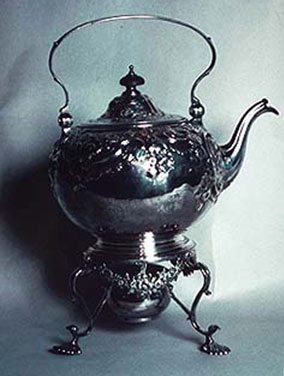
Silver teapot, made in London in 1754.
Owned by the Otis family of Barnstable
Parliament imposed a new tax in 1767. The Townsend Act taxed glass, lead, paper, paint and tea. Many Massachusetts colonists protested the taxes by boycotting British goods. Groups of patriotic women known as “Daughters of Liberty” made their own cloth as an alternative to British silks. Instead of British tea, they drank herbal brews of sage and other local plants.
Records of the Town of Plymouth
March 24, 1774:
Whoever Continues to Sell or shall for the future expose for Sale in this town any India tea is & ought to be Considered as an Enemy to the rights of America
Resolves of the Town of Marshfield
January 31, 1774:
This town ever have and always will be good and loyal subjects to our Sovereign Lord, King George the 3rd, and will observe, obey and enforce all such good and wholesome laws as are… made by the Legislature
James Thacher of Cape Cod & Plymouth
Military Journal:
Tea drinking is almost tantamount to an open avowal of Toryism. Those who are anxious to avoid the odious epithet of enemies to their country, strictly prohibit the use of tea in their families.
Judge Peter Oliver of Plymouth County
Origin and Progress of the American Revolution:
The Ladies were so zealous for the Good of their Country, that they agreed to drink no Tea, except the Stock they already had by them; or in Case of Sickness. Indeed, they were cautious enough to lay in large Stocks before they promised; & they could be sick just as suited their Convenience.
Your content goes here. Edit or remove this text inline or in the module Content settings. You can also style every aspect of this content in the module Design settings and even apply custom CSS to this text in the module Advanced settings.