
Affluence & Style in Early Plymouth
“I give to my loving sister Elizabeth Corwin my pocket watch… I give unto my brother Peregrine White my Spanish rapier & buff belt with silver clasps.”
– Will of Josiah Winslow, 1680
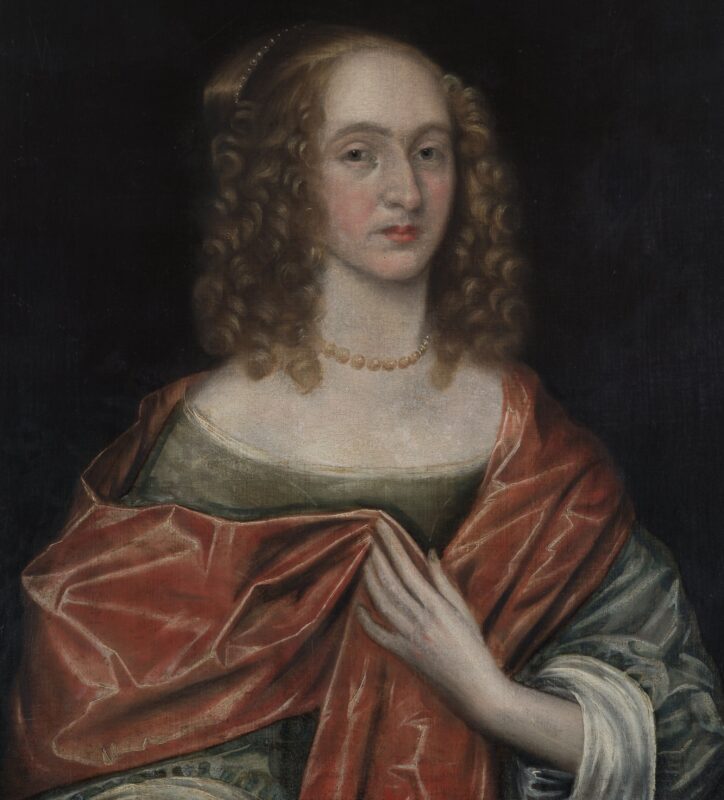
PENELOPE PELHAM WINSLOW
1633-1703
By the mid-17th century, colonists in Plymouth enjoyed more comfortable lives. Luxury became evident among the wealthier and more established families. Portraits and furniture show this affluence clearly.
When former governor Edward Winslow and his son Josiah visited London in 1651, Edward and Josiah, with Josiah’s bride, Penelope Pelham, had their portraits painted in stylish clothing.
Penelope Pelham Winslow was born in England to a Puritan family with aristocratic connections. Her father Herbert was among the founders of Massachusetts Bay Colony.
The Pelhams moved to Massachusetts in 1638 but returned to England in 1646. Herbert Pelham’s involvement in New England affairs continued and he worked in London with Edward Winslow of Plymouth Colony.
Penelope married Winslow’s son Josiah in London around 1651. The couple returned to the Winslow estate in Marshfield in Plymouth Colony where they lived in comfort with their growing family. During the 1670s, Penelope enjoyed high status as wife of the Colony’s governor. She outlived Josiah by 23 years.
Trade networks and the development of local industries meant that people could buy more goods. Boston craftsmen and entrepreneurs began to produce finished goods on this side of the Atlantic.
Although importation acts limited the colonies’ direct trade with other countries, the New England colonies had access, through England, to a range of wide goods from around the world.
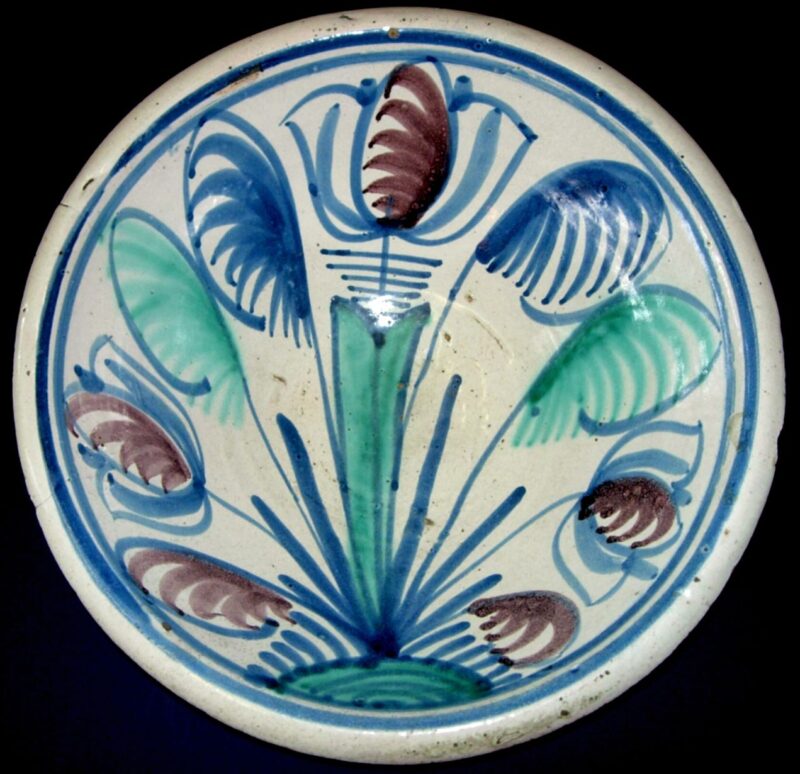
Bowl
London (Lambeth) or Brislington, 1675-1700
Tin-glazed earthenware
PHM 1346.1, Gift of Timothy O’Connell, 1967
This late seventeenth-century earthenware bowl has a tradition of being first owned by Plymouth colonists Mary Cooke (1626-1714) and Lt. John Thompson (1616-1696).
Mary was the daughter of Mayflower passenger Francis Cook and was born in Plymouth. She married Lt. John Thompson. The couple lived in Plymouth and were then among the earliest settlers of Middleborough.
The colorful bowl was a treasured family possession among Thompson descendants until it was donated to Pilgrim Hall Museum in 1967.
Ceramic bowls like this one were made in and around London. It is decorated with bright green, blue and purple tulips and flowers, which were popular motifs borrowed from Persian and Turkish artwork for fashionable European and colonial tableware.
By the late 17th century, Plymouth’s material culture was notably more elaborate than in the colony’s founding years. This trend was amplified in the early 18th century with the expansion of Atlantic trade and growing stratification of colonial societies up and down the Eastern seaboard.