
Financing the Colony
“I make no question now but that New Plymouth will quickly return your money again. For the most part they are honest and careful men. However, they have had many crosses.”
– Emmanuel Altham, 1624
The Mayflower passengers went heavily into debt to come to America, borrowing from a group of English “merchant adventurers.” Merchants and passengers together formed a stock company, which held all money, livestock and land. Assets were to be divided after seven years.
The Pilgrims were unlucky in their moneymaking efforts. Ships were lost at sea or captured by pirates. The Pilgrims had to ask for even more money for supplies.
The debt, which quickly became much larger, was renegotiated in 1626. Eight colonists, with four London associates, undertook to repay an agreed portion; these “undertakers” shared the debt with 45 Plymouth householders.
“Therefore they resolved, for sundrie reasons, to take in all amongst them, that were either heads of families, or single yonge men, that were of abillity, and free, (and able to governe them selvs with meete descretion, and their affairs, so as to be helpful in ye comone-welth,) into this partnership or purchass. First, yey considered that they had need of men & strength both for defence and carrying on of bussinesses. 2ly, most of them had borne ther parts in former miseries & wants with them, and therfore (in some sort) but equall to partake in a better condition, if ye Lord be pleased to give it. But cheefly they saw not how peace would be preserved without so doing, but danger & great disturbance might grow to their great hurte & prejudice other wise. Yet they resolved to keep such a mean in distribution of lands, and other courses, as should not hinder their growth in others coming to them.
“So they caled ye company togeather, and conferred with them, and came to this conclusion, that ye trade should be managed as before, to help to pay the debts; and all such persons as were above named should be reputed and inrouled for purchasers; single free men to have a single share, and every father of a familie to be alowed to purchass so many shares as he had persons in his family; that is to say, one for him selfe, and one for his wife, and for every child that he had living with him, one. As for servants, they had none, but what either their maisters should give them out of theirs, or their deservings should obtaine from ye company afterwards. Thus all were to be cast into single shares according to the order abovesaid; and so every one was to pay his part according to his proportion towards ye purchass, & all other debts, what ye profite of ye trade would not reach too; viz. a single man for a single share, a maister of a famalie for so many as he had. This gave all good contente.”
– William Bradford, Of Plymouth Plantation
Plymouth Colony was not a success for the investors. The colonists eventually repaid 1,800 pounds; the total invested may have been as high as 7,000 pounds.
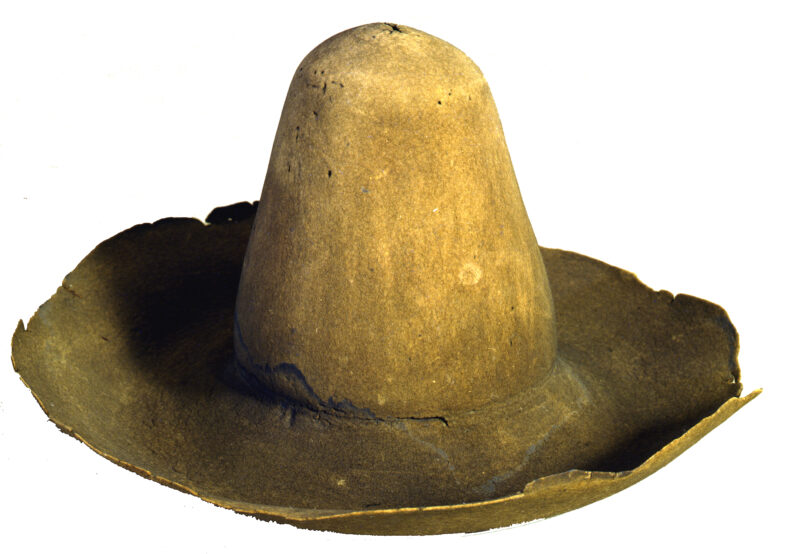
Hat, Wool, Mixed Fiber Felt
England, 17th century
PHM 1116
Ownership Attributed to Constance Hopkins Snow
In order to pay off their debts, the Plymouth colonists grew corn and traded it for furs with Indigenous communities in Maine. The furs were shipped to England and sold at auction to hatters. The hatters shaved the wool off the pelt and then felted the wool to produce fashionable and expensive hats such as the rare 17th-century beaver hat in Pilgrim Hall Museum’s Collection. High-crowned hats, usually with decorative bands, were very popular in Western Europe for both men and women.
This particular hat found its way back to Plymouth. It was owned by Constance Hopkins Snow, who voyaged on the Mayflower as a young teenager.
The Pilgrims’ primary trading partner was England. They did not, however, do business with England exclusively. In 1627, Dutch colonists from New Amsterdam first visited the Pilgrims to arrange trade relations.
The Plymouth colonists also traded with other English colonies. In 1630, a thousand Puritans came from England to the Massachusetts Bay Colony north of Plymouth and founded Boston. People from Plymouth Colony traded with the new arrivals, who needed cattle and finished goods.