
What Has Been Said About Plymouth Rock
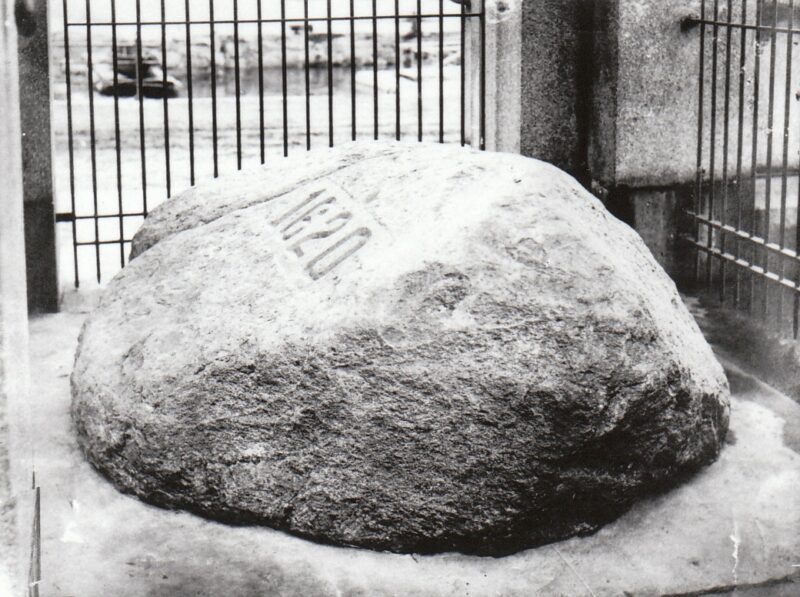
Plymouth Rock after 1880
John Quincy Adams, 1802
“No Gothic scourge of God— No Vandal pest of nations— No fabled fugitive from the flames of Troy— No bastard Norman tyrant appears among the lift of worthies who first landed on the rock, which your veneration has preserved as a lasting monument of their achievement.”
– John Quincy Adams, An oration, delivered at Plymouth, December 22, 1802. At the anniversary commemoration of the first landing of our ancestors, at that place (Russell and Cutler, 1802): 9
“When the persecuted companions of Robinson, exiles from their native land, anxiously sued for the privilege of removing a thousand leagues more distant to an untried soil, a rigorous climate and a savage wilderness, for the sake of reconciling their sense of religious duty with their affections for their country, few, perhaps none of them formed a conception of what would be within two centuries the result of their undertaking. When the jealous and niggardly policy of their British sovereign denied them even that humblest of requests, and instead of liberty would barely consent to promise connivance, neither he nor they might be aware that they were laying the foundations of a power, and that he was sowing the seeds of a spirit, which in less than two hundred years would stagger the throne of his descendants, and shake his united kingdoms to the centre.”
– John Quincy Adams, An Oration, Delivered at Plymouth, December 22, 1802. At the anniversary commemoration of the first landing of our ancestors, at that place (Russell and Cutler, 1802): 10-11
Daniel Webster, 1820
For Plymouth’s bicentennial in 1820, Daniel Webster gave a famous speech at Plymouth Rock about the legacy of Plymouth’s first settlers. The speech became a textbook classic, recited by generations of schoolchildren across the country, and established the Pilgrims as part of American’s founding narrative.
“We have come to this Rock, to record here our homage for our Pilgrim Fathers; our sympathy in their sufferings; our gratitude for their labors; our admiration of their virtues; our veneration for their piety; and our attachment to those principles of civil and religious liberty, which they encountered the dangers of the ocean, the storms of heaven, the violence of savages, disease, exile, and famine, to enjoy and establish. And we would leave here, also, for the generations which are rising up rapidly to fill our places, some proof, that we have endeavored to transmit the great inheritance unimpaired; that in our estimate of public principles, and private virtue; in our veneration of religion and piety; in our devotion to civil and religious liberty; in our regard to whatever advances human knowledge, or improves human happiness, we are not altogether unworthy of our origin…”
– Daniel Webster, “Plymouth Oration, December 22, 1820” in Kenneth E. Shewmaker, ed., Daniel Webster, “The Completest Man”: Documents from The Papers of Daniel Webster (Dartmouth College Press, 1990): 94-99.
Alexis de Tocqueville, 1835
“This Rock has become an object of veneration in the United States. I have seen bits of it carefully preserved in several towns in the Union. Does this sufficiently show that all human power and greatness is in the soul of man? Here is a stone which the feet of a few outcasts pressed for an instant; and the stone becomes famous; it is treasured by a great nation; its very dust is shared as a relic; and what is become of the gateways of a thousand palaces?”
– Alexis de Tocqueville, translated by Henry Reeve, Democracy in America: in relation to political institutions (Saunders and Otley, London, 1836): 29
William S. Russell, 1851
“….the increasing curiosity of visitors, each of whom sought a small fragment, if no more, have sensibly diminished the size of the rock, rendering it necessary to prevent such depredations in future, lest the ‘first stepping stone to those who should come after,’ might at last fail of a ‘local habitation and a name.’ These considerations, it is hoped, may in some degree relieve the disappointment occasionally expressed by strangers, on first viewing this rock. It should further be recollected that a mammoth rock of granite would have been inconvenient for the purpose of landing – particularly to the women and children who shared in the glorious event.”
– William S. Russell, Pilgrim Memorials, and Guide For Visitors to Plymouth Village (Boston, 1851), 10.
Henry David Thoreau, 1851
“July 31. Thursday…. Pilgrim Hall. They used to crack off pieces of the Forefathers’ Rock for visitors with a cold chisel, till the town forbade it. The stone remaining at wharf is about seven feet square.”
– Bradford Torrey, ed., The Writings of Henry David Thoreau Volume 8 (of 20), Journal II, 1850-September 15, 1851. Retrieved November 20, 2024 from
https://www.gutenberg.org/files/59031/59031-h/59031-h.htm
Chauncy Depew, 1884
“The Pilgrim planted beside his meeting-house the Dutch common-school, and inaugurated with his scanty fare the custom which he had found at Leyden, and in which his descendant revels, under the name of Thanksgiving Day. The Puritans direct from England, who landed twenty years after in Massachusetts Bay, burned witches, hung Quakers, and banished Baptists, but all sectaries fleeing from those persecutions found hospitable welcome at Plymouth. The men who stood on this famed rock were the leaven of American liberty.”
– Chauncy Depew, Orations and After-Dinner Speeches of Chauncy M. Depew (Cassell Publishing Company, New York, c.1896): 280-281
Anonymous Visitor to Plymouth, 1925
“You can walk inside the pillars, look over an iron railing and see the poor dead thing all unconscious of the many who look upon it in reverence or otherwise.”
– Postcard, 1925
Malcolm X, 1964
“We are a people who formerly were Africans who were kidnapped and brought to America. Our forefathers weren’t the Pilgrims. We didn’t land on Plymouth Rock; the rock was landed on us.”
– Malcolm X, Speech given at Washington Heights, NY, March 29, 1964 (http://www.vlib.us/amdocs/texts/malcolmx0364.html)
Bello, United American Indians of New England, 2017
“I and many others in the United American Indians of New England believe we move out of the motto that we are not vanquished, that we are not conquered and we are as strong as ever. And when we see that rock, as we gather in thousands, we see that.”
– Bello, quoted in Chipped And Split Over Centuries, Plymouth Rock’s American Symbolism Exceeds Its Appearance, November 21, 2017, WAMU 88.5 American University Radio, https://wamu.org/story/17/11/21/chipped-and-split-over-centuries-plymouth-rocks-american-symbolism-exceeds-its-appearance/, accessed 12/09/2005.
James W. Baker, 2020
“There are actually two related histories concerning the Rock. One is an account of the actual physical boulder – what it is made of, where it came from, and how it has been dealt with. The other is about the Rock’s meaning, whether laudatory or pejorative, and its changeable and mythic role in the Pilgrim story….It has meant many things to its beholders over the last several centuries.”
– James W. Baker, Plymouth Rock’s Own Story (The Pilgrim Society, 2020): 4.