
Treaty With Massasoit
There are two primary source accounts on the treaty of mutual aid agreed upon between the newly arrived Mayflower colonists at Plymouth, led by Governor John Carver, and the Great Sachem of the Wampanoag people, Ousamequin, in the spring of 1621. (The English generally referred to Ousamequin by his title, Massasoit, rather than his given name.)
Writing years later in his journal of Plymouth Colony’s history, William Bradford described the circumstances and terms of the agreement:
“… the coming of their great Sachem, called Massasoiet. Who, about four or five days after, came with the chief of his friends and other attendance, with the aforesaid Squanto. With whom, after friendly entertainment and some gifts given him, they made a peace with him (which hath now continued this 24 years) in these terms:
1. That neither he nor any of his, should injure or do hurt to any of their people.
2. That if any of his did any hurt to any of theirs, he should send the offender that they might punish him.
3. That if any thing were taken away from any of theirs, he should cause it to be restored; and they should do the like to his.
4. That if any did unjustly war against him, they would aid him; and if any did war against them, he should aid them.
5. That he should send to his neighbours confederates to certify them of this, that they might not wrong them, but might be likewise comprised in the conditions of peace.
6. That when their men came to them, they should leave their bows and arrows behind them.”– William Bradford, Of Plymouth Plantation
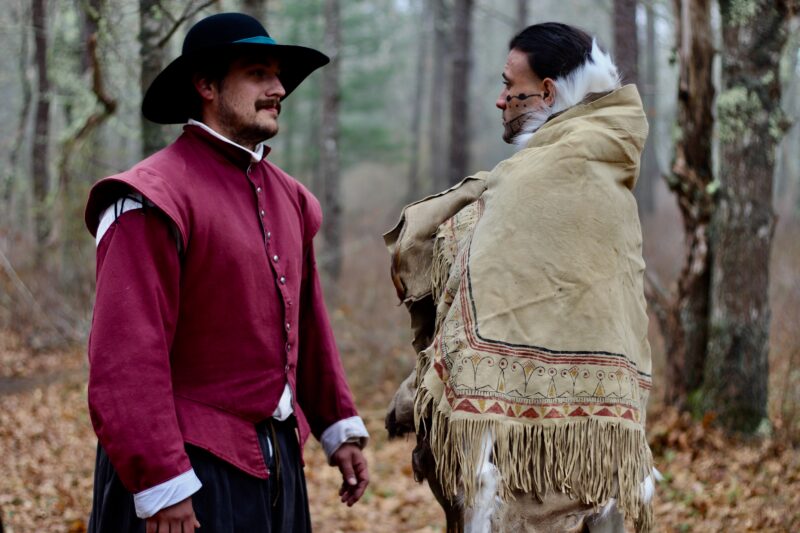 The other 17th-century report on the treaty appears in the first published account of Plymouth Colony, known as Mourt’s Relation, and was written by Bradford and Edward Winslow shortly after the actual event. There are subtle differences in the two accounts.
On Thursday, March 22, 1621, Samoset and Tisquantum arrived in the English village to announce the pending arrival of “their great sagamore Massasoit….with Quadequina his brother, and all their men.” Within the hour, Ousamequin, the Massasoit, appeared on the hill opposite the English settlement with sixty men in train.
The two sides exchanged hostages before arranging for the English governor and the Wampanoag sachem to meet together.
The Massasoit, with his brother and about twenty men, crossed over the brook, “leaving all their bows and arrows behind them,” and were met by Captain Standish and an escort of musketeers. The delegation was brought to an English house under construction, with a makeshift seating area outfitted with “a green rug and three or four cushions.”
“Then instantly came our governor with drum and trumpet after him, and some few musketeers. After salutations, our governor kissing his hand, the kind kissed him, and so they sat down….[after food and drink] Then they treated of peace, which was:
1. That neither he nor any of his should injure or do hurt to any of our people.
2. And if any of his did any hurt to any of ours, he should send the offender, that we might punish him.
3. That if any of our tools were taken away when our people were at work, he should cause them to be restored, and if ours did any harm to any of his, we would do the like to them.
4. If any did unjustly war against him, we would aid him; if any did war against us, he should aid us.
5. He should send to his neighbor confederates, to certify them of this, that they might not wrong them, but might be likewise comprised in the conditions of peace.
6. That when their men came to us, they should leave their bows and arrows behind them, as we should do our pieces when we came to them.
Lastly, that doing thus, King James would esteem of him as his friend and ally.”
– Mourt’s Relation (London, 1622)