Treasures of the Collection
Pilgrim Hall Museum cares for over 5,000 objects of historical and cultural significance that highlight the history of Plymouth from its first inhabitants, the Wampanoag people, to the English settlers of the early 17th century, and reflect the lives and stories of residents over 400 years.
The collection includes furnishings, costumes, textiles, currency, medals and plaques, containers, recreational objects, transportation artifacts, tools and implements, weapons and ammunition, and visual works of paintings, prints, sculptures, and drawings. The Museum also stewards extensive archival and library collections, consisting of over 35,000 books, manuscripts, photographs, and documents related to Plymouth history.
Mayflower Possessions
A handful of surviving Mayflower artifacts exist in a number of public and private repositories. These are items believed to have belonged to a Mayflower passenger at some point in their life, or in some cases, to have been brought over on the Mayflower in 1620. Pilgrim Hall Museum’s collection of Mayflower possessions is considered the most significant assemblage in the world. These objects are among the treasures of the collection.
Aboard the crowded Mayflower in 1620 were the Pilgrims, living and sleeping among their few provisions and belongings: a cradle, a plate, bibles and books, clothes and linen, weapons, tools, and other needful supplies. Most of the items brought over in the Mayflower were probably used to the point of disintegration and eventually discarded.
Authentic 17th century artifacts with established Mayflower associations are very rare.
While they represent the story of America’s beginnings in Plymouth, it’s worth noting that Mayflower objects are not American – to have been brought over on the Mayflower in the early 17th century, an object would have to be made on the other side of the Atlantic, in England or Europe.
The following are a sampling of early objects in the collection associated with specific Mayflower passengers.
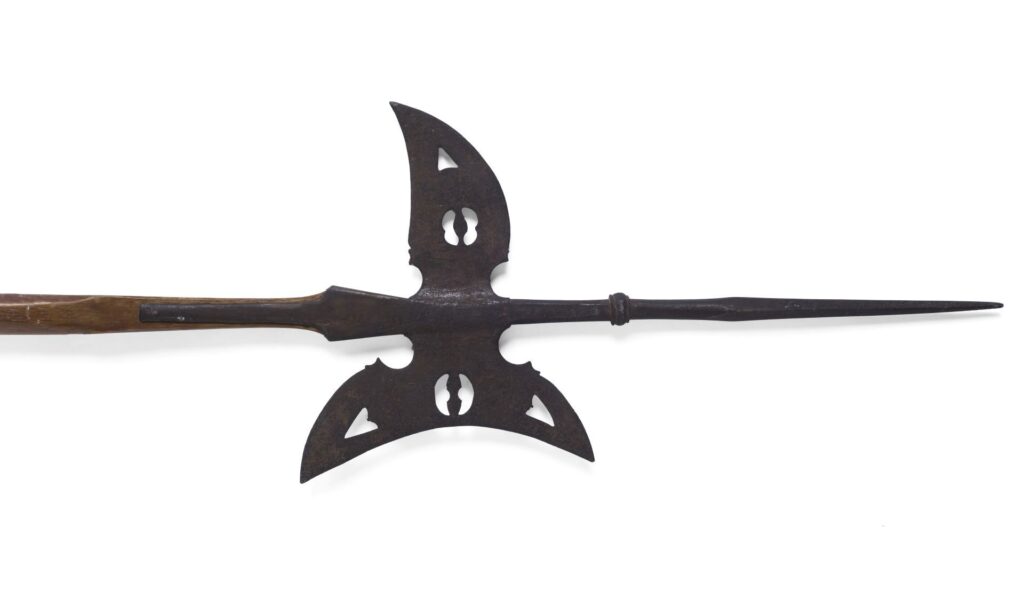
Halberd Head, Iron
England or New England, 1600-1650
PHM 88 Gift of Henry Stickney
John Alden — Halberd
Halberds were staff weapons, used for cutting and stabbing. By the 1600s, they were used for ceremony. This thin-bladed decoratively-pierced halberd would not have been very useful as a weapon.
Documents show that in Plymouth halberds were used largely as a sign of rank. John Alden (c. 1599 – 1687) served as Assistant Governor of Plymouth Colony.
The halberd head was found in the cellar of the second house built by John Alden about 1653 in Duxbury, Massachusetts.
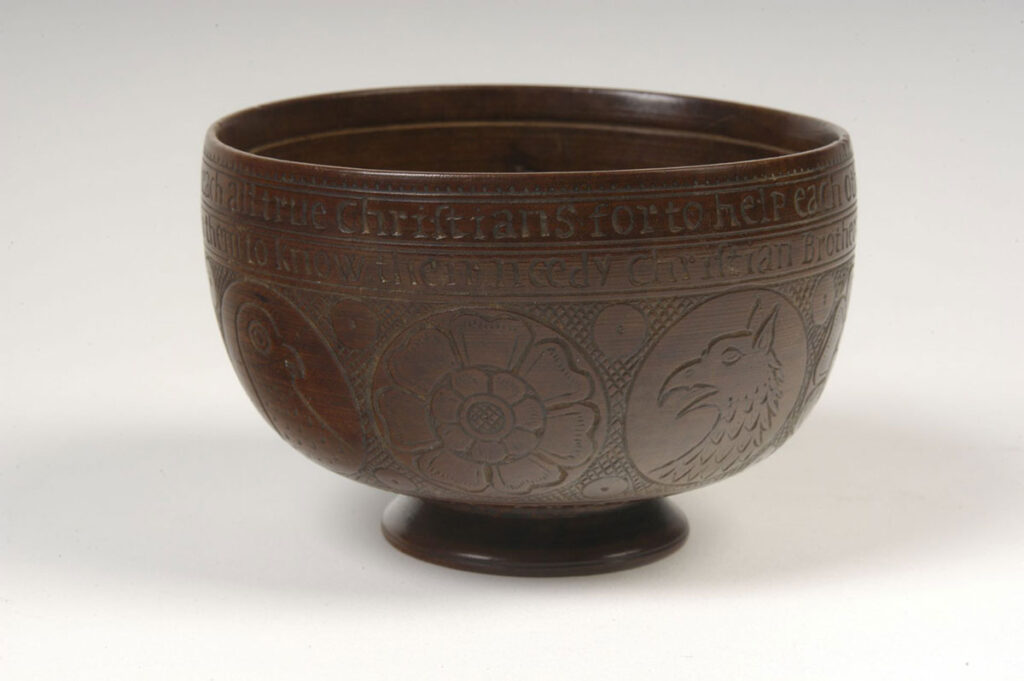
Cup, Walnut
England, 1608
PHM 998.1 Gift of the Carl Family,
in memory of Mercy Ramsey Carl, 1998
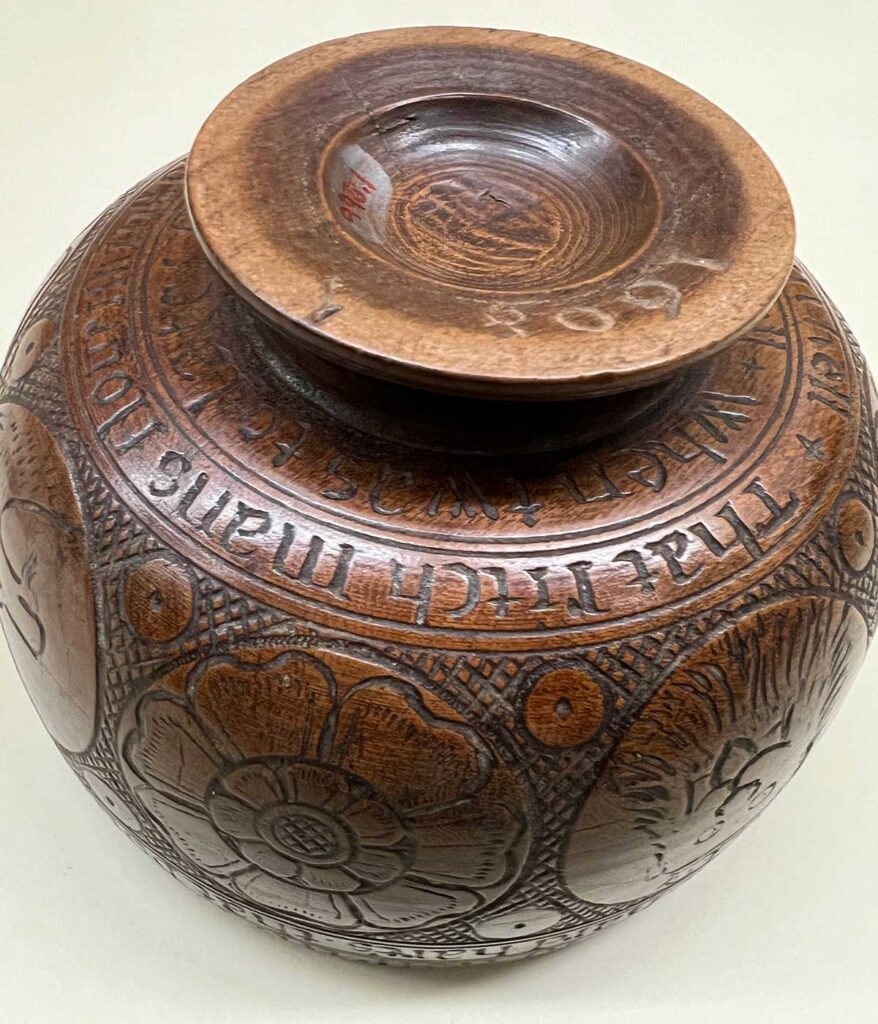
Mary Allerton (Cushman) — Wassail or Dipper Cup
Wassail cups like this one were special holiday items used for toasting. Wassail comes from the Old English waes hael meaning be thou hale or good health to you. Wassail as a drink was a spiced punch with an ale or wine base that was consumed during the holiday season of Christmas to Twelfth Night. Shakespeare has Hamlet say the king “keep[s] wassail” when drinking and celebrating.
Keeping wassail is not an activity associated with Pilgrims and Puritans, who objected to most Christmas traditions. But this intricately carved walnut cup has been an heirloom for centuries with a history of being passed down from mother to daughter starting with Mayflower passenger Mary Allerton (c. 1616 – 1699), the daughter of Isaac Allerton, who married Thomas Cushman.
The cup was made from walnut that was turned on a lathe and then decoratively carved with Tudor roses, a unicorn, lion, dove and a griffin or eagle. Around the top are the words:
Lord help thy people that are in Distresse:
teach all true Christians for to help each other:
turne + the hard hart’s * that doth the Poore opresse:
teach them to know their needy Christian Brother,
And around the bottom:
Think on + that ritch mans flourishing estate:
Which cried out in hell + When ‘twas to late:
Blessed are the mercyfull +.
The date 1608 is carved on the bottom.
Tankard, Oak, Birch
Baltic region, 1610-1650
PHM 1191 Gift of Mrs. Gorham Brown, 1959
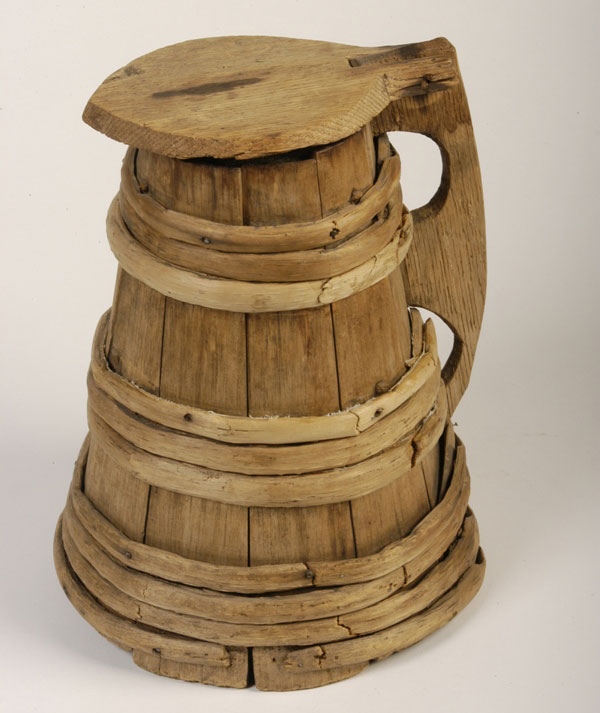
Peter Browne — Wooden Stave Tankard
This tankard has a history of ownership by Peter Browne (1595 – 1633). It is built like a barrel with oak staves circled by birch hoops. Tankards of this type were made by the thousands around the Baltic Sea (Finland, Russia, Latvia, Lithuania, Estonia), for export to Western Europe.
Stave tankards like this one were even used as communion vessels in New England.
Peter Browne owned a number of large coopered wares. A hogshead, a barrel, and a “butt” (a large cask typically used to hold liquid, such as beer) were listed in the October 1633 inventory of the “goods & Chattels of Peter Browne of New Plymouth deceased.” Though there is no mention of wooden tankards or any wooden tableware, inventory takers often did not itemize such inexpensive household items. Browne’s inventory does specify that he owned one “pewter cupp” and five other “peecs of pewter,” items that had more value than ordinary wooden vessels or plates.
Chair, Black Ash, Pine
Plymouth Colony, 1630 – 1657
PHM 1054 Gift of William Hedge and Catherine Russell Heirs, 1953
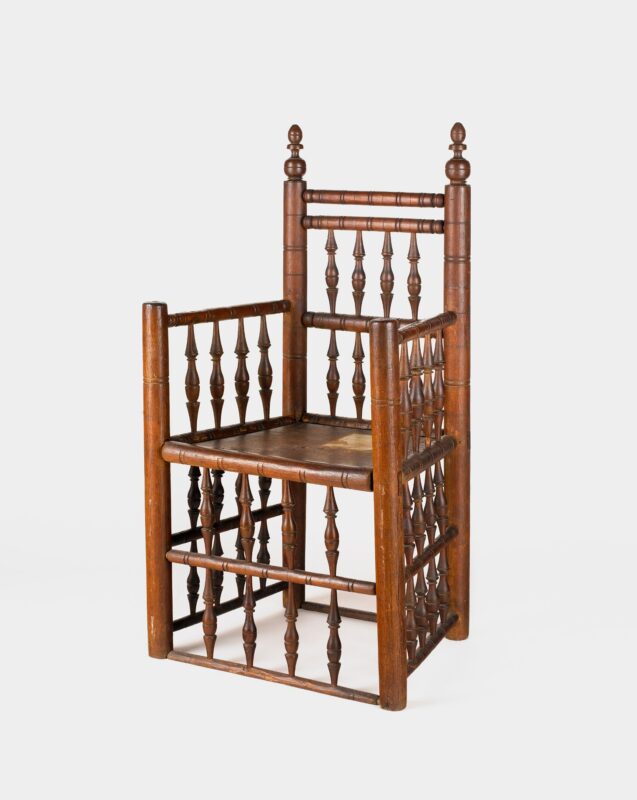
William Bradford —- Great Chair
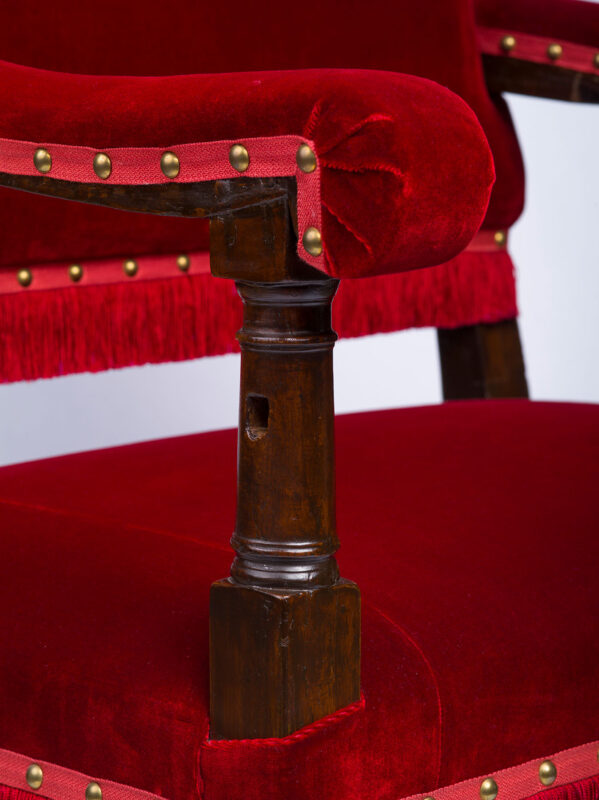
The ownership of this elaborate chair has long been attributed to Mayflower passenger William Bradford, Plymouth Colony’s second and longest serving governor. It was once believed to have been brought on the Mayflower until analysis showed it to be composed of American species of wood. The Bradford chair is one of the earliest chairs made in New England.
The list of Governor Bradford’s possessions made at the time of his death in 1657 lists two “great wooden chairs” in the parlor, worth a total of 8 shillings. “Wooden” referred to the seat material so it is very possible that this is one of the two chairs mentioned in the inventory. The chair descended in the Bradford family to the Hedge family, who donated it to the museum in 1953.
The chair was referred to as William Bradford’s chair as early as 1769, when it was used at ceremonies of the Old Colony Club, a social club of Plymouth men. It was illustrated in Dr. Alexander Young’s Chronicles of the Pilgrim Fathers in 1841, one of the first depictions of an American decorative arts object. President Warren G. Harding sat in the chair at the 1921 Tercentenary Pageant celebrating the 300th anniversary of the Pilgrims’ Landing. In 1995, Supreme Court Justice David Souter sat in Pilgrim Hall’s reproduction of the chair at Plymouth’s 375th anniversary celebration in which 175 new American citizens were naturalized.
The chair has been restored and has lost about three inches in height. The hand grips are missing. The top crest rail and pine board seat have been replaced, and several spindles are not original. While the chair has been coated with brown varnish, faint traces of black paint can be seen under the seat rails.
George Soule — Spoon
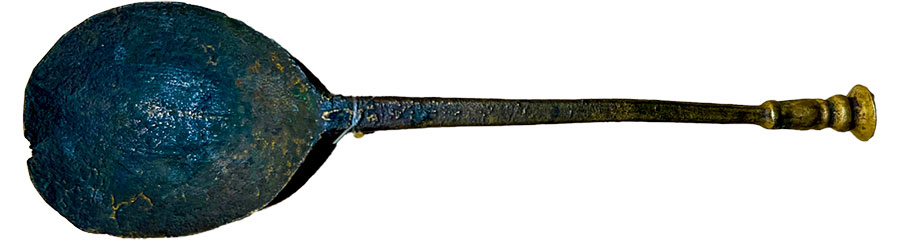
This spoon has a history of ownership by George Soule (probably c. 1595 – before 1678/9).
Spoon, Latten, Brass
England, before 1650
PHM 1312 Gift of Mrs. George W. Soule, 1965
Metal spoons with oval or fig-shaped bowls and a seal-top were popular during the 15th and 16th centuries. They were made from an alloy of brass and zinc with a tin wash and were known as latten spoons. Seal-top spoons like this one have been found in the earliest archeological sites of Plymouth Colony. This spoon was passed down by Soule descendants.
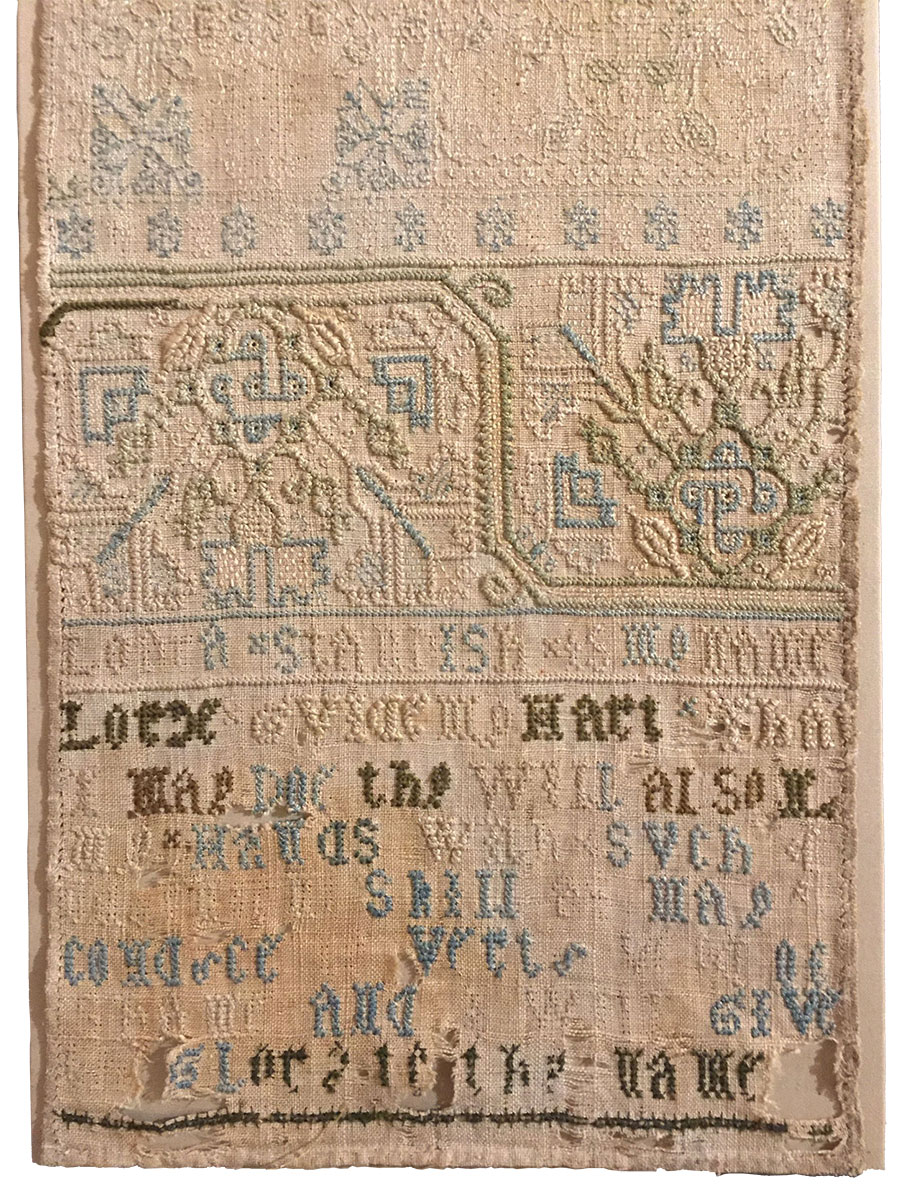
Sampler, Linen with Silk Embroidery
Made in Duxbury, MA, c. 1653
PHM 108, Gift of Lucius Alden 1844
Loara Standish— Sampler
Loara Standish, daughter of Captain Myles Standish, is thought to have made this sampler in her teens. It is the earliest known American-made sampler and the earliest known sampler with a verse.
Samplers of the 16th to mid 18th centuries served as permanent records of stitches and designs, intended for reference, unlike later samplers that were planned for display. The earliest American samplers followed the British form, as instruction in needlework passed from mother to daughter.
Like typical English band samplers, Loara Standish’s sampler is long and narrow. It measures approximately 7 1/4″ wide x 23 1/2″ tall, with patterns arranged in horizontal bands.
Worked in counted thread embroidery on very fine 50-count linen, the stitches include Montenegrin cross, long-armed cross, back, outline, eyelet, double running and arrow-head. The rose, carnation, oak leaf and an intertwined “S” are among the stylized floral motifs above the verse:
Loara Standish is my name
Lorde guide my hart that
I may doe thy will also
My hands with such
Convenient skill as may
Conduce to virtue void of
Shame and I will give
The glory to thy name
The sampler descended in the Standish and Alden families, and is faded from many generations of display. The reverse side of the sampler, however, retains more vivid thread colors.
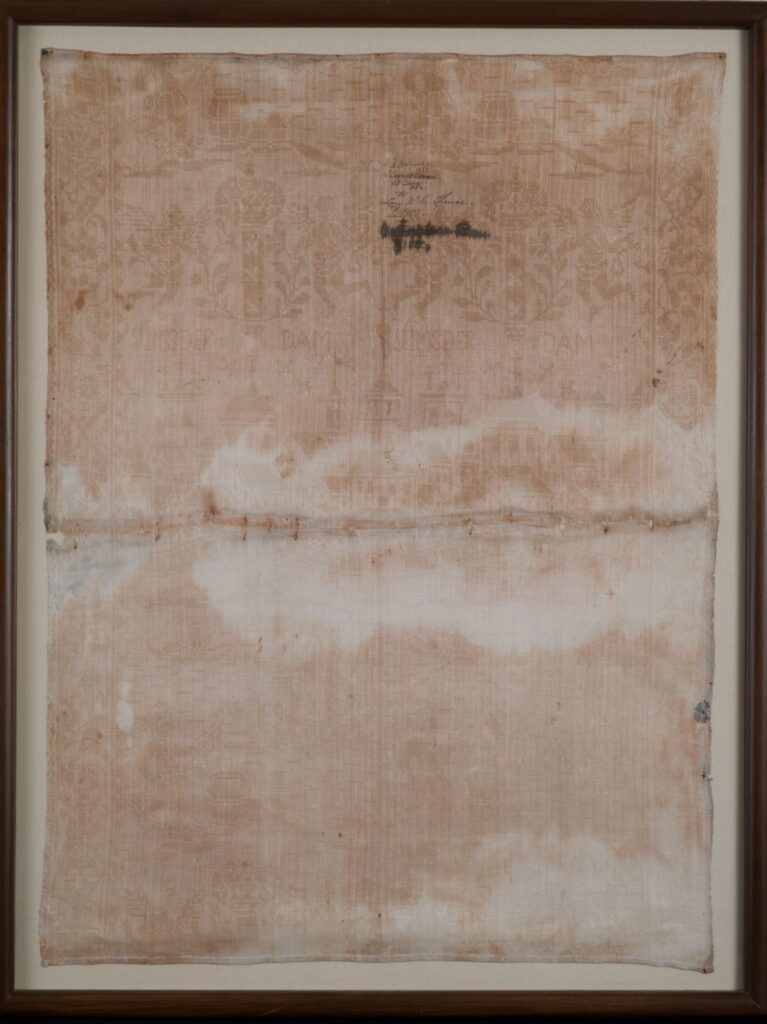
Napkin, Linen Damask
Probably Haarlem, The Netherlands, 1600-1625
PHM 1412, Gift of Robert Rhea Van Deventeer, 1977
Richard Warren — Napkin
In the 1600s people draped large linen napkins over their shoulders while eating to wipe their hands. Spoons, knives, and hands were the implements employed at table. Forks were not in common use.
Textiles were expensive, high-status furnishings in the 1600s. This napkin is elaborately decorated with bands of woven patterns. One band illustrates the coat of arms of the city of Amsterdam, surrounded by branches and winged cherubs with “Amster Dam” below. The city’s houses, churches, canal bridges and boats appear in a second band.
According to tradition, this napkin belonged to the Warren Family. Richard Warren (1580-1628) was a London merchant who came to Plymouth on the Mayflower in 1620. His wife Elizabeth and five daughters followed on the Anne in 1623.
The napkin descended through generations of the Warren Family, traditionally to the eldest female, some of whom signed and dated their own names on the napkin.
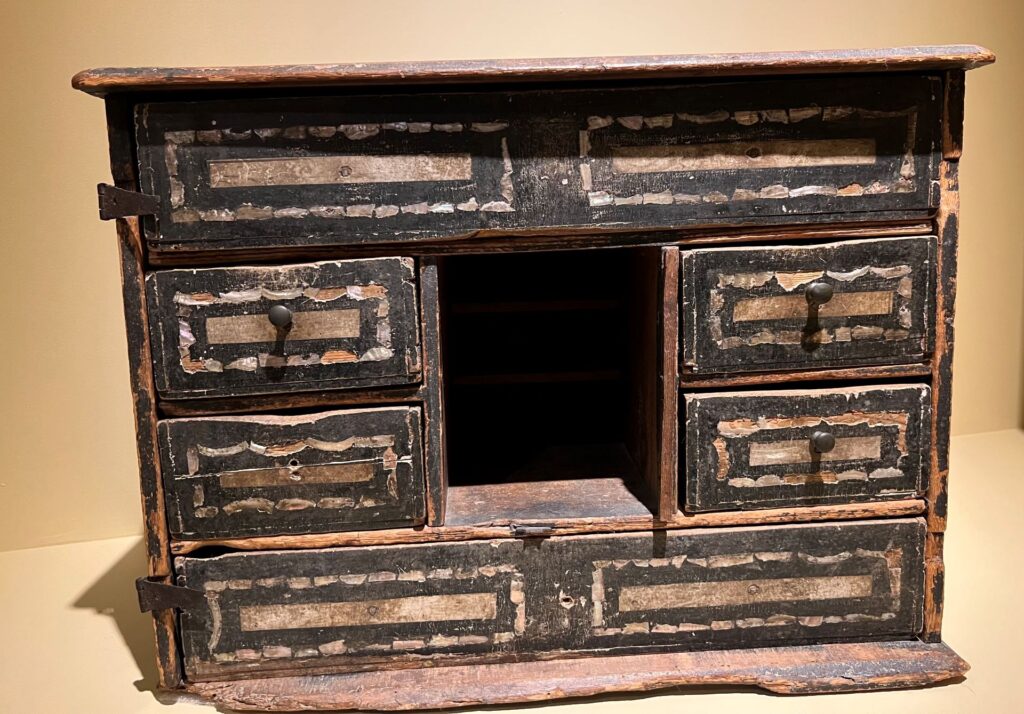
Writing Cabinet, Pine, Beech, Mother of Pearl, Iron
England or Netherlands, 1600-1650
PHM 0071, Gift of Mrs. Peddy Leonard Bowen, 1836
William White — Writing Cabinet
The portable cabinet has a tradition of ownership by William White (c. 1590 – 1620/21). It is made of pine with mother of pearl inlay and painted. A cabinet such as this would have been useful for carrying everything needed to keep records of the voyage and the colony: paper, quills, ink, a small knife.
In the early 1600s, paper was made from rags pounded and washed into pulp and then laid out on a screen in a paper mill. Quill pens came from goose feathers, cleaned and cut to a point using a small “pen” knife. Ink was made from oak galls which created a black ink. Blank books at the time were hand-sewn with leather or vellum covers.
The Mayflower passengers are known to have kept records, sent letters, and wrote the manuscripts of several later publications during their first year in Plymouth. Pilgrim leaders such as William Brewster, Edward Winslow and William Bradford undoubtedly brought their own supplies of writing materials.
This cabinet is a smaller version of cabinets found in the possession of wealthy families, businesses, governments and nobility during the early 1600s. Many were elaborately decorated with architectural or floral details. This cabinet features vine and flower decorations. It is missing its doors and probably had an original stand.