
Exile In Holland
Holland was a haven for English religious dissenters, including fleeing Separatist families who faced harassment at home. The Dutch were unusually tolerant, having themselves suffered religious persecution by Spain.
“Seeing them selves thus molested… by a joynte consente they resolved to goe into ye Low-Countries [Holland], wher they heard was freedome of Religion for all.”
– William Bradford, Of Plymouth Plantation
After first settling in Amsterdam, the Scrooby congregation moved to the Dutch city of Leiden in 1609. Leiden was a university town, vibrant and cosmopolitan. There, the refugees found jobs, sometimes as textile workers.
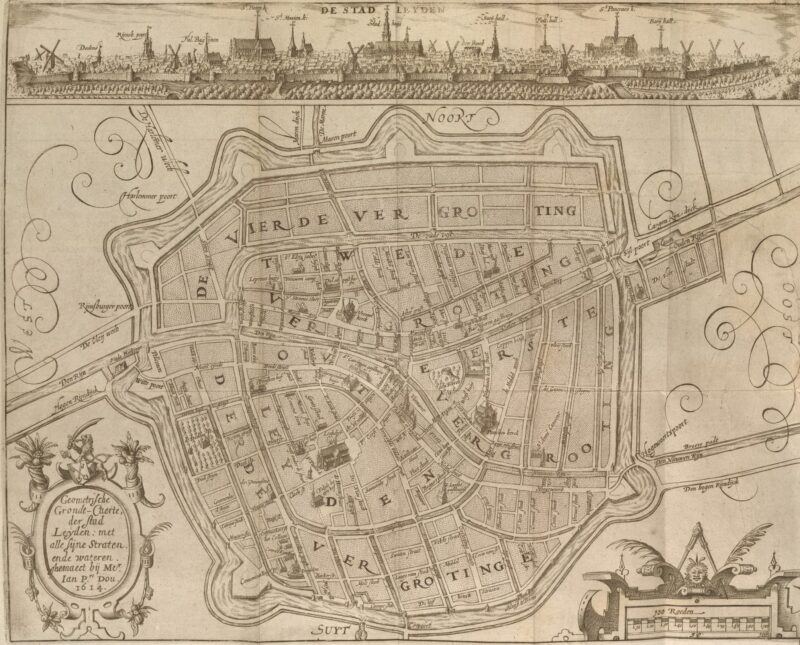
William Bradford described the Pilgrims’ move to Leiden in 1609:
“For these & some other reasons they removed to Leyden, a fair & bewtifull citie, and of a sweete situation, but made more famous by ye universitie wherwith it is adorned, in which of late had been so many learned men. But wanting that traffike by sea which Amsterdam injoyes, it was not so beneficiall for their outward means of living & estats. But being now hear pitchet they fell to such trads & imployments as they best could; valewing peace & their spirituall comforte above any other riches whatsoever. And at lenght they came to raise a competente & comforteable living, but with hard and continuall labor.”
For the next dozen years, the congregation found a home in Leiden.
“Being thus setled (after many difficulties) they continued many years in a comfortable condition, injoying much sweete & delightefull societie & spirituall comforte togeather in ye wayes of God, under ye able ministrie, and prudente governmente of Mr. John Robinson, & Mr. William Brewster, who was an assistante unto him in ye place of an Elder, unto which he was now called & chosen by the church. So as they grew in knowledge & other gifts & graces of ye spirite of God, & lived togeather in peace, & love, and holiness; and many came unto them from diverse parts of England, so as they grew a great congregation. And if at any time any differences arose, or offences broak out (as it cannot be, but some time ther will, even amongst ye best of men) they were ever so mete with, and nipt in ye head betims, or otherwise so well composed, as still love, peace, and communion was continued; or else ye church purged of those that were incurable & incorrigible, when, after much patience used, no other means would serve, which seldom came to pass.”
– William Bradford, Of Plymouth Plantation
The Pilgrims lived in the city of Leiden between 1609 and 1620. They worked in crafts and trades to support their families. They found homes, got married and raised families. Why did they decide to leave?
The exiles realized that their close-knit congregation was declining, “for many that came to them, and many more that desired to be with them, could not endure that great labour and hard fare, with other inconveniences which they underwent and were contented with” (Bradford). Continual poverty for many of their members, the hardships experienced by their children, the temptations of Dutch culture, and the threat of renewed war between the Dutch and the Spanish were among the reasons for their decision to seek to better their situation by voyaging to America.
Bradford eloquently described how their difficult circumstances as exiles in a foreign land and the prospect of uncertain times ahead caused the group to discuss the idea of emigrating a second time:
“After they had lived in this citie about some 11. or 12. years….and sundrie of them were taken away by death, & many others begane to be well striken in years….those prudent governours with sundry of ye sagest members begane to both deeply to apprehend their present dangers, & wisely to foresee ye future and thinke of timely remedy. In ye agitation of their thoughts, and much discours of things hear aboute, at length they began to incline to this conclusion, of remoovall to some other place.”
– William Bradford, Of Plymouth Plantation
The group was aware of the dangers involved in crossing the Atlantic and the risk of failure and death in attempting to establish a colony. They decided to emigrate to America despite the perils ahead:
“all great & honourable actions are accompanied with great difficulties, and must be both enterprised and overcome with answerable courages. It was granted ye dangers were great, but not desperate; the difficulties were many, but not invincible. For though their were many of them likely, yet they were not certaine; it might be sundrie of ye things feared might never befale; others by providente care & ye use of good means, might in a great measure be prevented; and all of them, through ye help of God, by fortitude and patience, might either be borne, or overcome. True it was, that such atempts were not to be made and undertaken without good ground & reason; not rashly or lightly as many have done for curiositie or hope of gaine, &c. But their condition was not ordinarie; their ends were good & honourable; their calling lawfull, & urgente; and therfore they might expecte ye blessing of God in their proceding. Yea, though they should loose their lives in this action, yet might they have comforte in the same, and their endeavors would be honourable. They lived hear but as men in exile, & in a poore condition; and as great miseries might possibly befale them in this place, for ye 12. years of truce [the truce between Holland and Spain] were now out, & ther was nothing but beating of drumes, and preparing for warr, the events wherof are allway uncertaine.”
– William Bradford, Of Plymouth Plantation
An additional motivation for these Separatists reformers was the opportunity to propagate their religious beliefs by bringing the gospel to remote parts of the world. Bradford expressed “a great hope and inward zeal” for eventually converting non-Christian Indigenous peoples if the Separatists settled their colony in America. Their desire to explain and advance their religious outlook back in England had already been furthered by the activities of William Brewster and others through the printing of religious tracts.
Towards the end of the Pilgrims’ stay in Leiden, Brewster operated a printing press. Between 1617 and 1619, this press, known informally today as the “Pilgrim Press,” printed and distributed controversial religious books. These books were banned by English law and had to be smuggled into the country. Brewster printed two books by David Calderwood that were directly critical of King James I of England. The English ambassador to Holland instigated a search for William Brewster and his press. Brewster went into hiding but his house in Leiden was searched and his printing type seized. The next year, the Pilgrims journeyed to Plymouth on the Mayflower.
It took ten years to transfer most of the community to Plymouth. Several ships after the Mayflower carried members of the congregation. Many members of the Separatist community, including pastor John Robinson, never made the journey. Robinson died before he could arrange passage; others simply ended up staying in Holland.
The Pilgrim Museum at the Pieterskirk in Leiden has detailed information on the English Separatist community in The Netherlands.