
The Courtship of Myles Standish
“Archly the maiden smiled, and, with eyes over-running with laughter, Said, in a tremulous voice, ‘Why don’t you speak for yourself, John?'”
– Henry Wadsworth Longfellow, The Courtship of Miles Standish
Henry Wadsworth Longfellow (1807-1882), Harvard professor of literature and the most popular American poet of the 19th century, wrote his epic poem, The Courtship of Miles Standish, in 1858. An Alden descendant, Longfellow wove his imaginative story around an old family tradition.
The courtship tale first appeared in print 44 years before Longfellow’s version, in a volume by another Alden descendant published in 1814:
“It is well known, that, of the first company consisting of one hundred and one, about one half died in six months after landing, in consequence of the hardships they were called to encounter. Mrs. Rose Standish, consort of captain Standish, departed this life, on the 29 of January, 1621. This circumstance is mentioned as an introduction to the following anecdote, which has been carefully handed down by tradition.”
“In a very short time after the decease of mrs. Standish, the captain was led to think, that, if he could obtain miss Priscilla Mullins, a daughter of mr. William Mullins, the breach in his family would be happily repaired. He, therefore, according to the custom of those times, sent to ask mr. Mullins’ permission to visit his daughter. John Alden, the messenger, went and faithfully communicated the wishes of the captain. The old gentleman did not object, as he might have done, on account of the recency of captain Standish’s bereavement. He said it was perfectly agreeable to him, but the young lady must also be consulted. The damsel was then called into the room, and John Alden, who is said to have been a man of most excellent form with a fair and ruddy complexion, arose, and, in a very courteous and prepossessing manner, delivered his errand. Miss Mullins listened with respectful attention, and at last, after a considerable pause, fixing her eyes upon him, with an open and pleasant countenance, said, prithee, John, why do you not speak for yourself? He blushed, and bowed, and took his leave, but with a look, which indicated more, than his diffidence would permit him otherwise to express. However, he soon renewed his visit, and it was not long before their nuptials were celebrated in ample form. From them are descended all of the name, Alden, in the United States. What report he made to his constituent, after the first interview, tradition does not unfold; but it is said, how true the writer knows not, that the captain never forgave him to the day of his death.”
– Timothy Alden, A Collection of American Epitaphs and Inscriptions with Occasional Notes (New-York : [S. Marks, Printer], 1814)
In his poetic rendering of the Alden family tradition, Longfellow imagines Myles as a brave but inarticulate soldier who sends young John to plead his case with the beautiful Priscilla. John is torn between duty to the Captain and his own love for Priscilla. And Priscilla, despite her maidenly reserve, chooses her own mate.
Longfellow’s romanticized colonial love triangle provided 19th-century readers with drama and a personal connection to history. Widely read from the time of its publication, it sold tens of thousands of copies in its first year in print, and embedded the story of John and Priscilla in the American popular imagination.
The Courtship: The 17th Century
“Mr. Mullins and his wife… died the first winter. Only his daughter Priscilla survived, and married with John Alden, who are both living and have eleven children.”
– William Bradford
Among the Mayflower passengers were Priscilla Mullins, John Alden and Myles Standish. Priscilla was in her late teens when she arrived in Plymouth. William Mullins, her father, died in February of 1621, and her mother and brother both died in the spring.
John Alden was in his early twenties. He had no family members in Plymouth and had arrived on his own, hired to be the ship’s cooper during the voyage. When the Mayflower returned to England, Alden stayed in Plymouth.
Myles, perhaps 27, was widowed during the first winter in Plymouth when his wife Rose died on January 29, 1620/21.
Legend told of a love triangle between the three colonists. The historical records, however, contain no mention of Standish’s interest in Priscilla.
Priscilla Mullins married John Alden sometime before 1627, though the date of their marriage is not recorded. It is probable that they were married before 1623. By 1627, John and Priscilla were not only listed as married in the colony records, they were the parents of two children.
Myles Standish married Barbara Standish, his second wife, in 1623 or 1624. Both families, the Aldens and the Standishes, were among the founders of the town of Duxbury to the north of the original settlement of Plymouth.
In the next generation, the two families became more closely tied. Alexander Standish, the second of seven children born to Myles and Barbara, married Sarah Alden, the fourth child of ten born to John and Priscilla. When Myles Standish died in 1656, his widow Barbara appointed John Alden to take the inventory of his estate.
The Spinning Wheel
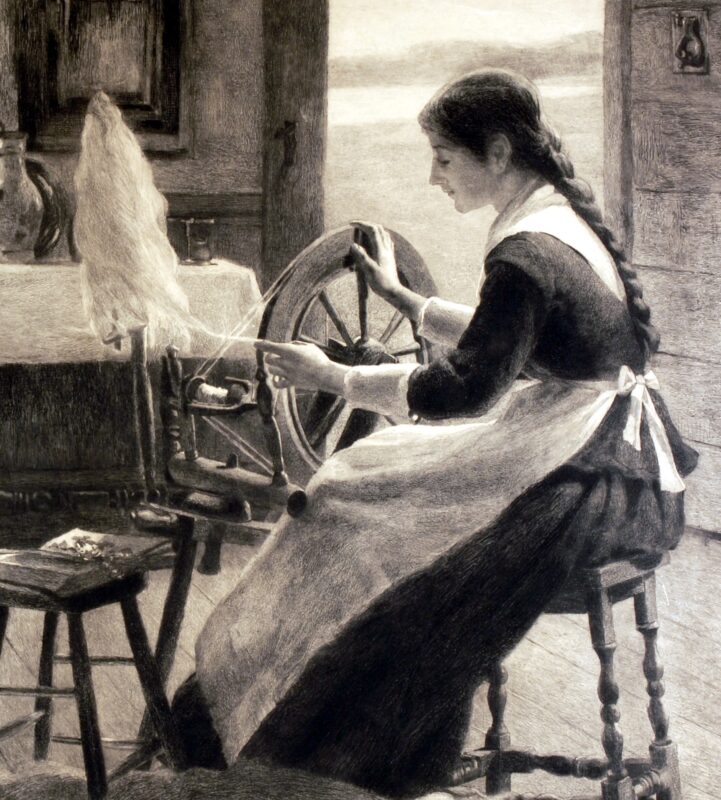
Longfellow’s romantic poem, The Courtship of Miles Standish, envisioned young Priscilla Mullins industriously working at her spinning wheel when, in the early 1620s, John Alden came calling. She is usually pictured using a flax wheel, which turned raw fibers into linen threads in a labor-intensive process.
During the early years of the Colony, growing and spinning flax was not feasible. Neither did the Colony have sheep, whose wool could be spun. There were, in fact, no spinning wheels recorded in the Colony until the late 1630s. Nevertheless, due to Longfellow’s vivid imagery, spinning wheels became a symbol of Colonial domestic virtue.