Thanksgiving Music & Verse
Music has long been a part of the American Thanksgiving tradition, from hymns to popular songs to more recent holiday compositions.
The familiar Thanksgiving hymn, “We Gather Together,” had its origins in the late 16th-century Netherlands as song of gratitude for the relief of the Dutch people from a brutal war with Spain. Published in German in the late 19th century, it was introduced in English translation to America in 1894 and became a frequent addition to hymnals as a “thanksgiving hymn.”
One of the most recognized American Thanksgiving songs began as poetry. In 1845, American author and activist Lydia Maria Child (1802-1880) wrote a poem entitled “A New-England Boy’s Song About Thanksgiving Day,” which is better known by its opening line, “Over the river and through the wood, to grandfather’s house we go.” It gained lasting popularity in 1874, when her friend, the Quaker abolitionist poet John Greenleaf Whittier, included it in Child Life, an anthology of poetry for children.
Over the river and through the wood,
To grandfather’s house we go;
The horse knows the way to carry the sleigh
Through the white and drifted snow.
Over the river and through the wood,
To grandfather’s house away!
We would not stop for doll or top,
For ’tis Thanksgiving Day.
Over the river and through the wood —
Oh, how the wind does blow!
It stings the toes, and bites the nose
As over the ground we go.
Over the river and through the wood,
With a clear blue winter sky,
The dogs do bark, and children hark,
As we go jingling by.
Over the river and through the wood,
To have a first-rate play.
Hear the bells ring, “Ting-a-ling-ding!”
Hurray for Thanksgiving Day!
Over the river and through the wood,
No matter for winds that blow;
Or if we get the sleigh upset,
Into a bank of snow.
Over the river and through the wood,
To see little John and Ann;
We will kiss them all, and play snowball,
And stay as long as we can.
Over the river and through the wood,
Trot fast, my dapple gray!
Spring over the ground like a hunting hound!
For this is Thanksgiving Day!
Over the river and through the wood,
And straight through the barnyard gate.
We seem to go extremely slow —
It is so hard to wait!
Over the river and through the wood,
Old Jowler hears our bells;
He shakes his pow with a loud bow-wow,
And thus the news he tells.
Over the river and through the wood,
When grandmother sees us come,
She will say, “Oh, dear, the children are here,
Bring a pie for every one.”
Over the river and through the wood –
Now grandmother’s cap I spy!
Hurray for the fun! Is the pudding done?
Hurrah for the pumpkin pie!
The Breaking Waves: A Thanksgiving Hymn
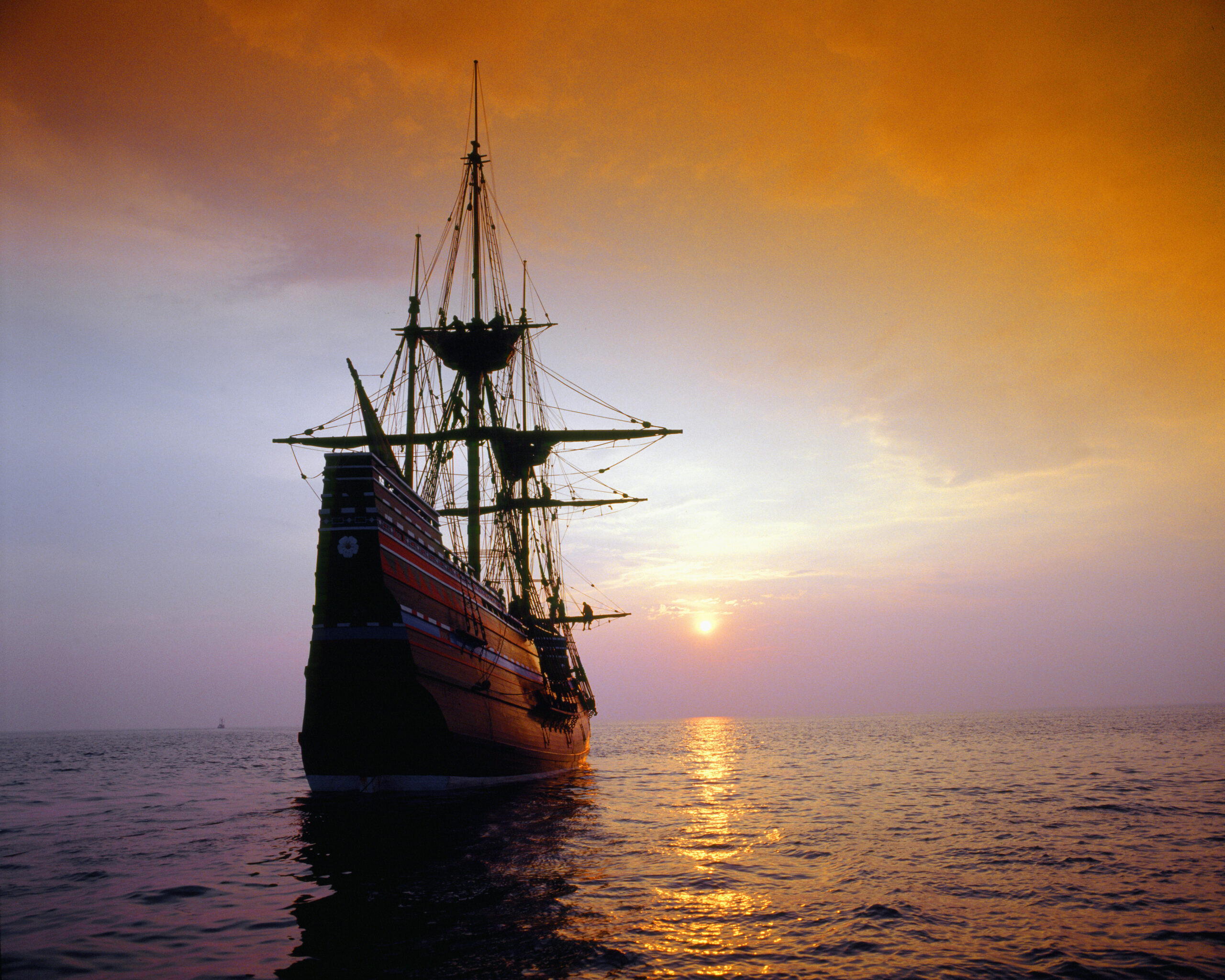
English poet Felicia Dorothea Hemans (1793-1835) wrote “The Landing of the Pilgrim Fathers in New England” in 1825 after learning about Plymouth Colony’s founding from published accounts of the bicentennial anniversary of the Mayflower landing. The verses were set to music by Mary Ann Browne and the poem gained popularity as a hymn.
According to Plymouth memoirist and historian William T. Davis:
“The story of the inspiration of “The Breaking Waves Dashed High,” written by Mrs. Hemans, is also an interesting one. In 1825 she was living with her brother at Rhyllon, a parish of St. Asaph at the mouth of the river Clwyd in North Wales. After shopping one day, one of her purchases was sent home in a bandbox covered with a newspaper, which she noticed was a Boston daily. Before throwing the paper away or burning it, she had the curiosity to look over its contents in which she found a long account of the Pilgrim celebration in Plymouth on December 22, 1824, and copious extracts from the oration delivered by Edward Everett. The Pilgrim story was a new one to her, and the account, which she read with great interest, was so circumstantial as to inspire her with the grandeur of the theme. She told Rev. Charles T. Brooks on a visit to her later home in Dublin, that she at once, after reading the account, turned to her desk and wrote the immortal lines. The original manuscript of the hymn she gave to James T. Fields of Boston and it is now preserved in the cabinet of the Pilgrim Society, a gift from Mr. Fields.”
– William T. Davis, Plymouth Memories of an Octogenarian (Plymouth, Mass.: Memorial Press, 1906), 501.
Original Verses
“The Breaking Waves Dash’d High”
The breaking waves dash’d high
On a stern and rock-bound coast,
And the woods against a stormy sky
Their giant branches toss’d;
And the heavy night hung dark
The hills and waters o’er,
When a band of exiles moor’d their bark
On the wild New England shore.
Not as the conqueror comes,
They, the true-hearted, came;
Not with the roll of the stirring drums,
And the trumpet that sings of fame;
Not as the flying come,
In silence and in fear;—
They shook the depths of the desert gloom
With their hymns of lofty cheer.
Amidst the storm they sang,
And the stars heard and the sea;
And the sounding aisles of the dim woods rang
To the anthem of the free!
The ocean eagle soar’d
From his nest by the white wave’s foam;
And the rocking pines of the forest roar’d—
This was their welcome home!
There were men with hoary hair
Amidst that pilgrim band;—
Why had they come to wither there,
Away from their childhood’s land?
There was woman’s fearless eye,
Lit by her deep love’s truth;
There was manhood’s brow serenely high,
And the fiery heart of youth.
What sought they thus afar?—
Bright jewels of the mine?
The wealth of seas, the spoils of war?—
They sought a faith’s pure shrine!
Ay, call it holy ground,
The soil where first they trode.
They have left unstain’d what there they found—
Freedom to worship God.
– The Poems of Felicia Hemans (London and Edinburg: William P. Nimmo, 1875).