Plymouth Succotash
Succotash, one of the most maligned American foods, has been Plymouth’s signature historical dish for generations.

Succotash is an Indigenous dish with origins in the nutritious corn-and-bean agriculture of the Wampanoag and other Native peoples along the eastern seaboard. In the 17th century, the English settlers at Plymouth and elsewhere in New England began preparing the dish themselves, making it part of their own Plymouth Colony foodways and traditions. In the 18th and 19th centuries, Plymouth families regularly enjoyed succotash as a notable local dish.
For at least three centuries, succotash has been associated with Forefathers Day, the anniversary of the landing of the Mayflower Pilgrims in Plymouth in December 1620.
The earliest known reference to this tradition appears in 1720 on the occasion of the first centennial anniversary of Plymouth Colony’s founding.
“Revd. Mr. Eph. Little of Plymouth made a century festival 1720, first a wooden Dish of Indian Corn and Clams to represent how our Fathers fed in 1620, then an elegant Dinner to shew 1720.”
– Extracts from the Itineraries and Other Miscellanies of Ezra Stiles D.D., L.L.D. 1755-1794. Franklin Bowditch Dexter, ed. New Haven: Yale University Press, 1916, 167.
Over the 18th and 19th centuries, Forefathers Day was enthusiastically celebrated in Plymouth and its regional popularity influenced the circulation of New England history and tradition well before Thanksgiving became a national holiday.
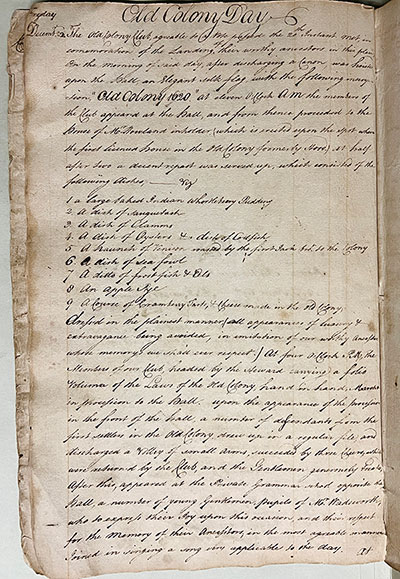
In 1769, when a new gentlemen’s society in Plymouth, the Old Colony Club, was established, club members celebrated Forefathers Day with a New England bill of fare including succotash.
Fryday December 22. The Old Colony Club, agreeable to a Vote passed the 20th Instant met, in comemoration of the Landing of their worthy ancestors in this place, In the morning of said day, after discharging a Canon, was hoisted upon the Hall, an Elegant silk flag, with the following inscription, “Old Colony 1620.” At eleven o’clock am the members of the Club appeared at the Hall , and from thence proceeded to the house of Mr. Howland in[n]holder (which is erected upon the spot where the first licenced house in the Old Colony formerly stood.) At half after two a decent repast was served up, which consisted of the following Dishes, – Viz
1 a large baked Indian Whortleberry Pudding
2 A dish of sauquetash
3 A dish of Clamms
4 A dish of Oysters & a dish of Codfish
5 A haunch of Venison roasted by the first Jack bro.t to the Colony
6 A dish of sea fowl
7 A ditto of frost fish & eels
8 An apple Pye
9 A Course of Cramberry Tarts, & Cheese made in the old Colony;
dressed in the plainest manner, all appearances of luxury& extravagance being avoided, in imitation of our worthy Ancestors whose memory we shall ever respect.”
– December 22, 1769, Old Colony Club Minute Book, 1769-1773 (unpaginated), Old Colony Club Collection, Pilgrim Hall Museum Archives.
Since 1820, a dish of succotash is traditionally served at the Pilgrim Society’s annual meeting held on December 21st, Forefathers Day.