
Plymouth Rock in the Old Colony Memorial
Selected articles about Plymouth Rock as reported in the Plymouth newspaper, the Old Colony Memorial, established 1822.
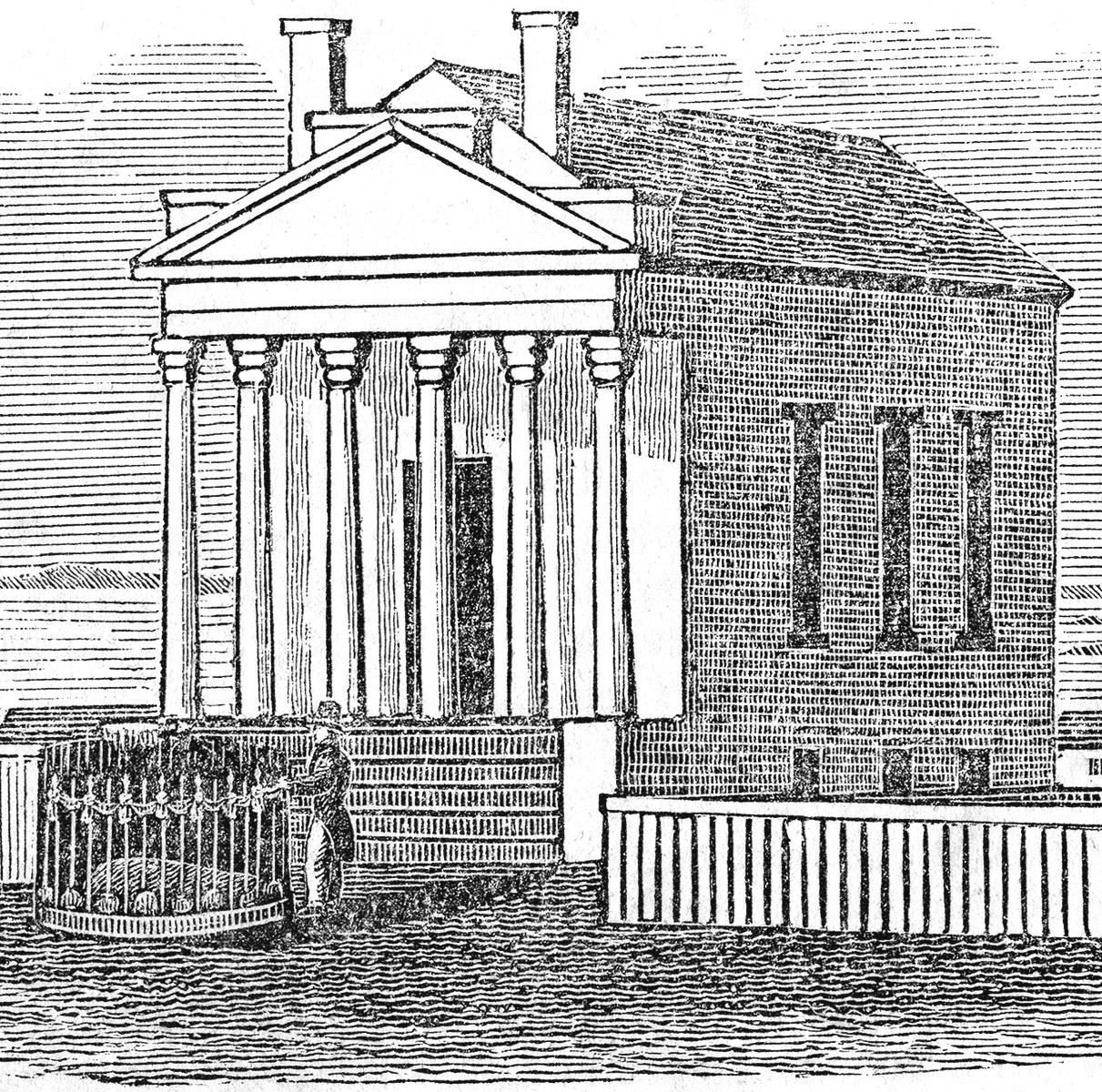
Pilgrim Hall Museum, 1839
July 4, 1834
“INDEPENDENCE
This day completes fifty eight years since the Declaration of Independence. Its return brings with it many interesting associations, and carries the mind back to a contemplation of the daring spirits who then came forward in defense of their unalienable rights and put at hazard their lives and fortunes to the success of their undertaking. Those patriotic men who signed the Declaration have ceased to live, but they left with this great nation the rich blessings of civil and religious liberty purchased by the blood and treasure of our fathers. The story of their sufferings and sacrifices, and devotion to the cause in which they were engaged, should be transmitted from father to son so long as a vestige of liberty remains in our land.
Celebrations of the day will take place in all the principal cities and towns throughout the Union.
In this town the day will be noticed by the removal to Pilgrim Hall of that part of “Forefather’s Rock,” which was separated from the main body in 1774, and deposited by the Whigs of that day, in Market square, near the Liberty Pole, where it has since remained; End the avidity with which strangers have sought to possess a portion of it, as a choice relict, has caused piece after piece to be broken from it till its size has been considerably reduced. By a vote of the town the charge of the Rock has been transferred to the Pilgrim Society, and they are now about to remove it to their edifice with a view to enclose it and protect it from further depredations. This day has been selected for this purpose as will be seen by the following notice:
PILGRIM SOCIETY
CELEBRATION OF AMERICAN INDEPENDENCE
The Pilgrim Society having made arrangements to remove the “FOREFATHER’S ROCK” from Town Square to Pilgrim Hall, on the birth day of our National Independence – The members of the Pilgrim Society, with other gentlemen who are disposed to join them, are requested to assemble in town square at 9 o’clock A.M.
ORDER OF ARRANGEMENTS.
A procession will be formed under the direction of Capt. Samuel Doten, Chief Marshall, assisted by the following gentleman who have been appointed Marshals – John Bartlett 3d, Barnabas B. Holmes, Isaac B. Rich, Jeremiah Farris, Winslow Tribble, Ephraim Holmes, Benjamin Goddard, Bartlett Holmes, Jr., Wm. Z. Ripley and James Cox, and will move from Town Square through Main and Court Streets, to Pilgrim Hall; at which place an Address will be delivered by CHARLES COTTON, M.D.
The services will close by a prayer by the Rev. Dr. KENDALL.
Lads and Misses belonging in the following order:
Escort by the Standish Guards,
Band of Music,
Officers and Members of the Pilgrim Society, and the Orator of the Day
Rev. Clergy
Citizens and Strangers
The Misses are desired to meet in the Town Hall, at half past 9 o’clock.
A Collation will be provided by Mr. Bryant, at the Pilgrim Hall. Tickets 50 cents, to be had at the Bar.”
– Old Colony Memorial, Vol 13, No. 12 (July 4, 1834), 2.
JULY 12, 1834
“Forefathers’ Rock.
That part of Forefathers’ Rock, which in 1774 was placed in Market Square, was on the Fourth of July removed to Pilgrim Hall. It is now in charge of the Pilgrim Society. The weight of the rock is 6997 pounds. The part which remains in its original location is much larger, though but the top is to be seen, owing to the building of a wharf over it in 1741.
The profession formed on this occasion under the direction of Capt. Samuel Doten, Chief Marshall, marched through the principal streets under the escort of the Standish Guards, commanded by Capt. Bartlett with the Plymouth Band, and passed Cole’s Hill, the place of the first interment in silence, except the best of the muffled drum. In the rear of the Rock was a miniature representation of the ship Mayflower, placed in a car tastefully decorated, and drawn by 6 boys. The whole procession presented a very interesting and imposing appearance.
On depositing the Rock in front of the Hall, and a discharge over it by the Guards, an acceptable Address was made from the steps by Dr. Charles Cotton, to the assemblage surrounding them. Though there was but brief opportunity for preparation, the notices of the first Landing and the subsequent Independence of the country, and of the recent intelligence of the death of Lafayette, together with some events of his life, were made interesting. The services were closed by a well adapted prayer offered by Dr. Kendall.
An entertainment was provided in Pilgrim Hall by Mr. Bryant, of which a company of a large number cheerfully partook. At the table Hon Nathl. M. Davis presided, assisted by Messrs Isaac L. Hedge, Abram Jackson, John Bartlett 3d, Nathl. Wood and Eliab Ward, Jr., Vice Presidents. Ardent spirits were excluded on this occasion, but the company were enlivened by good toasts, good songs and good temper. The entertainment was hastily got up and no regular toasts were prepared for the occasion. The following are selected from the volunteers.
By N.M. Davis, Esq. President of the Day – The Pilgrims of 1620, and the Patriots of 1775 – May the spirits that made them what they were, make their descendants what they ought to be.
By the Orator of the Day – The memory of the Pilgrim Fathers and the memory of the departed Heroes of the American Revolution – The first brought the principles of Civil and Religious Liberty to our shores; the last taught the proudest nation of Europe to respect them.
By the President – the Orator of the Day, who has well sustained the honors of an ancient name.
By Dr. James Thacher – To the memory of the illustrious Gen. Lafayette, the ardent friend of American Liberty; the apostle of Freedom; great and good in everything; the beloved of Washington.
By Abraham Jackson, Esq., one of the Vice Presidents – The 22nd of December and the 4th of July – Days ever to be commemorated in this land of liberty; While its Ruler’s motto is, “Ask for nothing but what is clearly right, and submit to nothing that is wrong.”
By Rev. Dr. Kendall – Our Children – The happy witnesses of this day’s ceremonies; When they shall be called to fill the places which we now fill, and discharge the duties which we now discharge, may they have as much reason as we, to rise up and bless the memory of those who have gone before them.
By the Orator – The Standish Guards – Their martial appearance and military evolutions are plenary evidence that they are worthy to bear the name of Him, whose sword was the physical protection of the Pilgrims.
By the President – The Plymouth Band- May they always have clear pipes and full horns.
By Joseph Lucas – The Mayflower -Which bloomed in December 1620, and whose fruit ripened in July 1776; may the latter be preserved to the end of time.
By J. Farris – Lafayette -Although he is no longer numbered among the living, he yet lives in the affections of the people.
By L. Bugbee– Ship Mayflower and Plymouth Rock -The former the cradle, and the latter the threshold of the Theatre of Liberty.
By Wm. M. Jackson – The names of Standish, Allerton, Carver and Bradford, which we see inscribed on these walls – May the next 4th of July see them in more appropriate dress.”
By a Guest – Old Maids and Old Bachelors – They may boast of their life of single blessedness; but their task is not easy and their burden is not light.
By C.A. Hack – Washington and Lafayette – Patriots whose memories will live to the vital spark of Liberty shall be extinct.
By I.B. Thomas – the spirit of the Pilgrims and the spirit of the Revolution; though ardent spirits, may their free indulgence never be restrained.
By a Guest – The World – The great theatre upon which mankind play their parts; may it witness many scenes similar to the Landing of the Fathers, and the Declaration of Independence.
By R.E. Cotton = Pilgrims’ Rock deposited on Pilgrims’ ground; there may it remain till time shall end.
By I.B. Thomas – The Young Men and the Old Men -May the former never forget that they may be old, and the latter that they have been young.
A Volunteer – The Young Men of Plymouth – May they always with truth adopt the excellent sentiment of the poet –
“Oh talk not to me of fame in proud story,
The days of our youth are the days of our glory;
The roses and myrtles of sweet two and twenty,
Are worth all your laurels, however so plenty.By a Guest – Lafayette – the hero of three revolutions.”
– Old Colony Memorial, Vol. 13, No. 13 (July 12, 1834), page 2?
JUNE 13, 1835
“The Forefathers’ Rock Enclosed.
It affords the highest satisfaction to announce that the long desired protection of the Forefathers’ Rock is at length completed, and it may be pronounced a noble structure worthy of the purpose intended. The fabric is a perfect ellipse 41 feet in circumference, consisting of wrought iron bars 5 feet high resting on a base of hammered granite. The heads of the perpendicular bars are harpoons and boat hooks alternately. The hole is embellished with emblematic figures of cast iron. The base of the railing is studded with emblems of marine shells, placed alternately reversed, having a striking effect. The upper part of the railing is encircled with a wreath of iron castings in imitation of heraldry curtains, with festoons; of these there are 41 bearing the names in bass relief of the 41 puritan fathers who signed the memorable compact while in the cabin of the Mayflower at Cape Cod in 1620. This noble acquisition reflects honor on all who have taken an interest in the undertaking. In the original design by George W. Brimmer, Esq. ingeniousness and a fine taste is displayed; and in all its parts the work is executed with much judgment and skill. The castings are executed in the most improved style of the art. This superb memorial will last for ages, and the names and story of the great founders of our empire will be made familiar to the latest generation.”
– Old Colony Memorial, Vol.14, No. – (June 13, 1835), 2.
DECEMBER 12, 1850
“The Rock of Plymouth.
We copy below, from the Boston Atlas, an extract taken from a Thanksgiving sermon delivered by the Rev. Rufus L. Clark of Portsmouth, N.H., which contains a recommendation, that efforts be made to erect an appropriate Monument on or near Forefathers’ Rock. It is gratifying to perceive an interest excited abroad, in relation to this subject; more particularly as it coincides with a similar project, which the Pilgrim Society have had under consideration, during the past year. We understand that the Trustees of that Society were appointed in December 1849, and clothed with full authority to take such course as they might deem most expedient, to promote the object in view, and hope learn the result of their deliberations at the next meeting, which is to be held on Saturday, the 21st day of the present month.
A Monument to the Pilgrims. – The Rev. Rufus W. Clark, of Portsmouth, N.H., in his Thanksgiving sermon, last week, after discoursing upon the origin, achievements, and mission of New England, made the following suggestion:
“While contemplating and numerous and inestimable advantages that have flowed from the heroism, fortitude and piety of our ancestors, it has occurred to me that it is due to the memory of those noble men, that a costly and magnificent monument be erected, by the sons of New England, on the very spot where they landed. We have monuments to commemorate important battles, to honor illustrious military heroes, and we erect marble columns sacred to the memory of departed friends. Why, then, should not this great event – the landing of the Pilgrims – An event the most important in the history of this continent, be suitably commemorated?
It is true, that our civil and religious institutions are splendid, and, we trust, enduring monuments of their self-devotion, courage and faith; but we are all more or less impressed by distinct memorials of past worth, and by tangible tokens of national gratitude. Such a monument, too, would set an example to the world of commemorating other besides military exploits, and of holding in reverence higher virtues, and nobler traits of character, than are usually exhibited amid the excitement and sufferings of the battle-field.
We have such confidence in the gratitude, liberality, and wealth of the sons of New England, to believe that this enterprise needs only to be suggested to awaken public attention and secure the public favor. It would be by no means difficult to have Plymouth Rock the foundation of a structure as imposing and splendid as that which is now being erected at the capital of the nation, in honour of the im[m]ortal Washington. And we would say of such a monument in honor of our fathers, as has been, by eloquent lips, said of another: “We wish that this structure may proclaim the magnitude and importance of that event to every class in every age. We wish that infancy may learn the purposes of its erection from maternal lips, and that weary and withered age may behold it, and be solaced by the recollections which it suggests.” We wish that labor may look up here and be proud in the midst of its toil. We wish, in those days of disaster, which, as they come on all nations, must be expected to come on us also, desponding Patriotism may turn its eye thitherward, and be assured that the foundations of our national power still stands strong. We wish that this column, rising towards heaven among the pointed Spires and temples dedicated to God, may contribute also to produce, in all minds, a pious feeling of dependence and gratitude. We wish, finally, that the last object on the site of him who leaves his native shore, and the first to gladden him who revisits it, may be something which shall remind him of the liberty and glory of his country.
‘Let it rise till it meets the sun in his coming; let the earliest light of the morning gild it, and parting day linger and play on its summit.’”
– Old Colony Memorial, Vol. – , No. – (December 12, 1850), 2.
SEPTEMBER 9, 1880
“Replacing of Plymouth Rock
A special meeting of the Pilgrim Society is called for Thursday evening of next week, to act upon a proposition to restore the piece of Forefathers’ Rock, at Pilgrim Hall, to its original position at the landing place. The inappropriateness of having the larger part of the rock entirely dissevered from its proper associations has always been apparent, and has often been a source of disappointment to visitors and frequently remarked upon.
The circumstances of its occupying its present place are known to many and are simply as follows. Just previous to the Revolution, in raising the Rock to prevent its being covered by the filling in of the wharf about it, the top part split off and the circumstances being deemed an omen that the colonies were to be separated from the mother country, the piece was carried to Town Square, and a liberty pole erected over it. In 1824, Pilgrim Hall was built, and in 1834 the piece of the Rock was transported thither in procession, placed in front of the Hall, and has since remained. Mr. J. H. Stickney, who is doing so much to improve the Hall, and insure the preservation of Pilgrim relics, recognizing the fact that the Rock is singularly out of place, and desiring that it should be again identified with the landing of the Fathers, now offers at his own expense, to transport it to the original situation and place it beneath the Canopy, securing it from depredation by iron gates in the arches of this monumental structure, as designed by Mr. Billings, the architect. There seems to be a general concurrence of opinion in this idea, and it would seem this Society will yield ready acquiescence at its meeting next week.
– Old Colony Memorial, Vol. 59, No. – (September 9, 1880), 4.
SEPTEMBER 14, 1882
“The “Funny Man” of the New York Times thus amusingly discourses concerning our blarney stone: –
Plymouth Rock Scattered.
A Congregational Society in Harlem is building a new meeting house, in front of which is to be placed a large piece of Plymouth Rock. Some years ago it was estimated that there were in the possession of Congregational Societies and of private Congregationalists 11,500 tons, in round numbers, of Plymouth Rock. In all probability, these 11,500 tons have by this time grown to be fully 20,000 tons, for no earnest Congregationalist and no loyal descendant of the Pilgrims is satisfied unless he is ballasted, so to speak, with a piece of Plymouth Rock. The quantity of specimens of the “true cross” in the possession of devout Roman Catholics is conceded to be very great, but it is insignificant in comparison with the quantity of pieces of Plymouth Rock that are scattered over our country. With these pieces a building six times the size of the Capitol at Washington could be constructed, and this building could be surrounded by a wooden fence seven miles long and eight feet high, made entirely of pieces of Elder Brewster’s favorite chair.
The world is slowly learning the truth concerning the landing of the Pilgrims. It is now pretty thoroughly established that they did not land on the day which has for so many years been celebrated as Forefather’s Day. In fact, there was no general and simultaneous landing of the Pilgrims. After the Mayflower had entered the Bay formed by Cape Cod, small parties of sailors in search of rum, and Pilgrims in search of a sufficiently gloomy wilderness, landed day after day at different points along the coast. There is no doubt that, after Plymouth had been selected as a good place to board during the Winter, all the Pilgrims still remaining on board the Mayflower were ordered to go ashore, but there is not the slightest foundation for the popular theory that all the Pilgrims went ashore at Plymouth, two by two, at precisely the same hour, and in a devout imitation of Noah’s collection of animals.
While the story of the landing of the Pilgrims has thus been stripped by learned critics of its original picturesque features, no one has disturbed the myth of Plymouth Rock. It is taken for granted by everybody that those Pilgrims who did land at Plymouth stepped ashore on the rock. Now, if Plymouth Rock was the regular steamboat landing, if there was a convenient wharf at the foot of it, and a commodious pair of stairs leading to the top, with, perhaps, a freight elevator, or at least a crane wherewith to hoist freight and baggage, it is quite possible that the Pilgrims did land on the rock. If, however, these conveniences are lacking, and there is too much reason to believe that they were – the Pilgrims unquestionably landed somewhere else.
Judging from the present height of Plymouth Rock, after thousands of tons have been carried away from it, we must believe that its summit was at least 40 feet above the water at the time of the arrival of the Pilgrims. What could be more absurd than to suppose that the pilgrims could step from a small boat to the summit of such a rock? The sailors of the Mayflower, instead of approaching the rock with their fragile boat, would have kept carefully away from it and all other rocks, in order to avoid being dashed to pieces. Had any well-meaning Pilgrim said to them, “Land us on the rock, so that posterity can have something to make relics out of,” the sailors would undoubtedly have made a very irreverent reply, consigning the rock and the well-meaning Pilgrim to an unpleasant locality.
The Pilgrims must have landed on a sandy beach, and they probably got very wet in so doing. It is all very fine for eloquent orators to picture to us the Pilgrims walking arm in arm over the gang-plank of the Mayflower to the flat summit of Plymouth Rock, preceded by a band of music, and welcomed by a deputation of leading Indians bearing banners inscribed “Welcome, Venerable Strangers,” and “Give us Bibles,” but the Pilgrims did nothing of the kind. They were rowed to the beach, where they were compelled to step overboard and wade ashore. They may have held a prayer meeting soon after they landed, but undoubtedly their first proceeding was to sit down in the sand and to proceed to empty the water out of their boots, at the same time informing the mate in charge that he was a loathsome Amalekite and that they would get even with him just as soon as they could organize a court with power to punish such like offenders. The Pilgrims were not in the least picturesque, and they were very wet and angry. Thus does the truth of history conflict with romance.
The fact that the Pilgrims landed on the beach instead of a rock, will, of course, impair the value of Plymouth Rock; but it will not put an end to the sale of relics. The precise beach must be found, and its inexhaustible sands will then become precious relics of the landing of the Pilgrims. Every Congregational meeting house will supply itself with a section of Plymouth Beach, and small bottles of sand will be exhibited by every descendant of the Pilgrims as proof of his reverence for his ancestors.”
– Old Colony Memorial, Vol.61, No. 37 (September 14, 1882), 1.
NOVEMBER 28, 1918
Excerpt:
“Plans for Tercentenary
General Outline of Arrangements for the Great Celebration.
At a meeting of the Society of Mayflower descendants held in Boston on Friday evening of last week Arthur Lord of this town told of the plans of the Pilgrim Tercentenary Commission of Massachusetts of which he is a member, the commissioner having available a fund of $250,000 which was appropriated by the state the purpose of aiding in the event. The gathering was held in Hotel Somerset. The Boston Post told the story as follows:
The commission proposes to restore the slope and contour of Burial Hill, where some of the Pilgrims were buried; To restore Cole’s Hill to its original condition and bring back from oblivion the graves of numerous Pilgrims over which there is now a highway much travelled by automobiles and general traffic. It is also planned to return Plymouth Rock to its original location; To wipe out its present unsightly surroundings and make the entire outlook from the bay attractive. A portico is proposed for the Rock, a portico of modern and attractive construction that will add and not detract from the impressiveness of it.
…. The reference to restoring Plymouth Rock to its original location is understood here to mean that the boulder will simply be dropped into the original bed, whence it was lifted, according to the old story about 1741, when a wharf was being built and the filling of which would have covered it. Today it is above but on a line with the high tide mark, and when replaced will be where the waters of the harbor will wash its sides twice daily, offering just as good a landing place from a small boat as it did in 1620….”
– Old Colony Memorial, Vol.98, No. – (November 28, 1919), 1.
APRIL 2, 1920
Excerpt:
“TERCENTENARY PLANS
Details of Plans Worked out by State Commission
…. For 1921, the shoreline will be made over. From two promontories on either side of the famous rock a new shoreline is to be created around a small bay. This will leave the Plymouth Rock at the head of a sheltered inlet. On the new-made land and along the waterfront, as well as be on the sides of Cole’s Hill, pines, hemlocks, cedars and such other trees is probably first greeted the eyes of the Mayflower party, will be planted. Paths will be laid out through the trees and along the shore toward the rock, and parking spaces for automobiles will be provided at both extremities to the park to avoid vehicular congestion.
The base of the rock still rests at sea level, at high water mark, but its cap, split off in 1774 and several times moved about the town before being placed under the present canopy, will be fixed upon the foundations from which it was separated.
A simple granite canopy, the gift of the Society of the Colonial Dames, will protect it. Here, on its original bed, it will be out of reach of the waves yet open towards the ocean….
….There seems to be some misunderstanding about Plymouth Rock resting at sea level. Plymouth’s history about it is that when the wharf was built many years ago, a predecessor of the present one, the filling in would have covered the famous rock and on learning of this Elder Faunce, a man of advanced age was brought into town at his request and pointed out the rock as the one the Pilgrims had told him they had landed upon, and objected to its being covered up. Accordingly it was raised from its bed and old pictures show its surface lying even with the top of the earth in the old pier, while other old pictures indicate the piece of the rock which was separated in 1774 as lying at the eastern corner of Town Square. When the present canopy was constructed over the rock it must have been raised once more for there is still living a man who says he can remember seeing Plymouth Rock on skids, and it laid higher in the canopy than it did when even with the surface of the wharf. In the 70’s [1870s] there used to be a square space inside the canopy where one could step down about four inches and place one’s feet on the rock, the top of the boulder then being in front of Pilgrim hall having been moved there from Town Square. When the rock is restored to its old bed it is likely that traces of some old filling in will be found beneath it….”
– Old Colony Memorial, Vol. 99, No. 14 (Friday, April 2, 1920), 1.
OCTOBER 1, 1920
“WATER FRONT CHANGES
Selectmen Approve Plans Submitted by Tercentenary Committee.
Answering an inquiry from Major Wildburr Walling, U.S. Engineer Corps, stationed at Boston, as to the views of the board of Selectmen on the plans made for the proposed changes along the water front, that body on Monday night considered the proposal and ordered a letter sent indicating that they had no objections to make to the plans as submitted, in connection with the alterations as shown by the plans of the State Committee on the Pilgrim Tercentenary celebration. These contemplate in addition to Craig’s wharf, northerly of the disused power station of the Brockton and Plymouth St. Ry. Co., with the acquirement of the land in front of the proposed altered pier, and its extension; the dredging of a channel 18 and 7 feet deep to this pier, which means that about 50,000 cubic yards of material will be removed, and what is fitting used to fill in solidly behind the existing piers, while the remainder of unusable spoil will be dumped off in deep water. The old shoreline at Plymouth Rock is to be restored, and the shore near it will be protected with rubble rip rap filled with the backing of gravel. The fill mentioned will obliterate the old wharves and leave Plymouth Rock at the head of a little cove with a round ended peninsula on either hand, these to be laid out with shrubbery and roads and paths.”
– Old Colony Memorial, Vol. 99, No. 40 (Friday, October 1,1920), 1.
NOVEMBER 12, 1920
“FOR ALTERING WATERFRONT.
State Tercentenary Commission Advertises for Bids – Official Opening Program.
Wednesday, the Massachusetts Pilgrim Tercentenary Commission advertised for bids on three contracts connected with the making over of the water front of the town in preparation for the Pilgrim anniversary next year. They also announced the programme for the official opening exercises on December 21, Forefathers’ Day.
The contracts call for the removal of the buildings on the shore between Brewster street on the north and Town Brook on the south, an extension of the wharf of Capt. D. H. Craig, just east of Brewster and Water street junction and dredging a new channel from the present anchorage basin, northerly to a point off the Craig wharf, to provide for a new steamboat landing.
With the land specified cleared, filling will be deposited north and south of Plymouth Rock to make two small peninsulas and Pilgrim wharf will be removed, Plymouth Rock, lying at the head of it, dropped a few feet, so that it will lie in its old bed directly under where it now is. Removal of the wharf will bring the shore line up to the site of the famous boulder. A rectangular granite structure of colonial design is to be erected over Plymouth Rock and is to bear the names of the Mayflower Pilgrims and perhaps a sentiment to be provided by President emeritus Charles W. Elliott of Harvard University….”
– Old Colony Memorial, Vol. 99, No. 46 (Friday, November 12, 1920), 1.
NOVEMBER 26, 1920
“Looked the Water Front Over.
Representatives of several contracting firms, about half a dozen being represented, were here last Friday looking over the buildings along the waterfront, which are marked for destruction to make room for the changes the plans for 1920 contemplate. Bids for the work will be opened on Nov. 20 according to bidders.
The buildings vary all the way from the nearly disused power station of the Brockton and Plymouth St. Ry. Co., to a fisherman’s shack and three big coal pockets, several storehouses and a few dwellings. The plans will sweep away about all of the present piers, public boat landing and the Plymouth Yacht Club. One wharf will be extended for a steamboat landing, this being at the extreme limit of the alterations at the junction of Water and Brewster streets. The southern limit is Town Brook.
More contractors were looking over the grounds and comparing blueprints with the reality Wednesday.”
– Old Colony Memorial, Vol. 99, No. 48 (Friday, November 26,1920), 1.
DECEMBER 3, 1920
“Bids All In
Bids for three contracts covering work along the water front for the Tercentenary observances of the landing of the Pilgrims, were received and opened at the office of the Pilgrim Tercentenary Commission, Tremont building, Boston, on Monday.
One contract calls for the removal of the buildings on the land taken for the reservation; a second is for the removal of Pilgrim wharf; the third is for dredging in the harbor and construction of a pile wharf.
For the removal of the buildings there were 30 proposals varying from $24,000 for the work to an offer of $5,000 for the privilege, a variation of $29,000 [sic] between the lowest and highest bidders. On the other two contracts there were 12 bidders.
Tuesday the commission awarded the contract for the removal of the canopy over Plymouth Rock and lowering of the latter to its original resting place to Power Brothers, of Brockton, who bid $16,990.
Approval of the Public Works of the Department of State will be obtained before decision is made regarding the contract for dredging the new channel in the harbor.
Power Brothers plan to start their work next Monday.”
– Old Colony Memorial, Vol. 99, No. 49 (Friday, December 3,1920), 1.
DECEMBER 10, 1920
“BEGINNING ON WATER FRONT.
Changes Involving Plymouth Rock and It’s [sic] Surroundings Are Under Way.”
Excerpt:
“Actual work on the construction reconstruction of a large part of the water front of Plymouth, began Wednesday afternoon at 2 o’clock, when one of the two steam shovels of Power Brothers, of Brockton, who have the contract for a portion of the work, bit into the earth fill of Pilgrim wharf and pulled out a cubic yard of the earth.
Pilgrim wharf is to be removed down to a foot below low tide mark, and when this is done and Plymouth rock lying at the shore end of the pier is dropped about six feet into its old bed on the shore the salt water will splash on its granite sides as it did 300 years ago.
There is about 14,000 cubic yards of material to be dug away, and a lot of wooden sheet piling held together with steel tie rods to be taken out before the cove is created at the head of which Plymouth Rock will rest.
The spoil from the digging is being conveyed in self-dumping motor trucks to the dock between the coal pocket of the Brockton and Plymouth St. Ry. Co. and Long Wharf, where it is being used to aid in forming the northern peninsula of the cove. A second shovel will soon be on the job, but at present is undergoing a few repairs.
The Powers Brothers also have the contract for the removal of the granite canopy over Plymouth Rock, and the lowering of the famous stone into its old resting place. The canopy known world wide in connection with the stone it shelters, is to be taken down with much care, each block of the granite being numbered and it is to be stored away for some possible future use, just what no one can yet even guess.
Instead of it being a tradition that in the upper portion of the canopy there are some of the bones of the Pilgrims which were discovered long ago in the place where the Pilgrim burial was on Cole’s hill, it is a matter of record and history that these bones were so placed about the time the canopy was completed, after having been first enclosed in a metal box and interred for some years on old Burial Hill. To someone it seemed fitting to so place them for preservation, rather than leave them in the earth, where their location was likely to be again lost as was for many years the site of the burial place of 1620-21. It is believed that the corner stone of the canopy also contains interesting matters and in the event of relics or any articles of note being discovered in the course of the demolition, President Arthur Lord, of the Pilgrim Society, and also a member of the Massachusetts Pilgrim Tercentenary Commission, has deputed William W Brewster, another official of the society to assume charge of the entire lot. The corner stone is the one on the northerly corner of the structure.
….Friday the outfit of the Swift-McNutt Co. of Boston who have the contract for the removal of the numerous buildings and several coal pockets on the space assigned for the shore reservation, come on the renew the removal of the numerous buildings and several coal pockets on the space assigned for the above reservation, are expected to arrive and get to work.”
– Old Colony Memorial, Vol. 99, No. 49 (Friday, December 10,1920), 1.
December 24, 1920
“PLYMOUTH ROCK MOVED.
Historic Boulder Finally Taken Off Its Old Resting Place.
The whole of Plymouth Rock is off its old time base and for the first time since 1859 it is possible to view the whole of the stone as it lies on the ground near the site of the canopy which covered it since 1870. The top of the rock which was best known to later generations, and which was replaced in 1880 after lying for years in front of Pilgrim hall, was lifted off on Monday afternoon and is now a short distance southerly from the old site. Beneath it was found some mortar and “pinners” of a few inches thickness and under these was disclosed the larger portion of the boulder as the boys of the period of 50 or more years ago recall it. The top is nearly flat showing only the slightly irregular lines of cleavage when the top was separated from the main mass in 1774, when it was attempted to carry the whole of the stone to Town Square. There were marks of tools where apparently the edges of the rock had been sliced down to permit of laying the wooden flooring which once covered it in part, being placed level with the threshold of the canopy. This flooring left exposed a central section for the reception of the gaze and feet of visitors, years ago. It was a bit less than two feet square.
After digging beneath it, Wednesday forenoon during which an old case knife, with the end of the blade turned up into a slight curve, as some old knives were said to have been made for convenience in place of a spoon, and a good specimen of a stone spearhead of aboriginal workmanship or found, chains were passed about the stone and the steam crane essayed to lift it. The machine pulled until one of its rear wheels was raised off the ground, and it was proved unequal to the task of getting what the crane man figured as weighing 6 tons up in the air. So a rope was rigged and while the crane held it up as much as it could the men pulled on the guy rope and dragged the mass of syenite to one side, turning it so that the westerly end now faces toward the water. Before it was moved at all Mr. Henry Chase, engineer in charge of the State Tercentenary Commissioner, marked it and sighted the location so that it can be replaced exactly as it was found today.
It was found after this lower section had been placed where it now lies that both ends of the rounded stone had been cut off in some past time, probably when it was being elevated to prevent the wharf filling covering it, and this accounts for some of the large pieces of Plymouth Rock which have been in the possession of various people in town, who had derived them from ancestors.
An examination under the brighter light than it had beneath the canopy shows there are indications of fine fissures in the top pieces, one on each side of the cleft which has existed in the upper section of the stone for a long time, and there is a possibility that water may get in there and freezing cause more breakage, unless steps are taken to protect the relic from this. Watchmen are on the spot day and night to guard the stone from depredations by relic hunters. Lee Cole is the day man and Capt. Charles H. Davis is on duty nights.
The canopy was all gone on Wednesday night except for some of the scattering stones of the foundation and the workers were grubbing out the hole down which the stone is to be lowered until it reaches the shore line of the harbor and the salt water will once more wash its base as it did when the exploring party from the Mayflower ranged alongside in their shallop, and climbed out on that, rather than step overboard in shallow water and wade ashore in December, wherein they showed themselves men of good judgment.
Consider as a whole the stone bears out its reputation of being a bolder subjected to glacial drift and wear, and perhaps came here in the geologic age when this part of the country was covered with a huge ice cap grinding its way across the country until it melted in warmer climates than prevailed at the starting point. It looks in shape like many another boulder to be found along the shore anywhere from Cape Ann to Cape Cod.”
– Old Colony Memorial. Vol. 99, No. 52 (Friday, December 24,1920), 1.
DECEMBER 31,1920
“Trouble Adjusted.
Work stopped at Pilgrim wharf on Monday for a short time, when the men employed by Powers Brothers of Brockton, contractors for lowering Plymouth Rock to its old berth on the shore and removal of the wharf, the building of the predecessor of which caused the rock to be raised from its old bed to prevent it being buried. The trouble was said to have arisen over the union rating of one of the engineers employed on one of the steam shovels. There was a short conference and then the men took their places again. The storm was bad enough to interfere with the work to some extent so the strike, if it could be called one, was but a slight stoppage of the work. One of the shovels came in from for an overhauling that day during the recess.”
– Old Colony Memorial, Vol. 99, No. 53 (Friday, December 31,1920), 1.
JANUARY 28, 1921
“Still Digging
The steam shovels of Powers Brothers of Brockton, contractors for the removal of Pilgrim wharf, have kept right at work in spite of the cold snap, just as they did in the previous cold spell. Much trouble has been met with in the shape of the old timber work of Hedge’s wharf, the predecessor of Pilgrim wharf. The latter was built outside of the old structure, and the grab buckets have been encountering the old logs and squared timbers which are not only embedded in the mud, but are interlocked with each other. So firm were some of these held that on Monday night dynamiting was resorted to in order to loosen them up so the steam excavators could remove them. One of the land dredges has advanced to a point near the head of the wharf site, where it will soon start to grade for the beach which is to slope up to the base of Plymouth Rock, while the other machine is some distance down the wharf even yet. It was estimated on Tuesday that the digging was about one-half accomplished, as it will not be necessary to go as deep on the land end of the wharf as at the outer point, the plans calling for a depth of a foot below low watermark, and as the shore slopes upward, the amount of material to be removed will be lessened as the high water mark is approached.
– Old Colony Memorial, Vol. 100, No.4 (Friday, January 28, 1921), 1.
JUNE 10, 1921
“Stone Comes For Reservation
Saturday evening the tug H. S. Nichols with the lighters Herbert and West End in tow arrived here from Rockport, with cargoes of Cape Ann granite for the riprap protection of the extensive filling along the water front of the state reservation on Water street. about Plymouth Rock. The voyage took about 11 hours, Capt. Charles Pettee of the tug said and he found smooth going all of the way. This week the stone has been in process of discharging on the southern point of the reservation.”
– Old Colony Memorial, Vol. 100, No 22 (Friday, June 10, 1921), 1.
JUNE 24, 1921
“To Be Replaced This Week.
A rumor was in circulation yesterday to the effect that Plymouth Rock was to be put back on its old site that day, but on the authority of Mr. Chase, the engineer in charge of the whole work, this is to be done sometime this week, although he was not able to set an exact time. The bed for the rock was not in condition on Thursday. When put back in its old position whence it had to be temporarily moved on account of construction work on the portico, which is to cover it, it will rest as closely as may be on the exact spot it occupied when the Pilgrims landed upon it, with the sea water washing against it daily as it did then when it formed the best landing place from the Mayflower’s shallop in which the exploring party were investigating the bay for a place to for settlement. All that has ever been done to the stone was to raise it from its bed when the first wharf was built there about 1741, and later transported to the top of Town Square, and later, still, to the front of Pilgrim hall, restoring it to the main portion in 1880. This time it is to be sunk back to the original position on the shoreline, and that is all there is to the moving of Plymouth Rock.”
– Old Colony Memorial, Vol. 100, No 25 (Friday, June 24, 1921), 1.
JULY 1, 1921
“Plymouth Rock Placed.
Famous Boulder on New Foundation Which Promises Permanency.
Saturday afternoon found Plymouth Rock once more on its old resting place after an absence of some months, during which the work of putting in the foundation for the portico which is to cover it, were in progress, and Pilgrim Wharf, at the head of which it laid was removed.
There was no ceremony about this last travel of the boulder. It was housed in a brick building on Water street about hundred yards away from its old site, and on Friday was dragged on rollers, by means of tackle, close to the scene of operations.
In the centre of the seaward line of the base of the portico will be an opening through which the salt water will ebb and flow about Plymouth Rock, which will lie several feet below the level of the floor of the edifice. The portico foundation extends rearward from this opening at right angles with the front and in the centre of this space lies the noted rock. The sandy soil beneath it was liable to be washed away in time and permit the stone sinking and to prevent this a heavy granite foundation was laid in square form, Plymouth Rock was placed on short granite piers in the center of this space and the entire hollow beneath it rammed full of cement concrete, which when hardened will make one solid block of cement and stone about 10 feet square. The lower section of the rock was raised by the derrick first and carefully deposited in place according to marks made by surveyors previous to it being moved. The flat upper surface of this did not unite well with the upper pieces, as when the old canopy was built over it, it was considered needful to chip off the top to permit of laying the wood floor, which once was the canopy, to lie flat, while in the centre of the woodwork was a space a couple of feet square where the stone was exposed. The chipping left a small bulge where the floor opening existed. When the top pieces were taken back from their resting place in front of Pilgrim Hall in 1880 they were simply laid on this lower section, and later the cement floor of recent years hid the lower portion entirely.
The lower piece was placed during Saturday forenoon and the laborers on the job lost their Saturday half holiday in completing the work during the afternoon.
Cyrus E. Dallin, one of America’s best known sculptors who is in charge of uniting the pieces of the boulder, was superintending operations all of Saturday, but the fine work of adjusting the pieces and subsequently closing all seams with cement to keep out water and weathering was postponed until later. The top lies as it used to with the figures 1620 chiselled in it facing to the westward.
The work of putting the rock in place was done by the men employed by Roy B. Beattie of Fall River, who has the contract for the erecting of the portico and also for the new stone front of Pilgrim hall.
For a temporary protection of the rock while the portico is being constructed a steel fence supported by concrete posts will be erected about it, resting on the same foundation as does the stone. “
– Old Colony Memorial, Vol. 100, No 26 (Friday, July 1, 1921), 1.
AUGUST 26, 1921
“All to Come Down, Pronto.
Clearing Cole’s Hill of the bleachers and private boxes as well as the illumination towers of the Pilgrim Pageant is underway, the contractor for the extensive wrecking operation being Robert R McNutt, formerly of the Swift-McNutt Co., which tore down the buildings standing on the state reservation about Plymouth Rock. Tower B, the northerly one is down and nearly all of the top of the hill is cleared of the box row, and according to Secretary William W. Brewster of the Pilgrim Society, the owners of Coles Hill, the work is to be hastened as fast as may be, as the society desires its grounds put back into shape at the first possible moment. It had been told that the ranges of seats on the hill were to be left during the rest of the summer to accommodate audiences at concerts and other gatherings, but this will not be done and the lumber is to be removed as fast as the small gang employed on it can accomplish the work. A large portion of the lumber is available for use again and is being disposed of to buyers daily. There are many thousands of feet of two inch planking which composed the seats which is to all intents as good as when it came from the lumber yards, except for a few nail holes, and there are many stout pieces of joist which will work as well for framing. In the old days when old iron was worth something it might have paid a boy after circus money to stick around the place and gather the nails for there must be many hundreds of pounds in those stands. A second thought is that means should be taken to prevent those nails getting into the street or untraveled ways with possible resultant damage to vehicles or animals.”
– Old Colony Memorial, Vol. 100, No 34 (Friday, August 26, 1921), 1.
SEPTEMBER 16, 1921
“Making Progress.
Work is going on steadily on the state reservation, and the new waterfront is getting a really finished look. Grass is springing up on the north headland, and the southern headland is about all graded, and the concrete walks are nearing completion. Pipes for a water supply are in place and drains are being connected to care for surface water. Long Wharf is being started for the second hand lumber-pile, the gateway and freight shed on it both being mere matters of history. With this pier removed the finish of the contour line of the north headland can be completed. Rubbish fires this week disposed of much trash which was gathered about the territory. Stone for riprapping arrived on Wednesday. In addition, Cole’s hill has been refinished as to the slope and on the top loam is being placed to form grass or flower beds, and the place is beginning to resume something of its former aspect.”
– Old Colony Memorial, Vol. 100, No. 37 (Friday, September 16, 1921), 4.
DECEMBER 2, 1921
“Another Memorial Dedicated.
New Portico Over Rock Personally Presented to the State.”
Excerpt:
“The old canopy which the new structure displaced was designed by the late Hammatt Billings, who patterned it after an arch of Trajan at Ancona on the Adriatic Sea. The cornerstone was laid Aug.2, 1859 and the edifice finished in 1867, the Civil War interrupting activities in this direction. It cost about $35,000 and after being removed was dumped in two parts of the town, the stones more or less chipped in the process and is simply so much refuse stone for reworking as parts of it may be made to meet requirements of modern days. It measured 15 x 15 feet on the ground and was 30 feet high. In the top was a chamber which contained the bones of some of the pilgrims discovered on Cole’s Hill in 1855 while trenching for water mains. Those were removed and now are buried beneath a fine cenotaph on Cole’s Hill not far from the spot where they were first found and within the lines of the original burying ground of the Pilgrims. They are enclosed in a pine box, which is placed in a cement casket sealed against dampness and air and this involved beneath the granite memorial which stands on the cement top of the vault and is a memorial to the Pilgrims.
The removal of the old canopy disclosed that it was evident the rock was too large for that structure as both ends of the lower sections of the stone seemed to have been cut away to permit it to being placed within the limits of the floor space of the erection.”
– Old Colony Memorial, Vol. 100, No. 48 (Friday, December 2,1921), 1.
DECEMBER 16, 1921
“Fixing It Up.
Work men were busy Wednesday repairing places along a considerable portion of the south headland of the state reservation on the water front, where recent storms had washed away the edge of the earth fill above the riprap, cutting back about a foot from the edge and eating down about the same distance. The laborers were toting the smaller riprap stones from lower levels and piling them in a little wall along the upper edge to make some protection of the earth lip, and then breaking down the edge of the earth to meet the top of the riprap. Some of the longshore men are predicting that more protection than the small loosely piled stones and loose earth fill will be needed if a heavy northeaster comes on the time of the spring tides.
– Old Colony Memorial, Vol. 100, No 50 (Friday, December 16, 1921), 1.
DECEMBER 16, 1921
“Plymouth Rock Out of Sight.
Visitors to Plymouth to gaze on Plymouth Rock will not accomplish [illegible] unless things get changed. For the first time, probably since it first came to light on this shore, Plymouth Rock is hidden from public view. It is covered completely with a heavy plank boxing, perhaps to protect it from the ice and water of the winter storms, and certainly for the disappointment of winter visitors. The bronze grating planned for the arch through which the tide is to wash daily is not yet at hand and perhaps the boxing is to check the possible depredations of the relic hunters. The rock now belongs to the Nation with this state as custodians and the individuals of that nation are now debarred from seeing it.”
– Old Colony Memorial, Vol. 100, No 50 (Friday, December 16, 1921), 1.
DECEMBER 16, 1921
“Coal Rehandled.
The barge load of coal arrived this week for the Millar Coal Co., and the craft was tied up to the [reserve….], the only one where there is deep water enough to float a craft of its size. A lighter has been in operation since transferring the coal first to itself and then after being towed to the wharf of the Atwood Robbins Lumber Co., discharges there into auto trucks which carry it to the coal yard on Summer St., quite different from the way such cargoes used to be handled in the days of a few years since and probably making a decided difference in the cost of coal to the individual in these times when there is a difference between “dumped or lugged in” coal. It would have seemed a fair deal to Plymoutheans if when the changes on the waterfront were planned, to have provided some facilities nearly as good as those demolished.”
– Old Colony Memorial, Vol. 100, No 50 (Friday, December 16, 1921), 1.
DECEMBER 23, 1921
“In Sight Again.
Plymouth Rock was all ready for the dawning of the 301st anniversary of the landing of the boating party from the Mayflower, which made the first landing on it Dec. 21, 1620. For some time the rock has been covered in with heavy planks, hiding it completely from the eyes of visitors who come often from long distances to gaze upon it in its new setting beneath the lately dedicated portico presented by the Society of Colonial Dames of America. Tuesday laborers placed a stout steel grill in the low archway through which the sea at high tide comes in and laves the historic boulder, (when the tide is high enough) and this steel work prevents too close approach of relic hunters. A little sandbar has been filled in just outside the archway affording those who wish for a closeup, sea level view of the rock , a chance to gaze through the grating without getting into the mud. Around the rock, filling of sand and gravel has been placed to such a height that only the top piece of the rock is in sight, this being that section which laid in front of Pilgrim hall until it was replaced on the larger section beneath the old canopy on the waterfront in 1880 and which since that time has been all visible of the boulder. The buried part weighs about six tons. Amateur photographers will not find the rock an easy subject as it is below the flooring of the portico and difficult to “shoot” from that position.
Blasting has been going on this week just north of the rock in an attempt to remove the old piling of Long Wharf, which was used for a steamer landing for years, and included in the destruction when the reservation was created about Plymouth Rock. This work is done at low tides when the stumps of the piling are insight and endangers the portico and rock very little.
– Old Colony Memorial, Vol. 100, No. 51 (Friday, December 23, 1921), 1.
JANUARY 13, 1922
“TO RESTORE WHARVES
Revetment to Supply Water Front Facilities Lost by Making Reservation
When the Massachusetts Tercentenary Commission started to create the reservation about Plymouth Rock, it cleared away a lot of old buildings and also [—] practically all of the available places for unloading water born [tugboats?]. There are two small piers left, both off the channel and only approachable at high water and not always then by a craft of any size. The Plymouth Cordage Co., North Plymouth, has its own pier in channel on its own water frontage, and in the business centre there is the pier at the State reservation, but it is inconceivable that coal, fish and such commodities will be permitted to land there in the near future, when the reservation is completed. This is the only landing which is now served by the dredged channel which was made at much outlay by the Federal Government, the operations of the Tercentenary Commission practically rendering this channel useless as far as business purposes go, for it reaches no wharf but that of the reservation.
Plymouth now receives practically all of its coal for manufacturing and domestic purposes by rail instead of water, and water freights are lower than they were during the war period and are usually counted as less than rail, a condition which affects every householder and citizen who has to pay for fuel, which costs enough nowadays no matter how it comes. Some few thousands of [tons] have been landed here from barges but the work called for at least one rehandling and probably two, which added expense in the customary order of things usually gets to the ultimate consumer, one of them being, it is likely, the reader of these lines and therefore having a vital interest for him or her.
In another part of this issue is a letter from an old resident, calling attention to the need of Plymouth in the direction of a landing place for mercantile usages and in line with this comes the sign of definite action in that line as indicated by the following letter from Otis P wood of the puritan mill to representative Joseph Walsh M.C., and the reply of the latter.
Mr. Wood has launched the movement and it is up to each individual interest in town to see to it that there is ample backing in all directions to the end that Plymouth have its landing place facilities restored. As things are at present Plymouth people have been practically fined for living here by the destruction of their sea front privileges in the preparations for the Tercentenary celebration, being forced to use rail transportation exclusively with its increase in rates, and the failure to provide anything to replace what is taken away.
No special site is mentioned for the proposed pier, but it will probably have to be placed somewhere north of the reservation and South of the railroad station, which will mean a dredged channel to it, and this may be in extension of the present channel northerly is costing less than a new route which would be more direct and less liable to fill from tidal driftage.
– Old Colony Memorial, Volume 101, No. 2 (Friday, January 13, 1922), 1.
SEPTEMBER 24, 1959
BILLINGS CANOPY DEMOLITION
“RELICS OF THE PAST EXHUMED” –
Contractor’ s men at work building the new revetment at town Wharf were surprised this week when the big bucket of their shovel hit against what at first seemed to be huge stones embedded in harbor clay. The “stones” (right) turned out to be granite sections of the old canopy (left) over Plymouth Rock torn down during the general demolition of the waterfront which preceded the 1920 Tercentenary.”
– Old Colony Memorial, Vol 141, No. 38 (Thursday, September 24, 1959).