
Patuxet
Today’s Plymouth was originally the site of the thriving Wampanoag community of Patuxet.
The area had been settled and cultivated for thousands of years before European contact.
Throughout the 16th century, French fishermen and traders explored the Eastern seaboard. The French were joined by Basques, Dutch and, by the early 17th century, the English.
The inhabitants of Patuxet and other Wampanoag villages and towns encountered these visitors many times in the decades before European settlement. Indigenous people up and down the seaboard, including the Wampanoag, gained familiarity with different European nations. One deadly result of these exchanges was the introduction of pathogens to Natïve peoples who had no immunity.
By the time of the Pilgrims’ arrival in 1620, the Wampanoag residents of Patuxet had suffered a devastating contagion, known as the “Great Dying,” that emptied their village. The few who survived left to join other communities.
A 1605 French map is the earliest representation of Patuxet. It is the only contemporary image that shows the robust Wampanoag community of about 2,000 people who lived there before the Great Dying and the arrival of the Mayflower.
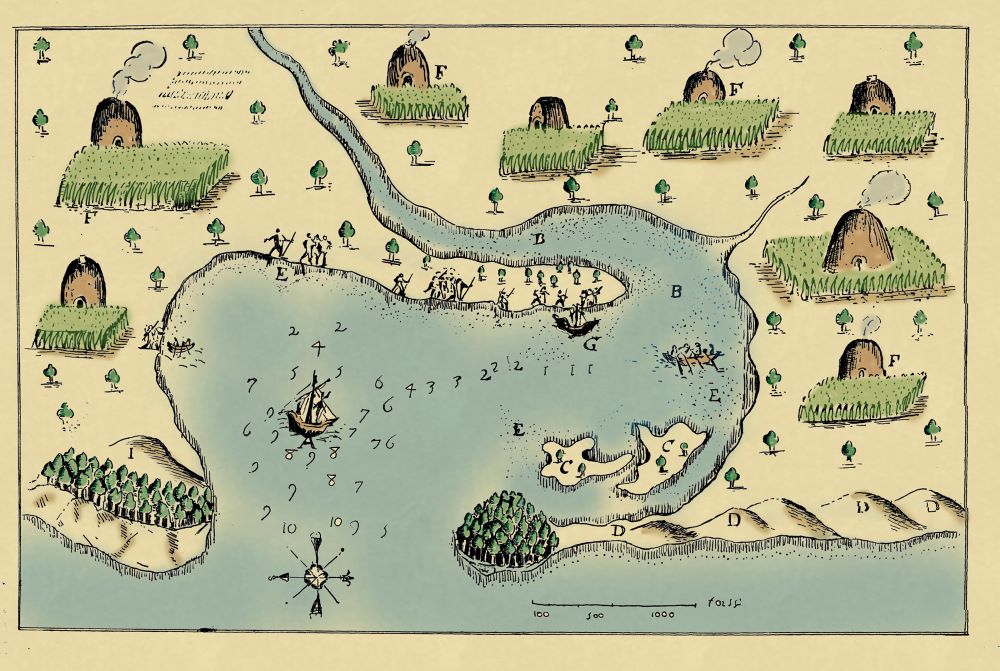
Map of Plymouth Harbor by Samuel de Champlain, 1605
A. [beneath ship in center of harbor] Anchorage with depths in fathoms [1 fathom = about 6 feet]
B. The Channel
C. Islands
D. Dunes [Duxbury Beach today]
E. Shoals.
F. Indian wigwams and cultivated fields
G. Where Champlain’s ship ran aground
H. [in trees, lower half, center] Wooded land
I. [in trees, lower half, left side] Promontory [Manomet Hill today]
Samuel de Champlain (1567-1635) was the son of a French ship captain. He first went to sea in 1599, when he visited the West Indies and Mexico. On his next expedition, he went north, exploring Canada and the St. Lawrence River. He then traveled south, sailing along the New England coast from Cape Anne to Cape Cod.
Champlain surveyed the Northeast coast for the French in 1605. His account of his explorations, including a map drawn during an unexpected stay in Plymouth Harbor, was published in Paris in 1613.
In 1605, Champlain’s ship ran aground in Plymouth Harbor, at that time named by the French as Port St. Louis. While waiting for the tide to come in, Champlain drew a map of the bay and shoreline, with depictions of the planting areas, houses, and Wampanoag inhabitants of the village of Patuxet and surrounding area. Fifteen years later Patuxet became the site of Plymouth Colony.
Champlain never returned to New England. He spent the rest of his life exploring Canada and establishing New France.
Champlain’s account of Plymouth Harbor, 1605:
“The next day we doubled Cap St. Louis, so named by Sieur de Monts, a land rather low, and in latitude 42 45’. The same day we sailed two leagues along a sandy coast, as we passed along which we saw a great many cabins and gardens. The wind being contrary, we entered a little bay to await a time favourable for proceeding. There came to us two or three canoes, which had just been fishing for cod and other fish, which are found there in large numbers. These they catch with hooks made of a piece of wood, to which they attach a bone in the shape of a spear, and fasten it very securely. The whole has a fang-shape, and the line attached to it is made out of the bark of a tree. They gave me one of their hooks, which I took as a curiosity. In it, the bone was fastened on by hemp, like that in France …
Some of them came to us and begged us to go to their river. We weighed anchor to do so, but were unable to do so on account of the small amount of water, it being low tide, and were accordingly obliged to anchor at the mouth. I went ashore … [and made] an examination of the river, but saw only an arm of water extending a short distance inland… Running into this is merely a brook not deep enough for boats except at full tide. The circuit of the bay is about a league. On one side of the entrance to this bay there is a point which is almost an island, covered with wood, principally pines, with sand-banks, which are very extensive all about. On the other side, the land is high. There are two islets in this bay, which are not seen until one has entered, and around which it is almost entirely dry at low tide. This place is very conspicuous from the sea, for the coast is very low, excepting the cape at the entrance to the bay.”
– Samuel de Champlain, The Voyages of Samuel de Champlain, 1613. Originally published as Les Voyages du Sieur de Champlain Xaintongeois, Capitaine ordinaire pour le Roy, en la marine. (Paris, Jean Berjon,1613)