
Needlework Samplers
Needlework Samplers: Wrought By Tradition
Pilgrim Hall Museum Special Exhibition
February 1 – April 25, 2014
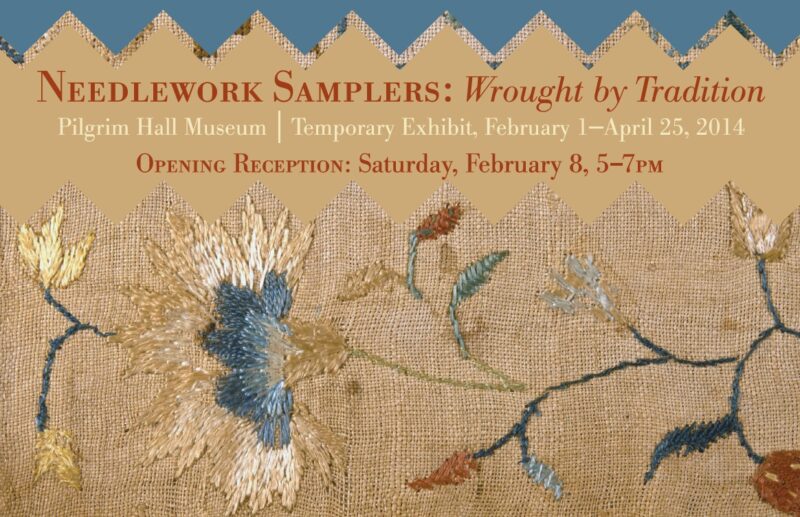
This online exhibition catalog was originally published in print form for the 2014 exhibition Needlework Samplers: Wrought By Tradition at Pilgrim Hall Museum, Plymouth, Massachusetts. The online catalog – edited for clarity and layout.
Original publication funded by a generous donation from Denise De More.
©2014 Pilgrim Hall Museum. All rights reserved, including the right to reproduce this book or portions thereof in any form.
Printed in the United States of America.
Published by Pilgrim Hall Museum.
ACKNOWLEDGEMENTS
This publication could not have happened without the help of many individuals. Stephen O’Neill directed the sampler research and curated the entire exhibit; Deb Partain spearheaded documenting the linen counts, sampler size, thread used and verses. Staff members and interns were invaluable resources for research, images and organization. Board members have given their full support to the project. Finally my deepest gratitude to everyone who worked to make this exhibit and catalog a success.
Denise De More
FLOWERS, TREES & FLORAL BORDER SAMPLERS
1. Mary Prentiss (b. 1811)
Sampler, 1822
Linen with silk thread
Dims: H 18 ¾” x W 19 ¾”
Hopkinton, MA
Loan courtesy of Henry T. Callan, Fine Antiques
This 19th century Hopkinton sampler was completed by Mary Prentiss in 1822 out of silk threads on a linen background. Encompassing the text on this particular sampler is a unique border, which is stylized after the shape of a gravestone. Imagery of baskets and grapevines also appear on this sampler as well as a sawtooth border.
Now whilst my needle does my hours engage,
With care I mark my name and age.
Let me reflect though few have been my years
Crowded with sins this narrow space appears.
Wrought by Mary Prentiss. AE 11 Yrs. 1822.
2. Ann Maria Weston (b. ca. 1813)
Sampler, 1822
Linen with silk thread
Dims: H 13” x W 13”
Acc. 2003.13, Loan courtesy of Plymouth Antiquarian Society, Plymouth, MA
In 1822, nine-year-old Ann Maria Weston composed this linen sampler using silk thread. The styles of stitches used were cross stitch, herringbone or plaited stitch, surface satin stitch, and four-sided stitch or four-sided open work stitch. This simple piece has six sets of alphabets, two sets of numerals, a variety of flowers, and states:
Ann Maria Weston / Aged 9 June 4, 1822
3. Lavinia Winship (1800-1878)
Sampler, 1810
Linen with silk thread
Dims: H 22 ½” x W 23”
Lexington, MA
Acc.1998.002.017, Loan courtesy of the Duxbury Rural & Historical Society
This sampler wrought by Lavinia Winship was completed when she was ten years old and contains three sets of alphabets, a set of numerals containing numbers one to twenty, and one partial alphabet. In addition, Lavinia’s sampler contains both a floral motif border, as well as a style of border known as “sawtooth.” Included in these borders is a verse that reads:
How grateful is the search with pride we trace/ Useful inventions that exalt our race/ Now to invent new arts or old to find/ Becomes the glory of the ingenuous mind/ To raise the virtues animate the bliss / And guide the youthful mind to happiness
4. Caroline Winslow (b. 22 Jul 1813)
Sampler, 1824
Linen with silk thread
Dims: H 14” x W 16 ¼”
Boston, MA
Loan courtesy of Henry T. Callan, Fine Antiques
This sampler belonged to Caroline Winslow and came out of Boston, Massachusetts. Stitching in 1824 when she was eleven years old, Caroline Winslow used silk threads on a linen background to make a floral motif border. In addition to the floral border, one can also see the sawtooth border that is featured on many Massachusetts samplers. The range of stitching styles used includes cross, outline, surface satin, stem, chain, straight, counted satin, sawtooth satin, and Algerian eye.
Wrought by Caroline Winslow in her 11th year
1824
5. Sarah Spooner (b. ca. 1772)
Sampler, 1782
Linen with silk thread
Dims: H 19 ¾” x W 12 ¾”
Plymouth, MA
Loan courtesy of Spooner Collection, Plymouth Antiquarian Society, Plymouth, MA
WSarah Spooner completed this sampler in 1782 at the age of nine years. She employed cross stitch, counted satin stitch, couching stitch, and queen stitch in her work. Surrounded by blue flowers, there are three sets of alphabets, one set of numbers and a verse with other flowers and strawberries scattered throughout.
Sarah was born in Plymouth, MA in 1772 to Ephraim and Elizabeth Shurtleff Spooner.
Sarah Spooner her Sampler
Aged 9 Years 1782
In Books or Works or healthful
play
Let my first Years be past
That I may give for every Day
Some good account at last
6. Sarah Sturtevant (possibly 1799-1833)
Sampler, 1813
Linen with silk thread
Dims: H 23” x W 20 ½”
Duxbury or Plymouth, MA
Acc. 2001.02, Loan courtesy of Plymouth Antiquarian Society, Plymouth, MA
Sarah Sturtevant’s sampler was stitched in 1813 and includes many different styles of imagery in the border. A common border that appears on samplers and is utilized in this particular example is what is known as a “sawtooth border.” In addition, Sarah also incorporates flowers and leaves into the imagery featured on her sampler. Encircled by the border are five sets of alphabets, a set of numerals, and text which reads,
T’is education forms the common mind;
Just as the twig is bent the tree’s inclin’d.
Wrought by Sarah Sturtevant Oct’r AD 1813
She used a variety of stitches on this piece including cross, counted satin, surface satin, saw tooth satin, split, French knots, outline, Algerian eye, four sided or open weave, and long armed cross stitch.
This piece was found in a Plymouth house that had belonged to the Spooner family, a member of which, Zilpha Harlow Spooner (b. 1818), was related to the Sturtevant family.
7. Grace Cobb (1781-1804)
Sampler, 1794
Linen with silk thread
Dims: H 11 5/8” x W 10 ¼”
Plymouth area
PHM 78, Gift of Grace Cobb Bonney, 1895
Grace was born in 1781 and was the third child of Cornelius Cobb (1747-1830) and his wife Grace Eames (1752-1811). Raised in Plymouth, Grace was a descendant of Henry Cobb, who arrived in Plymouth in 1632 and his second wife Sarah Hinckley. Sarah’s brother, Thomas, was the last governor of Plymouth Colony. Grace died in 1804 at the age of twenty-three, only ten years after the completion of her sampler.
Grace Cobb was thirteen years old in 1794 when she completed her sampler. It is almost square in shape and measures almost 10 ¼” wide and 11 ½” in height. Grace’s sampler is comprised of one- and two-ply silk threads on a tan-colored linen ground of 24 x 26 threads per inch. All four sides were turned under twice and hem stitched. It has cross stitches and herringbone or plaited stitches.
Grace utilized threads of many different colors, which include black, green, white, beige and madder pink. These threads would have been dyed naturally, with the pink coming from the roots of the madder plant. Although many of the colors except the pink have faded, they can be seen vibrantly on the reverse side of the sampler.
Grace’s sampler contains a banded design, and borders that are extremely similar to those found on 17th century samplers. However, her border and other designs are so stylized that it is often difficult to see the similarities. Grace’s sampler is comprised of three bands that are bordered by a scrolling vine of stylized strawberries. These bands are divided into sections containing an alphabet, numerals and a verse. Grace’s verse reads: “Fear God and keep his commandments.”
Like many samplers of the time, Grace signs her sampler and dates it to 1794, including a grouping of vowels alongside her signature.
After Grace’s death in 1804, her sampler was presumably given to her older brother Cornelius (1775-1853) and his descendants in the Pembroke and Hanson area northwest of Plymouth. Cornelius married Betsey Thomas (1778-1863) in 1801 and they had nine children together. The sampler passed on to their son, Theodore (1804-1889) and his wife Sarah Harlow Perkins (1815-1904). Theodore and Sarah married in 1840, later having four children of their own. Their daughter Grace C. Cobb (1842-1904) married Otis Lafayette Bonney (1838-1922) and eventually acquired the sampler herself. This last owner of the sampler was the only one of three children to live to adulthood, and was the namesake of an aunt, Grace Cobb (1806-1832) who died at twenty-six, close to the age of death of the sampler’s maker who also died young. In 1895, Grace C. (Cobb) Bonney donated the sampler to Pilgrim Hall Museum.
8. Betsy Whitmarsh (1785-1872)
Sampler, 1799
Linen with silk thread
Dims: H 8 ½” x W 14”
Roxbury, MA
Acc. 2003.9, Loan courtesy of Plymouth Antiquarian Society, Plymouth, MA
Linen Count: 28 x 24
Stitches: Cross stitch over 1×1 and 2×2 threads
Top side, left and right side were turned under twice and hem stitched and the bottom edge is a selvage edge.
Betsy Whitmarsh’s sampler was stitched on April 26th, 1799. Her sampler includes imagery of bands of strawberries as well as small animals and birds. She used cross stitch to compose this piece.
Betsy’s lengthy verse has several elements found in many samplers, including where she is from and the idea of remembrance once one has passed away.
Betsy Whitmarsh is my name new
England is my station Roxbury is my
Dwelling place and Christ is my
Salvation when I am dead and in my
Grave and all my bons are rotten
when this you se remember me
that I may not be forgotten the
Rose is red the grass is green
the day is past which I have seen
Betsy Whitmarsh
Aged 15
April 26, 1799.
9. Mary B. Hall (1834-1916)
Sampler, 1847
Linen with silk thread
Dims: H 14” x W 16 ½”
Taunton, MA
Acc. 1937.65, Loan courtesy of the Old Colony Historical Society, Taunton, MA
Stitches: Cross stitch over 1×1 and 2×2 threads; Algerian eye stitch over 4×4 threads; counted satin stitch; sawtooth satin stitch; queen stitch over 4×4 threads or the Rococo stitch.
Mary Bowers Hall’s sampler shows four different font styles of the alphabet in rows, in addition to the stitching of her name and a verse.
Mary B. Hall Aged 13 years 1847
Of all the lines on samplers found,
Remember this be sure,
Sin gives the conscience such a wound,
That none but Christ can cure.
The sides of the piece are bordered by vines and flowers, ending with flower baskets in each corner. The top and bottom borders are also embroidered flowers. Stitches seen in this needlework are cross stitch, Algerian eye stitch, counted satin stitch, sawtooth satin stitch, and either queen stitch or Rococo stitch.
Mary Hall married Thomas Washburn of Raynham in Taunton, 1866, and had one son.
10. Mary Spooner (b.1787)
Sampler, 1795
Linen with silk thread
Dims: H 14 1/4” x W 10 ¼”
Plymouth, MA
Loan courtesy of Spooner Collection, Plymouth Antiquarian Society, Plymouth, MA
Linen Count: 26 x 26
Stitches: Top edge, the left side edge and the right side edge were turned under and hem stitched. The bottom edge is a selvage edge. Cross stitched over 1×1 and 2×2 threads; surface satin stitch; herring bone stitch or plaited stitch; Algerian eye stitch; counted satin stitch.
Mary Spooner was born in Plymouth, MA in 1787 to parents Nathaniel Spooner and Mary Holmes. Unfortunately, it is unknown when she died. At the age of eight, Mary stitched this needlework using the techniques of cross stitch, surface satin stitch, herringbone or plaited stitch, Algerian eye stitch, and counted satin stitch. An array of flowers is scattered throughout, and her sampler also contains some birds, an alphabet and two verses:
The needle work / of one most kind / May you and I / Keep in mind
Mary Spooner her Sampler 8 1795
In Books in works or youthfull play / Let my first years be Past / That I may Give for every day/ Some good account at last
11. Rebeckah Sampson (1819-1839)
Sampler, 1832
Linen with silk thread
Dims: H 17 ½” x W 17 1/8”
Plymouth, MA
PHM 2010.2.1, Gift of Frances Burns, 2010
This sampler is by thirteen-year-old Rebeckah Sampson, who was born in Plymouth to Joseph Sampson and Hannah Burgess. She was the eldest of eight children, six of whom died between the ages of twelve and twenty.
The distinctive octagonal shape enclosing the lettering with flowers on the outside border is typical of the “Plymouth School” of sampler making. The bordering flowers and vines are exceptionally fine. There is also a saw-toothed, serrated edge around the border often found on Plymouth School samplers. These elements are found on the Hannah G. Holmes and Betsy Hutchinson samplers from Pilgrim Hall Museum’s collection, the Lucy Lanman sampler from the Plymouth Antiquarian Society’s collection, and the privately-owned Nancy Holmes sampler.
There is one-ply and crinkled silk thread sewn onto a linen ground of 24 x 22 threads per inch. It has cross stitch, counted satin stitch, four-sided or four-sided openwork, surface satin, sawtooth border satin, stem, and straight stitches.
There are four different alphabets and one verse sewn into this sampler. The text is from a scene in a play called The Search After Happiness, A Pastoral Drama, written by Hannah More, an English religious writer. Penned in 1762, this pastoral play was the first that Hannah wrote. She attempted this sort of writing because, being a teacher at the time, it was an appropriate form of performance for young ladies. The play became very popular by the end of the 18th century, selling thousands of copies.
I sigh not for beauty nor languish for wealth
But grant me kind Providence virtue and health
Then richer than kings and more happy than they
My days shall pass sweetly and swiftly away
The sampler is signed with the typical “Wrought by Rebeckah Sampson, July 4th, 1832 Aged 13 years.”
The sampler was donated to Pilgrim Hall Museum in 2010 after being passed down through the family in Kingston and Duxbury to the donor. It has never been publicly displayed before now.
12. Mary W. Spinney (1792-1812)
Sampler, ca. 1804 [photograph]
Linen, wool and silk
Portsmouth, NH
Photograph courtesy of Plymouth Antiquarian Society, Plymouth, MA
A photograph in the exhibit shows a long narrow band sampler in the collection of the Plymouth Antiquarian Society. It was made by Mary W. Spinney of Portsmouth, New Hampshire. She was born in 1792 and died in 1812 just days before her twentieth birthday. She was the oldest of nine children. Her brother Thomas (1795-1872) lived in Boston and was married to Abigail T. Savery (1796-1839) of Plymouth, who is buried with her son on Burial Hill in Plymouth.
The sampler’s maker, Mary Spinney, created her sampler on green linsey-woolsey, a mixture of linen and wool. It is a late example of the traditional band sampler’s long, narrow form. The design features letters and dividing lines with a variation on the popular New Hampshire bird and basket motif, although in a very stylized form. Two figures, male and female, are done in deep blue thread while the flower basket is done in pink, red, and yellow with two flanking birds of mixed color threads.
Mary W. Spinney’s very simple original gravestone is still standing in Portsmouth, New Hampshire’s North Burying Ground.
13. Nancy Whitman (1778-1843)
Sampler, 1791
Linen with silk thread
Dims: H 20” x W 17 ¾”
Bridgewater, MA
Private Collection
Linen Count: 28 x 32 threads, Silk Thread – 1 & 2 ply
Stitches: Cross stitch over 1×1 and 2×2 threads; surface satin stitch; counted satin stitch; split stitch; outline stitch; straight stitch; couching stitch.
Nancy Whitman, born May 20th, 1778, was the 8th of 11 children born to Peter Whitman, son of Thomas Whitman and Jemima Alden (6 girls and one son survived to adulthood). The first six children were born to Peter and his wife Susanna Keith (died 1773). Sarah Wright was Peter’s second wife and bore five children of which Nancy was the second born of this marriage. Nancy’s 3x great grandparents were John Whitman and Pricilla Alden. Nancy’s father served as a Lieutenant during the Revolutionary War and died December 3, 1801.
Nancy may have attended class taught by her cousin Bathsheba Whitman in the local parish school. Employed by the school for eight summer sessions, Bathsheba went on to be a widely sought after instructor, well known for the needlework skills that were part of her curriculum. Limited documentation suggests that Nancy’s sister Dolly may have also taught with Bathsheba. Census and directory information says Nancy may have worked as a tailoress. Unmarried all her life, Nancy lived to the age of 64 years and on June 27th of 1843 died of consumption and was buried at The Old Burying Grounds of East Bridgewater.
14. Lydia Barker (1809-1888)
Sampler, 1822
Linen with silk thread
Dims: H 8 ½” x W 21”
Nantucket, MA
Loan courtesy of Henry T. Callan, Fine Antiques
Linen Count: 26 x 32
Stitches: Cross stitch 1×1 and 2×2.
Lydia Barker’s 1822 cross stitch sampler is very simplistic in style. Created in Nantucket, this sampler’s shape is unique in comparison to the many others featured in the exhibit. Featuring clusters of flowers, this sampler has many stylistic attributes derived from a Quaker influence.
Lydia Barker aged 12 years Nantucket 1822
15. Elizabeth Packer Thomas (b.1770)
Sampler, 1783
Linen with silk thread
Dims: H 23” x W 15”
Marshfield, MA
Acc. 181, Loan courtesy of the Historic Isaac Winslow House & Cultural Center
Linen Count: 24 x 32
Stitches: Cross stitch over 1×1 and 2×2 threads; cross stitch with Bar over 2×2 threads; four sided stitch or four sided open work stitch; Algerian eye stitch; tent stitch over 1×1 stitch; surface satin stitch; counted satin stitch; sawtooth satin stitch; plait stitch; stem stitch.
Elizabeth Packer Thomas’ sampler is an example of a late 18th century sampler. She was the 7th child of Marshfield’s leading Tory Nathaniel Ray Thomas.
Stitched in 1783, the sampler includes many different examples of natural motif images. Throughout the sampler there are stitched flowers, as well as trees and acorn nuts. In addition, Elizabeth includes imagery of a crown, two birds and two other animals and two lions depicted with crowns located at the top of the sampler. In addition to the three sets of alphabets, Elizabeth Packer Thomas includes a short verse which reads: “Let this be your plan/ Learn all that you can.”
16. Caroline H. Kingsbury (b.1817)
Sampler, 1826
Linen with silk thread
Dims: H 20” x W 17”
Boston, MA
Acc. 1888.207, Loan courtesy of the Old Colony Historical Society, Taunton, MA
Stitches: Top and bottom were turned twice and hem stitched using a back stitch. The right side and left side were selvage edges; cross stitch over 1×1 and 2×2 threads; Algerian eye stitch over 4×4 threads.
Caroline Kingsbury’s sampler dates from the 19th century and is more squared in shape compared to the long and narrow samplers of earlier. Stitched with silk threads on linen fabric, Caroline’s sampler contains a border of both geometric shapes and stylized vines. Like other banded samplers, Caroline’s contains four different styles of alphabets, sewn in both cross and Algerian eye stitches. In addition, the band containing the verse and signature included depictions of two trees and a bouquet of flowers. What is unique about this sampler is that it includes the location where it was worked, Boston, and the exact day it was completed, July 13th, 1826.
The verse seen here comes from a poem written in the mid-18th century by English author Samuel Johnson. He wrote a variety of pieces, including essays, novels, and poetry. The first line of his original poem has been slightly altered in the needlework.
Seise mortal seise the transient hour / Improve each moment as it flies / Life’s a short summer man a flower / He dies Alas how soon he dies
Wrought by / Caroline H. Kingsbury / Aged nine years
Boston July 13.th 1826
17. Elizabeth Gooch (1727-1747)
Sampler, ca. 1738
Linen with silk thread
Dims: H 16 ¾” x W 13 5/8”
Boston, MA
PHM 1218b, Gift of Mrs. Jerome C. Smith, 1959
Elizabeth Gooch was the daughter of Elizabeth Valentine (1703-1762) and Col. Joseph Gooch (1700-1770). Her mother’s family, the Valentines, were a large and wealthy family that mostly lived on Long Island in New York. Her father, Joseph, was the son and grandson of prominent leaders from York, Maine. He graduated from Harvard in 1720 and trained as an attorney at the Inner Temple in London before starting an unsuccessful practice in Boston. Joseph’s sister, Elizabeth Gooch (namesake of the sampler maker) married first Capt. John Hubbard and then John Franklin (1690-1756), a soap chandler and Postmaster of Boston who was also the older brother of Founding Father Benjamin Franklin. Elizabeth (the sampler maker) was, therefore, the niece of John and Elizabeth Franklin who were, among other accomplishments, the first owners of the Robert Feke portrait painting of Benjamin Franklin painted in 1746. Her illustrious relative had left Boston, where Col. Joseph Gooch and Elizabeth Valentine Gooch were living when Elizabeth was born in 1727, for Philadelphia in 1723.
Elizabeth’s birth date is clearly revealed on the sampler which incorporates the text: “Elizabeth Gooch was born the 29 day of October 17 hundred & 27 on the day of the great earthquake Finished 1738.” The quake she mentions was centered on the Massachusetts North Shore around Cape Ann. The earthquake started at 10:00 p.m. at night and continued intermittently until dawn.
Elizabeth was around eleven years old when she completed her sampler in 1738. Her parents had moved to Braintree, south of Boston, by this time and moved to Milton sometime around 1740. Col. Joseph Gooch owned a large home in Milton, ran it as a tavern and was appointed colonel of a military regiment. Elizabeth Gooch died, unmarried, at the age of twenty in 1747. It is presumed that most of the family members were buried in the Gooch Family Tomb, No.3, in the Granary Burying Ground in Boston.
Elizabeth Gooch’s sampler shows many characteristics of having been created in Boston in its technique, its design, and its overall composition. It has a verse from a 1715 book called Divine Songs for Children by Rev. Isaac Watts. Watts wrote lyrics for the popular Christmas song “Joy to the World” but few of his lyrics were as cheerful. Elizabeth’s sampler verse reads “While monsters sporting on the flood in scaly silver shine Speak terribly their maker God & lash the foaming brine.” The motifs used on the sampler include hearts, diamonds, and crowns. Animal figures such as large ducks and small sheep are used. The motifs are more naturalistic than those seen in earlier samplers. The stitches are predominantly very fine cross stitch.
Two side border panels flank the rectangular center section with leaves and carnations rising out of very small pots above striking watery-blue zigzag bases. Without the border panels, the center section would resemble the narrow band samplers of the previous century. These flower-filled borders are similar in fashion to the floral borders found on gravestones with similar meaning for the viewer. Man “cometh forth like a flower, and is cut down,” states Job 14 in the Old Testament, reinforcing the visual imagery of flowers from vases and spiraling, trailing tendrils such as those found on the Ruth Carter gravestone of 1697/8 and Thaddeus Macarty gravestone of 1705 both in the Granary Burying Ground in Boston.
The sampler has one- and two-ply silk thread on a linen ground of 42 x 40 threads per inch. The top, bottom, and right-hand sides were turned under and basted, while the left side is a selvage edge. There are number of different stitches used on this sampler including cross stitch, counted and satin stitch, sawtooth border, long and short stitch, flame or Florentine stitch, lazy daisy stitch, stern stitch, French knots, outline stitch, closed herringbone stitch and seed or straight stitch.
The sampler was donated to Pilgrim Hall Museum in 1959 by Mrs. Jerome C. Smith and has a history of descent from the Morton family at the Morton homestead in East Freetown, Massachusetts, along with several other pieces in Pilgrim Hall Museum’s collection.
18. Rhoda Bowker Wheeler (b.1814)
Sampler, 1823
Linen with silk thread
Dims: H 19 x W 19 ½”
Boston, MA
Loan courtesy of Henry T. Callan, Antiques
Linen Count: 30 x 30
Stitches: Cross stitch over 1×1 and 2×2 threads; counted satin stitch; sawtooth satin stitch; seed stitch; tent stitch over 1×1
Another example of a 19th century Boston sampler is one that belongs to Rhoda Bowker Wheeler. Wheeler’s sampler was completed in 1823 and comprised of silk threads on a linen background. Like many other Massachusetts samplers, and seen quite often throughout this exhibit, Rhoda Bowker Wheeler’s sampler includes a sawtooth and floral border. Rhoda only used a few styles of stitching, including cross stitch, counted satin stitch, sawtooth satin stitch, seed stitch, and tent stitch, to complete this piece. She sewed in a lengthy verse, which reads:
Happy the child whose green unpractis years / The guiding hand of parent fondness rears / To rich instructions ample field removes / Prunes every fault and every worth improves / Till the young mind unfolds each secret charm / With genius bright with cherished virtue warm / Like the springs boast the lovely Plant shall rise / In grateful odors to the nurturing skies / 1823
Wrought by Rhoda Bowker Wheeler / Aged 9 years Boston May th 8
19. Catharine Adams (b.1804)
Sampler, 1816
Linen with silk thread
Dims: H 18 ½” x W 17 3/4”
Medway, MA
Acc. 1916.032, Loan courtesy of the Duxbury Rural & Historical Society
Linen Count: 30 x 30
Stitches: Hem stitched all four sides; cross stitch border 2 x 4; cross stitch 2×2.
Catherine Adams was twelve years of age when she completed this sampler in 1816, in Medway. Incorporated in Catherine’s sampler are three sets of alphabets and one partial alphabet, and an additional two sets of numerals for numbers one through ten. Catherine Adams includes geometric shapes, such as the two hearts and two diamonds stitched at the end of the numerals and last set of alphabet. In addition, Catherine includes depictions of four trees at the bottom of her sampler.
Like many samplers, Catherine’s includes a verse with religious undertones:
Let virtue be a guide to thee / Should natures charms to please the eye / In sweet assemblage join / All natures charms would droop and die / Jesus compared with thine
20. Emeline Gill (b.1812)
Sampler, 1823
Linen with silk thread
Dims: H 19 ½” x W 13 ½”
Canton, MA
Private Collection
Linen Count: 24 x 22
Stitches: Cross stitch over 1×1 and 2×2 stitches.
Emeline Gill was born on August 13, 1812 in Lincolnville, Maine; she was the 5th born of nine children to parents Elijah Gill and Rebekah Hawes. On March 2nd, 1859 at the age of 47, Emeline became the third wife of Isaac Gay (born September 10, 1786), a farmer in Stoughton, MA. Emeline and Isaac had no children but census data shows Emeline, Isaac and her mother Rebekah Hawes Gill all residing together in 1860. Isaac died in 1852 and by 1870 Emeline and her mother are raising or caring for her nephew Henry G. Sylvester, age 12, the son of her sister Elvira Gill Sylvester who died of typhoid fever in the late fall of 1859.
Emeline Gill Gay died of stomach cancer November 10th 1884 at the age of 72. She is buried at Maplewood Cemetery in Stoughton MA.
21. Lucinda Mann (b.1814)
Sampler, 1826
Linen with silk thread
Dims: H 18 ½” x W 18”
Randolph, MA
Loan courtesy of Henry T. Callen, Antiques
Linen Count: 32 x 30
Stitches: Cross stitch over 2×2 threads; outline stitch; arrowhead stitch; counted satin stitch; surface satin stitch; split stitch; chain stitch.
Lucinda Mann’s sampler is another mid 19th century sampler that was completed in 1826, and attributed to the town of Randolph. Similar to other samplers, this piece was stitched using silk threads on a linen cloth background and includes a border of floral motifs. Like many Plymouth and Southern Massachusetts samplers, this piece also includes the serrated sawtooth border, this time as an inner border for the piece.
Lucinda used cross, outline, arrowhead, counted satin, surface satin, split, and chain stitches to complete this sampler.
Wrought by Lucinda / Mann aged 11 years 1826 / Randolph August 4th
22. Sarah Watson (b.1768)
Sampler, 1777
Linen with silk thread
Dims: H 13 ½” x W 11 ½”
Leicester, MA
Acc. 1955.28, Loan courtesy of the Old Colony Historical Society, Taunton, MA
Linen Count: 32 x 30
Stitches: cross stitch over 2×2 threads; Algerian eye stitch over 4×4. The edges were turned under twice and were back stitched.
Sarah Watson employed the techniques of cross stitch and Algerian eye stitch in this simple needlework piece. Although this sampler has been worn by age, one can still see the rows of two separate alphabets, one row of numbers, and the depictions of a sheep, a rooster, two crowns, and flowers. Her verse simply states “Sarah Watsons samp/ler worked at Leicester / In the 9th year of my age 1777.”
23. Amee Harris (ca.1756-1794)
Sampler, 1767
Linen with silk thread
Dims: H 13 ¼” x W 10 1/6”
Taunton, MA
Acc. 1949.16, Loan courtesy of the Old Colony Historical Society, Taunton, MA
Linen Count: 28 x 28
Stitches: All four sides were turned and were hem stitched; cross stitch over 1×1 and 2×2; back stitch; Algerian eye stitch over 4×4.
Stitched on a linen background, using cross stitch, back stitch, and Algerian eye stitch, Harris utilized an assortment of colored threads; with the various blues holding color best. Bordered with a stylized scrolling vine, Harris’ sampler contains two alphabets comprised of capital letters.
Later in her life, Amee married Captain David Vickery and they had four children. Of those four, two of their daughters were Sally Culey Vickery and Eliza Vickery, whose samplers can also be seen in this exhibit.
The phrase Amee has stitched here was common among samplers at the time: “Amee Harris Her Sampler. Made in the thirteenth year of her age 1767” and “Love thou the Lord and he will be a tender Father unto thee.”
BAND SAMPLERS
24. Elizabeth Brewster (1690-1741)
Sampler, ca.1700-1710
Linen and wool thread
Dims: H 17” x W 7 ½ ”
Plymouth, MA
PHM 1040, Gift of Stephen H. Roberts, 1940
Linen Count: 32 x 30
Stitches: The edges were turned under twice and were back stitched. Stitches: cross stitch over 2×2 threads; Algerian eye stitch over 4×4.
The most likely maker of this sampler was Elizabeth Brewster of Kingston, Massachusetts (the north precinct of Plymouth until 1726), who was born in 1690 to Wrestling Brewster (1644 -1697) and his wife Mary Brewster (1661-1742). She was a great-granddaughter of the Mayflower Pilgrim William Brewster. She married Ephraim Bradford (1685-1746) of Kingston in 1710 when she was twenty years old. Together the couple had eleven children.
Mary Atwood, a well known needlewoman of a 17th century sampler, can be tied to Elizabeth Brewster. Ephraim Bradford, Elizabeth’s husband, was the son of William Bradford (1624-1704), the eldest son of Mayflower Pilgrim and Plymouth Governor William Bradford and his second wife Alice Carpenter. William’s wife was Mary Atwood Holmes (1665-1714/15), the maker of the other existing 17th century Plymouth Colony sampler.
Elizabeth Brewster Bradford died at the age of fifty-one and is buried in the Old Burying Ground in Kingston where her gravestone carved by Nathaniel Fuller still stands.
Stylistically, Brewster’s sampler can be dated to the early 1700s as a transitional piece. The long, narrow rectangular shape is reminiscent of 17th century samplers. This one, however, is sewn with wool thread, which was an uncommon occurrence among samplers, worked on the standard linen backing. The linen ground is 28 x 26 threads per inch.
All three sides were turned under twice and hem stitched and the bottom is s selvage edge. The wool thread has retained the richness of the original colors, blue, green, yellow, pink, and red, all of which are bright and relatively unfaded. Wool thread could be made and dyed at home using natural vegetable dyes, with colors like blue from the indigo plant and pink came from the madder plant.
The cross-stitch is predominant throughout the sampler, although there are a variety of other stitches including the Algerian eye, herringbone or plaited, satin and queen stiches. Some of the newer elements of styles found in the sampler include the shape of the letters and numerals. A very narrow border of red rosettes is located all around the sampler. The bands feature geometric patterns and motifs as well as a stylized floral design in the center. Like other samplers of the period, Elizabeth Brewster incorporated her own signature with the words “Elizabeth Brewster, her sampler.”
The sampler was given to the museum in 1940 by Stephen H. Roberts who had inherited it from his grandmother and both Brewster descendants, but the full provenance of the sampler is uncertain.
25. Hannah Jackson (ca.1755-1777)
Sampler, 1763
Linen with silk thread
Dims: H 14 ¼” x W 7 ¾”
Plymouth, MA
Loan courtesy of Plymouth Antiquarian Society, Plymouth, MA
Linen Count: 28 x 28
Stitches: The top edge and left and right side edges wer all turned under and hem stitched. The bottom edge is a selvaged edge. Cross stitch over 2×2 threads; surface satin stitch.
Hannah Jackson executed cross stitch and surface satin stitch to complete her 18th century piece. Mixed in with the bands of flowers are rows with two sets of alphabets, two sets of numbers, and a simple religious verse. Since the dates would match up, it is possible the eight-year-old who made this sampler in 1763 was a Hannah Jackson who was born in Plymouth in 1755 to parents Thomas Jackson and Sarah Taylor Jackson. This Hannah married John Goodwin in 1774, died in 1777 and was buried on Burial Hill here in Plymouth.
Sewn onto the sampler are the words “Hannah Jackson / Her sampler aged / 8 In anno Domini / 1763” and “Remember now / Thy creator In / The Days of Thy”
26. Elizabeth Hayward (ca.1729-ca.1801)
Sampler, 1740
Linen with silk thread
Dims: H 18” x W 12 ¼”
Possibly Bridgewater, MA
Loan courtesy of the Alden House Historic Site, Duxbury, MA
Linen Count: 42 x 41
Stitches: Hemstitched all four sides; cross stitch 1×1 and 2×2 threads; long arm cross 2 x 4 threads; Algerian eyelet 4×4 threats; satin or flat stitch; four-sided stitch.
Elizabeth Hayward’s sampler is a fine example of an early 18th century sampler embroidered with silk thread on linen cloth. It is a band sampler containing three sets of alphabets and a set of numerals. The bands are separated with borders of geometric and floral designs including images of stylized plants in vases, fruit, and birds. Elizabeth employed cross stitch, long arm cross stitch, Algerian eyelet, satin or flat stitch, and four sided stitch. There was an Elizabeth Hayward from Bridgewater, MA whose birth year matches the eleven-year-old creator of this sampler.
Fall out is deceitful and beauty i / s vain but a woman that feareth / the Lord she shall be praised
O Praise The Lord in Ye Names Praise
Him All Ye People For His Merc[iful Kind]
[nes] Is Great Towards Vs The Truth Of
T[he] Lord For Ever Praise The
Psalm The II7 Also The 12 verse
Elizabeth Hayward is my nam / e I was 11 years old when I wrou / ght the same in the year of our / Lord God 1740
27. Susanna White (possibly 1734-1801)
Sampler, ca.1744-1750
Linen with silk thread
Dims: H 24 ½” x W 12”
Marshfield, MA
Loan courtesy of the Historic Isaac Winslow House & Cultural Center
Linen Count: 24 x 26
Stitches: Cross stitch over 2×2 threads; counted satin stitch; sawtooth satin stitch; Algerian eye stitch or Algerian eye open work stitch; straight stitch; tent stitch; herringbone stitch or plait stitch.
Susanna White’s sampler is an example of an 18th century banded sampler, which contains two sets of alphabets. In addition, stitched throughout the sampler are geometric imagery, such as shapes and various patterns. The verse that is stitched onto White’s sampler may appear to be very grim by modern standards but was quite a common motif during this period.
Susanna White is / my name & English / is my nation / Marshfield is my / dwelling place & / Christ is my Salva / tion
When I am dead & / in my grave & / all my bones are / rotten when this / you see remember / me Let me not be / forgotten
This done in the ye / ar of our Lord
28. Mary Atwood (b. between 1637 and 1645 – 1714/15)
Sampler, ca. 1650-1660 [photograph]
Linen with silk thread
Dims: H 22” x W 5 ½”
Plymouth, MA
Photograph courtesy of a Private Collection
This is a photograph of the only other documented 17th century Plymouth Colony sampler known to exist. It passed down among the descendants of the maker in the Bradford and Jackson families and is now in a private collection.
The maker was Mary Atwood, the daughter of early Plymouth residents John Atwood and his wife Sarah Masterson. Mary Atwood first married Rev. John Holmes (d.1675) of Duxbury in 1661 and then remarried to become the third wife of Maj. William Bradford (1624-1703/4), son of Mayflower Pilgrim Gov. William Bradford and his second wife Alice Southworth. William and Mary’s son Ephraim Bradford (1685-1746) married Elizabeth Brewster (1690-1741) who was the maker of the sampler in Pilgrim Hall Museum’s collection.
Unlike the wool stitches and rough appearance on her daughter-in-law’s sampler, Mary Atwood’s sampler is an extraordinarily fine composition of silk thread bands on linen backing. The deep indigo blues and rich greens are still striking, among other colors used, on the interconnected and spiral vines, different flowers, and lettering.
Mary Atwood Bradford’s original gravestone is still standing in Kingston’s Old Burying Ground.
29. Loara Standish (ca.1640-d. before 1655)
Sampler, ca. 1653
Linen with silk thread
Dims: H 23” x W 7”
Plymouth or Duxbury, Massachusetts
PHM 108, Gift of Lucius Alden, 1844
Descended in the Standish and Alden families, Loara Standish, daughter of Captain Myles Standish, is thought to have made this sampler in her teens. It is the earliest known American-made sampler and the earliest known sampler with a verse.
Samplers of the 16th to mid-18th centuries served as permanent records of stitches and designs, intended for reference, unlike later samplers that were planned for display. American samplers followed the British form, as instruction in needlework passed from mother to daughter.
Typically, Loara Standish’s sampler is long and narrow (measuring approximately 7 1/4″ wide x 23 1/2″ tall) with patterns arranged in horizontal bands. Stitches, worked in counted thread embroidery on very fine 50-count linen, include Montenegrin cross, long-armed cross, back, outline, eyelet, double running and arrow-head. The rose, carnation, oak leaf and an intertwined “S” are among the stylized floral motifs above the verse:
Loara Standish is my name / Lorde guide my hart that / I may doe thy will also / My hands with such / Convenient skill as may / Conduce to virtue void of / Shame and I will give / The glory to thy name
30. EC, (fl. Mid-17th century)
Sampler, 1664
Linen with silk thread
Dims: H 28 ¾” x W 6 ½”
England
Museum Purchase, 1995, Loan courtesy of Plimoth Plantation
Linen Count: approx. 50
Stitches: Montenegrin cross stitch; double running stitch running stitch and seed stitch.
Unfortunately, not much is known about the young girl who stitched this sampler. All that we know is that the sampler was stitched in 1664 by a young girl with the initials “E.C.”, which is information that the sampler itself gives us.
E.C. used blue, green, and pink in this piece and used a variety of different types of stitches. No verse was stitched into this sampler, but E.C. does give us her initials, the date, and an odd version of the alphabet. She starts with letters S – Z and then, below that, she gives us the remaining A – R. The bottom half is made up of a couple colorful flower patterns, while the top half is made up of whitework.
31. Theodora Oxenbridge (1659-1697)
Sampler, ca. 1670 [photograph]
Linen with silk thread
Dims: H 28” x W 8 ½”
England or New England
Given in memory of Theodora Oxenbridge Hallett Adams
Photograph courtesy of Plimoth Plantation, Plymouth, MA
This is a photograph of one of the very few samplers with a 17th century New England connection. It is in the collection of Plimoth Plantation. It is typical of English band samplers of the 17th century like the Loara Standish from Pilgrim Hall Museum’s collection and shows the close connections in the trans-Atlantic culture of New England’s colonists during the 17th century.
HISTORY & GENEALOGY SAMPLERS
32. Hager Family
Sampler, 1890-1910
Linen with silk thread
Dims: H 15 5/8” x W 18 5/8”
Massachusetts
Acc.1993.26, Loan courtesy of the Old Colony Historical Society, Taunton, MA
Linen Count: 24 x 26
Stitches: Cross stitch over 1×1 and 2×2 threads.
Along with three sets of alphabets and a set of numbers, this sampler shows the genealogy of the Hager family. Completed in cross stitch, it is not known who from the Hager family embroidered this piece, although there is an initial of “W” near the alphabets and numbers. The range of dates listed span from the earliest born in 1781 to the last death in 1902. The large amount of open space on the piece indicates that it is likely incomplete as more family members could have been added, including the author’s own birth date.
33. Caroline Young (b. 1808)
Sampler, 1820
Linen with silk thread
Dims: H 21” x W 21”
Roxbury, MA
Loan courtesy of Henry T. Callan, Antiques
Linen Count: 28 x 30
Stitches: Cross stitch over 1×1 and 2×2 threads; surface satin stitch; French knots; straight stitch; outline stitch; chain stitch; long and short satin stitch; lazy daisy stitch.
This 19th century Roxbury sampler is attributed to Caroline Young. Young completed her sampler in 1820 and stitched it using silk thread on linen fabric. Squared in shape, this sampler is another unique example of a genealogical register.
34. Louisa Pierce (1826-1896)
Sampler, 1840
Linen with silk thread
Dims: H 23” x W 19”
Brighton, MA
Loan courtesy of Henry T. Callan, Antiques
Linen Count: 28 x 30
Stitches: Cross stitch over 1×1 and 2×2 threads; surface satin stitch; counted satin stitch; sawtooth satin stitch; outline stitch; couching stitch; straight stitch.
This 19th century Brighton sampler was made by Louisa Pierce. Stitched from silk threads on a linen background, the piece was completed in 1840. A unique attribute of this particular sampler is the fact that it includes genealogical information of her family. Many samplers of this time period were banded samplers that contained alphabets and verses as opposed to family records. Surrounding the entire piece is a floral motif border.
Louisa Pierce married Cephas Brackett, died in 1896, and was buried in Brighton’s Evergreen Cemetery.
35. Sarah Thayer (1819 –1872)
Sampler, 1829
Linen with silk thread
Dims: H 17” x W 10 ½”
Randolph, MA
Loan courtesy of the Alden House Historic Site, Duxbury, MA
Linen Count: 24 x 24
Stitches: Hemstitched all four sides; cross stitch 1×1 and 2×2 threads; sawtooth satin stitch; flat stitch 4×4.
This 19th century sampler is stitched in silk thread on linen cloth. The banded design has vividly colored threads of green and blue and features stylized flowers.
Sarah Thayer included her birth date along with her “signature” which also includes the date of the sampler’s completion. The birth date of several Thayer family members is included as well, including her mother, Rachel Alden Thayer, who also has a sampler on display in this exhibit.
36. Saba Cushman (1816-1881)
Sampler, 1832
Linen with silk thread
Dims: H 24” x W 17”
Plymouth, MA
PHM 802, Gift of Miss Viola H. Cornell, 1917
Linen Count: 26 x 28
Stitches: Hem stitched border all four sides; cross stitch over 1×1 and 2×2; counted satin stitch; surface satin stitch; sawtooth satin stitch; seed stitch; straight stitch; outline stitch; stem stitch; four-sided stitch or four-sided open work stitch.
Saba Adams Cushman’s sampler is an example of a Plymouth sampler that shows genealogical pride. It refers directly back to the 200th anniversary celebrations of the landing of the Pilgrims held in 1820 when she was four years old when. The sampler’s verse reads:
From native shores by tempest driven
They sought a purer sky
And found beneath a wilder heaven
the home of liberty
Through toil and travail sore
Their native land forgo
And sought a home and freedom here
Two hundred years ago
Saba was the daughter of Levi Cushman (1785-1817), a physician of Needham, Massachusetts, and Elizabeth Gray of North Carolina. She was named for her grandmother Saba Adams (1762-1848) who married Zachariah Cushman (1753-1826). Saba’s father Levi died in Williamstown, North Carolina, in 1817 at age 32. Her father had 2 sisters, Sally, who married Thomas Sturtevant of Middleborough, and Nancy, who married Josiah Robbins of Plymouth, and a brother named Zachariah. Saba herself married William Ritchie (1813-1877), a clerk in the railroad office of Springfield, Massachusetts.
Saba and William Ritchie had three daughters, Sophia (1841-1886) who married Marcus Perrin Knowlton, Chief Justice of the Massachusetts Supreme Judicial Court; Isabella (1837-1905) who married Charles R. Stickney (1834-1922); and their youngest daughter Martha (1848-1866) who died at age eighteen. Isabella and Charles Stickney’s son was William R. Stickney (1868-1916) whose sudden and tragic death was noticed in the May 9, 1916 New York Times:
“William R. Stickney of Springfield, Mass., died suddenly from heart disease yesterday at the Cleveland Memorial Home in Caldwell, N.J., on the eve of his marriage to Miss Viola Cornell, daughter of Peter Cornell caretaker of the home. He had been staying at the home for a few days while preparations were being made for the wedding. Mr. Stickney had not been well for some time and was in the Springfield Hospital before going to visit Caldwell.”
The Miss Viola Cornell that William Stickney was visiting donated the sampler to Pilgrim Hall Museum the following year. Presumably, William Stickney had inherited his grandmother’s sampler and given it to his fiancé as a gift. William Stickney is buried near the graves of his parents, Isabella and Charles Stickney, and his grandparents, William Ritchie and Saba Adams Cushman Ritchie, the sampler’s maker, in the Springfield Cemetery.
Saba Adams Cushman was a descendant of Fortune passenger Robert Cushman, and Mayflower passengers Myles Standish and William Bradford. The sampler lists her genealogy in three columns, divided by narrow geometric bands. In the lower corners are small urns with stylized flowers and leaves. The sampler is worked on a linen ground of 26 x 28 threads per inch and measures approximately 17″ wide x 24″ high. Stitches used on the sampler include cross, counted satin, surface satin, sawtooth satin, seed, straight outline, stem, and four-sided or four-sided openwork stitches. It is in poor condition, having been exposed at some time to moisture which caused the black dyed thread to run.
Saba Adams Cushman’s sampler was completed in 1832. It combines genealogical pride and references the 200th anniversary celebration of the Mayflower’s landing held in Plymouth in 1820:
From Native Shores by tempest driven / They sought a purer sky And found beneath a wilder heaven / The home of liberty Through toil and travel sore / Their native land forgo And sought a home and freedom here / Two hundred years ago
In addition to the verse, Saba Cushman’s sampler includes her own family ancestry. Three columns separated by geometric bands list a different family lineage back to Mayflower passengers Myles Standish and William Bradford and Fortune passenger Robert Cushman. The writing is stitched in black threads, with color being added through the incorporation of flowers and small urns as well as the surrounding geometric border.
37. Lura Oakes Cushman (1895-1988)
Sampler, 1935
Linen with silk thread
Dims: H 22 ½” x W 23”
Duxbury, MA
Acc. 2004.041.112, Loan courtesy of the Duxbury Rural & Historical Society
Lura Oakes Cushman’s sampler is a 20th century sampler that commemorates the history of Plymouth, Massachusetts. The unique aspect of this sampler is that it does not contain any sets of alphabets like many of the others. Instead, Lura Oakes Cushman’s sampler contains beautifully stitched scenes pertaining to the Pilgrims.
At the top of the sampler, are depictions of the Mayflower leaving England and the Pilgrims coming to America, followed by a second band of images depicting both Pilgrims and Native Americans with weapons as well as Plimoth Plantation. Lura Oakes Cushman includes Pilgrim imagery, such as a Pilgrim couple, a hearth with cooking tools, and Priscilla Alden with a spinning wheel. Interspersed throughout the many Pilgrim images is the verse that reads:
The breaking waves dashed high / on a stern and rock-bound coast / Plymouth England Sept. 5 Plymouth American Dec. 21 / A band of Exiles moored their bark / on the wild New England shore / They sought a faith s pure shrine / Ay, call it holy ground, 1935 / The spot where first they Trod! / They have left unstained what / there they found: / Freedom to worship God.
Lura Oakes Cushman
38. Allena E. Ward (1866-1947)
Sampler 1938-39
Linen with silk thread
Dims: H 25 ½” x W 19 ½”
Carver, MA
Private Collection
Linen Count: 24 x 26
Stitches: Cross stitch over 1×1 and 2×2 threads; Algerian eye stitch.
Unlike most of the samplers in this exhibit, this piece was not created by a young girl, but rather an elderly woman. Allena Ward was born in 1866 and would have been 72 and 73 years old when she stitched this sampler in 1938-9. The needlework contains four different styles of alphabet, with the fourth and largest font created from multiple bright colors, and one set of numbers. The border is made from two rows of flowers and a sawtooth design. There are two trees encompassing Allena’s verse near the bottom of the sampler.
When I was old And past my prime In ways like this I spent my time.
Wrought by Allena E. Ward of Carver, Mass. 1866——— 1938-9
The younger age of this piece, as well as probably less exposure to light, has left the thread colors brighter than the 17th, 18th, and 19th century pieces surrounding it.
39. Elizabeth Perkins (b.1835) and Allena E. Ward(1866-1947)
Sampler, 1835 and 1932
Linen with silk thread
Dims: H 8 ¾” x W 18 ½”
Carver, MA
Private Collection
Linen Count: 24 x 28
Stitches: Cross stitch 1×1 and 2×2 threads.
This sampler is unique because it not only had one author but instead had two, a mother and later her daughter. Elizabeth Perkins was born in Carver, MA in 1827, making her about eight years old when she completed her portion of the sampler. Her daughter, Allena E. Ward, who has another sampler that can be viewed in this exhibit, was born in 1867, making her sixty-five when finishing this sampler. Allena appeared to enjoy stitching as she got older as opposed to only completing needlework when young.
Based on the faded three sets of the alphabet and one line of numerals, it is likely that Elizabeth had completed this portion of the piece and Allena added the verse. In addition to the alphabet, there is a figure of a girl holding a basket.
This needlework of ours doth tell We in our youth were learned well And by our elders also taught Not to spend our time for naught.
Sampler wrought by Elizabeth Perkins of Carver, Mass. About A.D. 1835, and finished by her daughter Allena E. Ward, also
SAMPLERS WITH BUILDINGS, FIGURES & SCENES
40. Sally Deane (1771-1805)
Sampler, ca. 1780
Linen with silk thread
Dims: H 10” x W 8 1/8”
Mansfield, MA
Acc. 1953.36, Loan courtesy of the Old Colony Historical Society, Taunton, MA
Linen Count: 38 x 44
Stitches: Cross stitch 1 x 1 and 2 x 2; outline stitch; split stitch; straight stitch
This is one of two small samplers made by Sarah “Sally” Deane of Mansfield, MA, in this exhibit. The words are stitched in black thread but yellow and green are used for a flower in a vase, an hourglass, two houses, hearts, squares and a small border. Sally used the techniques of cross stitch, outline stitch, split stitch, and straight stitch.
The words read:
Sally Deane is my name,/ English is my nation; /Mansfield is my dwell’g place/ And Christ is my salvation./ Ours days run thotleƒsly along,/ Without a moments stay;/ Just like a story or a song./ We paƒs our lives away.// As runs the glaƒs, Our lives doth paƒs.// Let this be to remember me,/ That I be not forgotten,/ When I am dead and buried,/ And all my bones are rotten.// Love and live happy
Sally Deane died at the age of thirty-four.
41. Charlotte Winsor (1795-1867)
Mourning piece, 1810
Linen with silk thread
Dims: H 14 ½” x W 18”
Middleborough or Duxbury, MA
PHM 1021, Gift of Emma A. Tufts, 1917
This needlework piece is one of the finest examples of early nineteenth century sewing from Southeastern Massachusetts both for its preservation and its excellence of skill. It represents an entire period (1790-1850) when mourning scenes were considered cherished decorations in the family home.
Charlotte Delano Winsor was fifteen years old when she made this needlework mourning piece. It depicts a stylized mourning scene with a veiled woman holding flowers and weeping as she stands near a neo-classical grave monument. The names on the monument are for her two maternal uncles and her sister. Captains Joshua and William Delano were the older brothers of Charlotte’s mother, Charlotte Delano. Capts. Joshua and William were mariners from Duxbury, Massachusetts, who died in the trade service of the town’s Weston family. Deborah Winsor was Charlotte’s older sister who died young, three years before Charlotte was even born. This needlework piece was made ten years after the death of Captain Joshua Delano and nineteen years after the death of Deborah.
The mourning scene is silk needlework on a silk cloth background which is painted with watercolors. The scene contains all the traditional elements of a mourning scene: the neo-classical monument capped with an urn, a tree on one side, a figure in mourning posture, and a small building in the far background. The building is possibly an image of Duxbury’s Third Meetinghouse which existed on Tremont Street in that town from 1785 until the present structure was built in 1840. The woman’s figure is notable for wearing an empire style dress in a light color with a black veil, indicating that she is in remembrance of the dead, but not in active mourning.
Charlotte Winsor married Capt. Solomon Corey (1791-1865) in 1812, just two years after she made this sampler, at the age of seventeen. Charlotte and Solomon buried two of their children, Charlotte and George, in the Old Burying Ground in Kingston, Massachusetts in 1825. They had another daughter in 1826, who they named Charlotte Winsor Corey (1826-1894), and she married Nathan Tufts (1823-1911) in 1848. This Charlotte inherited the mourning sampler and gave it to her daughter, Emma Augusta Tufts (b. 1853) who gave the mourning scene to Pilgrim Hall Museum in 1917.
42. Sarah Holmes Lanman (b. 1817)
Sampler, 1830
Linen with silk thread, paint
Dims: H 20” x W 19”
Plymouth, MA
Private Collection
Stitches: Top and bottom edges were hem stitched. Stitches: cross stitch 1×1 and 2×2 threads; surface satin stitch; stem stitch; Algerian eye stitch; four-sided stitch or four-sided open weave stitch; buttonhole wheels stitch; fly stitch; straight stitch; chain stitch; split stitch; arrowhead stitch.
This Plymouth School sampler is unique in combining the typical octagonal border, flowers, and landscape with mourning imagery. A neo-classical memorial bears the name of the maker’s older brother who died at the age of six. This sampler is still in private ownership and has never been exhibited in Plymouth.
May I improve my youthful days. In learning business useful ways / Careful industrious to my power. And rightly spend each day and hour.
Wrought by Sarah h Lanman Aged 12 Plymouth March 1830
In Memory of Ellis T. Lanman Who died March 20th 1818 Aged Six Years
43. Hannah G. Holmes (1822-1881?)
Sampler, 1832
Linen with silk thread
Dims: H 20 1/3” x W 21 ½”
Plymouth, MA
PHM 2010.1, Gift of Arthur Beane, 2010
This extraordinarily fine sampler is the work of ten-year-old Hannah G. Holmes (1822-1881?). She was the daughter of Ellis Holmes Jr., who died in 1854 and his wife Catharine Gibbs of Sandwich, Massachusetts. A younger brother, Alvan E. Holmes died in October of 1825 one month before his third birthday and his gravestone is on Burial Hill. Hannah Holmes graduated from Bridgewater State Normal School (State College) in 1842. She was listed in the school’s History and Alumni Record published in 1876 as having taught in Plymouth schools for twenty-eight years.
Like other Plymouth samplers, this one demonstrates the “Plymouth School,” style by having the text surrounded by an octagonal design, a flower border and prominent roses in the four corners.
The sampler is one-ply, two-ply, and crinkled silk thread sewn onto a linen ground of 28 x 30 threads per inch. Hannah employed different stitching techniques on her letters and numbers including cross stitch, four-sided or four-sided openwork, outline, surface satin, chain, counted satin, stem, straight, seed, French knots, fly, and rice stitches.
The bucolic scene at the bottom shows a house with a smaller barn or addition, a man possibly holding a gun for hunting or a fishing rod and several small boats on the water in the distance. The verse she used was very popular in both the 18th and 19th centuries and was sometimes stitched with two additional lines: “With thy dear children let her have a part, And write thy name thyself, upon her heart.”
Jesus permit thy gracious name to stand As the first efforte of
An infant’s hand And while her fingers oer this canvas move
Engage her tender heart to seek thy love
Following the verse, the sampler is signed “Wrought by Hannah G, Holmes aged 10 years AD. 1832.”
The sampler was a bequest to the Museum by antiques collector Arthur Beane in 2010 but its provenance is unknown.
44. Lucy A. Lanman (b. ca. 1834)
Sampler, 1845
Linen with silk
Dims: H 16 ¼” x W 17”
Plymouth, MA
Acc. 1920.85, Loan courtesy of Plymouth Antiquarian Society, Plymouth, MA
Linen Count: 24 x 24
Stitches: All edges were turned over and hem stitched; Cross stitch over 1×1 and 2×2 threads; surface satin stitch; outline stitch; straight stitch; lazy-daisy stitch; four-sided stitch or four-sided open work stitch; tent stitch over 1×1 threads; stem stitch; seed stitch.
Lucy A. Lanman stitched this Plymouth style sampler in 1845, at age eleven. With four flowers in each corner, the octagonal shape encompasses four sets of alphabets, one set of lengthy numbers, “Wrought by Lucy A Lanman Aged 11,” and a one-line verse: “Let truth innocence and love Adorn your youth.”
The pictorial scene shows a hidden house and a variety of trees. The horizontal details made using yarn were most likely added by another person. Many different stitching styles were used here, such as cross, surface satin, outline, straight, lazy-daisy, four-sided or four-sided open work, tent, stem, and seed stitch.
There was a Lucy Ann Lanman born in 1834 in Plymouth, MA to Nathaniel Cobb Lanman and Nancy E Bagnall, and it’s possible she was the creator of this piece. This Lucy married an Eleazer Thomas, but the marriage date is unknown.
45. Betsy Ellis Hutchinson (1822-1854)
Sampler, 1831
Silk, linen
Dims: H 17 1/8” x W 16 ¾”
Plymouth, MA
PHM 1019, anonymous source, ca. 1917
Linen Count: 28 x 28
Stitches: Hem stitched on right and left sides; cross stitch over 1×1 and 2×2; counted satin stitch; surface satin stitch; outline stitch; fly stitch; sawtooth satin stitch; four-sided stitch or four-sided open work stitch; stem stitch; straight stitch
Betsey Ellis Hutchinson was a descendant of William Brewster of the Mayflower. Her mother Elizabeth Ellis Brewster (1799-1891) married a Scottish seaman, Robert Hutchinson (1790-1868) as his second wife. Betsey, their daughter, was born in 1822 and raised in Plymouth as the eldest of four children. Her younger brother Joshua B. Hutchinson was born in 1824 and died in 1843 at age nineteen.
Betsey eventually married Thomas Rider, a carpenter and the couple lived on Sandwich Street, where they had two daughters. The eldest child was Albertina, born in 1846 and died in 1851 of a “nervous fever” at age five, and their second daughter was Sarah, born in 1847 and died in 1873 at the age of twenty-six. Thomas Rider was the first cousin of Rebekah Rider whose sampler is also owned by Pilgrim Hall Museum. During this period, Plymouth was a very small town, with its population never exceeding 5,000 until 1840.
Betsey Ellis Hutchinson Rider was buried in Hutchinson family plot on Burial Hill with her parents and two daughters. It is not known when Thomas Rider died or where he was buried.
The unique octagonal center panel shape featured on Betsey’s sampler is reminiscent of the styles of the Turner School. This Plymouth School is connected with Marie deVerdier Turner, the wife of Captain Lothrop Turner of Plymouth. Arriving in Plymouth in 1815, Maria joined Lothrop’s two sisters, Deborah and Sarah, who were conducting classes for girls, adding genteel arts such as embroidery and painting to the curriculum. Samplers from this particular school are known to have distinguishing features, like the octagonal panel, in addition to borders containing full blossom roses and houses set in elaborate landscapes. Betsey’s sampler contains the attributes associated with this Turner School, and measures approximately 16 3/4″ wide x 17 1/8″ high, worked in silk threads, of blacks, greens, and pinks, on a linen ground of 28 x 28 threads per inch.
The sampler contains three alphabets which are separated by bands and a meander band of 5-petalled flowers. The center panel is an octagonal shape and bordered by roses and rosebud sprays. The sampler contains a square framed house set against greenery. The window details on the house are clumsily sewn in contrast to the rest of the sampler’s fine stitches. Betsey Hutchinson used paint for the sky, and to highlight the tops of the embroidered trees and grasses.
Like other samplers of the time, Betsey’s contains a stitched signature and verse. The verse stitched in black reads “Jesus permit thy gracious name to stand as the first effort of an infants hand. And while her finger oer canvas move engage her heart to seek thy love”. The sampler is signed “Wrought by Betsey Ellis Hutchinson Aged 9 years 1831.”
The provenance for this sampler is unknown as the record of its gift to Pilgrim Hall Museum sometime around 1917 was not recorded.
46. Nancy Holmes Bartlett (1807-1894)
Sampler, 1823
Linen with silk thread
Dims: H 20” x W 20”
Plymouth, MA Private Collection
Linen Count: 26 x 28
Stitches: Cross stitch over 1×1 and 2×2 threads; surface satin stitch; counted satin stitch; outline stitch; straight stitch; stem stitch; French knots; Algerian eye stitch; arrowhead stitch; four sided or four sided open work stitch; sawtooth satin stitch.
In 1823 Nancy Holmes Bartlett, then 15-year-old Nancy Holmes, meticulously stitched this detailed sampler with the image of Mount Vernon. The scene is enclosed with an octagonal shape and flower border, making it a “Plymouth School” style of sampler.
Above the pictorial scene, Nancy depicted her stitching skill with several forms of the alphabet, a few numerals, and a verse originally written by the British poet Alexander Pope in 1734. The two lines are from Pope’s work “An Epistle to the Right Honourable Richard Lord Visc. Cobham,” which was often compiled with three of his other poems and labeled together as Moral Essays.
Cross, surface satin, counted satin, outline, straight, stem, French knots, Algerian eye, arrowhead, four sided or four sided open work, and sawtooth satin stitches were all used in this piece.
Tis education forms the common mind / Just as the twig is bent the trees inclined” “Wrought by Nancy Holmes / Aged 15 years 1823
47. Deborah Winslow (b.1743)
Sampler, 1757
Linen with silk thread
Dims: H 19” x W 18”
Marshfield, MA
Acc.166, Loan courtesy of the Historic Isaac Winslow House & Cultural Center
Linen Count: 28 x 30
Stitches: Cross stitch over 2×2 threads; surface satin stitch; counted satin stitch; outline stitch; French knots; stem stitch; a piece of lace for the collar of the woman’s dress.
At fourteen years old, Deborah Winslow stitched this example of an 18th century sampler in 1757. Containing a single alphabet, Deborah Winslow’s sampler includes many images of floral motifs. These include the image of a large tree, two cloves, and a flower.
What makes this sampler unique compared to other banded samplers at the time is the imagery of people. While samplers did have figures stitched onto them, such as the girl walking with a fan, this sampler includes imagery of a young African American girl following the girl with a fan. In samplers it is quite rare to find depictions of African American individuals.
48. Mary E. Brown (b. 1816)
Sampler, 1826
Linen with silk thread
Dims: H 18” x W 20”
Possibly Ipswich, MA
Loan courtesy of Henry T. Callan, Antiques
Linen Count: 24 x 26
Stitches: Cross stitch over 1×1 and 2×2 threads; queen stitch; outline stitch; lazy daisy stich; surface satin stitch; French knots; tent stitch over 1×1 thread; long arm cross stitch; closed buttonhole stitch.
Mary E. Brown’s sampler is a mid-19th century piece that could possibly be from Ipswich, Massachusetts. Stitched with silk thread onto a linen background, this particular piece has a floral motif border comprised of pink and green thread. Also depicted on this sampler is a house with a garden.
Mary used the stitching techniques of cross stitch, queen stitch, outline stitch, lazy daisy stitch, surface satin stitch, French knots, tent stitch, long arm cross stitch, and closed buttonhole stitch. Her verse reads: “Wrought by Mary E Brown. Aged 10 years. 1826.”
49. Eveline Borden (possibly 1816-1853)
Sampler, 1829
Linen with silk thread
Dims: H 18” x W 17”
Rhode Island
Acc.1959.25kk, Loan courtesy of Plymouth Antiquarian Society, Plymouth, MA
Linen Count: 24 x 24
Stitches: All four sides were turned under twice and were hem stitched. Stitches: cross stitch 1×1 and 2×2 threads; stem stitch; surface satin stitch; outline stitch; rice stitch; long-armed cross stitch; straight stitch; tent stitch over 1×1 thread; lazy daisy stitch; back stitch.
Eveline Borden’s sampler is an example of an early 19th century piece. Wrought in 1829, this particular sampler includes four sets of alphabets as well as a single numeral set. A geometric pattern comprises of three borders of the piece, while imagery of four girls in gowns, a lone tree and house, depicted on grass are also found.
Eveline used cross stitch, stem stitch, outline stitch, rice stitch, long-armed cross stitch, straight stitch, tent stitch, lazy-daisy stitch, and back stitch on this piece.
50. Eliza Standish (b.1795)
Sampler, 1805
Linen with silk
Dims: H 16” x W 14 ¾”
Dighton, MA
Loan courtesy of Plimoth Plantation
Linen Count: 28 x 24
Stitches: Hemstitched border three sides, top, left bottom; right side is selvage edge; queen stitch; cross stitch 2×2 threads; satin stitch 4×4 threads, stem stitch; short & long sating stitch; French knots; seed stitch; straight stitch; blanket stitch.
Eliza Standish completed this sampler on October 4, 1805 in Dighton, Massachusetts when she was 10 years old. Eliza used many different colors when stitching this sampler, including green, yellow, pink, tan, and dark brown. Flowers appear throughout the sampler along with four different bands of the alphabet, including cursive capitals, capitals, lower case, and numbers.
At the bottom of the sampler, there is an image of a house with a chimney and a fenced-in garden. Surrounding the house are some trees, a bush, a couple birds, a cat and a deer. Eliza also included the following verse: “Virtue guided by thy say nourishes by the power refind / Still may I hold the onward way, and / sweet peace of mind”
51. Eliza Vickery (ca. 1784-1846)
Sampler, 1796
Linen with silk thread
Dims: H 22” x W 22”
Providence, Rhode Island
Acc. 1949.21, Loan courtesy of the Old Colony Historical Society, Taunton, MA
Linen Count: 24 x 28
Stitches: Cross stitch over 1×1 and 2×2 threads; surface satin stitch; counted satin stitch; French knots; outline stitch; queen stitch or rococo stitch; tent stitch; chain stitch; stem stitch.
Eliza Vickery’s sampler is quite different from 18th century banded samplers. Dating from 1796, this sampler contains many different and elaborate images. The focal point of the sampler is divided into three bands. The top containing imagery of a house and animals, the second depicting a house surrounded by a fence and trees, and the third depicting a man and a woman. These bands are encircled by a geometric border, and another border with images of people, trees and flowers. The silk threads used to embroider this piece still have much of their color.
The verse stitched here has been commonly attributed to Mr. Pope, and has also appeared as epitaphs on gravestones. Common stitches found on this piece are: cross, surface satin, counted satin, French knots, outline, queen, rococo, tent, chain, and stem.
Virtue out shines the stars, outlives the tomb, climb up to Heaven and finds a peac-ful home.
Let virtue be a guide to thee Eliza.
Eliza Vickery Work 1796
52. Betty Macomber
Sampler, 1784
Linen with silk thread
Dims: H 17” x W 14 ½”
Possibly Newport or Warren, Rhode Island
Acc.1955.63, Loan courtesy of the Old Colony Historical Society, Taunton, MA
Linen Count: 40 x 36
Stitches: Cross stitch over 1×1 and 2×2 threads; tent stitch over 1×1 thread; stem stitch; surface satin over 1×1 thread; plait stitch over 2×2 threads or Spanish stitch; split stitch; outline stitch; buttonhole wheels stitch or buttonhole stitch; straight stitch; chain stitch.
Little is known about the maker of this sampler. The scene in the middle is labeled “Saint Pauls Church this Cathedral was first built by S Egburt, a saxon king A.D. 610” and shows four figures, two holding umbrellas, and the church. The simplified building shows St. Paul’s Cathedral in London originally begun as a wooden church in the 600s under King Aethelberht (ca.520-616) of Kent. King Egbert of Wessex, the grandfather of King Alfred the Great lived from ca.769-771 to 839. If Betty Macomber’s history was not exact, her quote from John Milton’s Paradise Lost is just as incorrect; “Eve thus Adam freely ate, he scrupled not to eat against his better knowledge, not deceived, but fondly overcome with female charm——but past who can recall or don undo?——Not God omnipotent, nor Fate! Milton.”
Betty embroidered her piece using a variety of stitches, including cross stitch, tent stitch, stem stitch, surface satin stitch, plait stitch, Spanish stitch, split stitch, outline stitch, buttonhole stitch, straight stitch, and chain stitch.
ALPHABET SAMPLERS (NUMBERS, WORDS & LETTERS)
53. Eliza Winslow (b.1791)
Sampler, 1801
Linen with silk thread
Dims: H 19” x W 14”
Freetown, MA
Acc. # 157, Loan courtesy of the Historic Isaac Winslow House & Cultural Center
Linen Count: 28 x 30
Stitches: Cross stitch 1×1 and 2×2 threads; French knots; tent stitch vertical satin stitch; short & long satin stitch; cross stitch reversible four sided stitch, seed stitch; stem stitch; outline stitch; flat stitch.
Eliza Winslow’s sampler was completed on October 6th, in 1801 when she was eleven years old.
On this particular sampler, Eliza Winslow stitched four sets of alphabets as well as three flowers and a floral motif border. Similar to other signed verses, Eliza’s speaks of the importance of needlework for women, as well as including her date of birth.
Eliza Winslow’s sampler made in the 11th year of her age, Born March 30th 1791. Of female arts in usefulness The needle far exceeds the rent. Freetown October 6th AD 1801
54. Rachel Alden (1792-1838)
Sampler, 1801
Linen with silk thread
Dims: H 13” x W 12 ¼”
Randolph, MA
Loan courtesy of the Alden House Historic Site, Duxbury, MA
Linen Count: 26 x 26
Stitches: Hemstitched border all four sides; cross stitch 2×2 threads; sawtooth satin or flat stitch; Algerian eye stitch 4×4 threads.
Rachel Alden completed this sampler on October 24th, 1801 when she was 9 years old. Though Rachel’s sampler is a banded sampler, it does not have the long and narrow shape that most banded samplers tend to have. Instead, this sampler has more of a square shape. The border of this sampler consists of different geometric shapes stitched in black. Rachel’s sampler has four different sets of alphabets. Three of the alphabets contain all of the letters but the fourth one remains unfinished. Though Rachel did not include a verse in her sampler, she did provide her name, age, date and the words “my property” though the letter Y seems to be missing from the word. She employed a hemstitched border on all sides, along with sawtooth satin or flat stitch, cross stitch, and Algerian eyelet throughout the piece.
Rachel Alden aged 9 Oct. 24 / My property 1801 . B. W. C.
55. Hannah Guild (b.1820)
Sampler, 1831
Linen with silk thread
Dims: H 18” x W 20 ½”
Sandwich, MA
Loan courtesy of Henry T. Callan, Antiques
Linen Count: 26 x 34
Stitches: All edges were turned under and hem stitched. Cross stitch over 1×1 and 2×2 threads; Algerian eye stitch or Algerian eye open work stitch; lazy daisy stitch; surface satin stitch; straight stitch.
Another sampler exhibiting Quaker influence is this Sandwich, Massachusetts sampler that belonged to ten year old Hannah Guild. She used silk threads and a linen background to create this particular piece which she completed in 1831. Cross stitch, Algerian eye or Algerian eye open work stitch, lazy daisy stitch, surface satin stitch, and straight stitch, were all used by Hannah on this piece. An interesting attribute about this sampler is that the letters include double-lines.
Father, beneath whose watchful care / The blessings of each day I share, / Help me the worth of life to know, / That better daily I may grow/ With willing heart, and active hands, / Lord, may I practice thy commands, / Improve the moments as they fly, / And live as I would wish to die” “Wrought by Hannah B Guild Sandwich aged 10 / year Sept 7th AD 1831
56. Lucy Taylor Cooper Brush (1843-1927)
Sampler Linen with silk thread
Dims: H 11” x W 13”
Plymouth, MA
Private Collection
Linen Count: 28 x 28
Stitches: All sides were turned under and hem stitched; Stitches: cross stitch over 1×1 and 2×2 threads; queen stitch or rococo stitch; long-armed cross stitch; arrowhead stitch; tent stitch; sawtooth satin stitch; surface satin stitch, counted satin stitch Sampler Linen with silk thread.
In this smaller piece, 11-year-old Lucy practiced several different stitching techniques, including cross stitch, queen or rococo stitch, long-armed cross stitch, arrowhead stitch, tent stitch, sawtooth satin stitch, surface satin stitch, and counted satin stitch. She bordered her alphabets with what appears to be flower buds or strawberries inside of blue diamonds.
Wrought by Lucy Tayler / Cooper Aged 11 AD 1817
57. Jane Russell Sever (1802-1876)
Sampler, 1810
Linen and wool with silk thread
Dims: H 11 ½” x W 8 ¾”
Kingston, MA
Acc.1916.093, Loan courtesy of the Duxbury Rural & Historical Society
Linen Count: 25 x 25
Stitches: Cross stitch 1 x 1 and 2 x 2; Algerian eyelet stitch.
Jane Russell Sever’s sampler is a 19th century sampler from Kingston, MA, completed on the ninth of July in 1810. Stitched in silk threads on linen background, Sever’s sampler was completed when Jane was only eight years of age, and includes green fabrics.
Like many banded samplers of the time, Jane Russell Sever’s includes the alphabet, numerals and a verse. In this particular sampler, there are three sets of alphabets and one set of numerals, which include the numbers one to eight, while three floral designs are situated at the top of the sampler. The verse included in Jane’s sampler is small, but speaks to the religious undertones of many of the sampler verses: “Fear God and keep his commandments.“
58. Welthea Alden (1797-1806)
Sampler, 1805
Linen with silk thread
Dims: H 18” x W 10 ½”
Duxbury, MA
Loan courtesy of the Alden House Historic Site, Duxbury, MA
Linen Count: 23 x 21
Stitches: Hemstitched right and left sides; selvage edge at top and bottom; cross stitch 2×2 threads.
Welthea Alden was the daughter of Maj. Judah Alden and Welthea Wadsworth. She made this sampler in 1805 just one year before she died at age nine. Her sampler is a banded sampler and does take on the normal banded sampler long and narrow shape. The sampler contains three versions of the alphabet, which were stitched with silk thread on linen. Though the colors of the threads she used have faded over the years, some color does still remain. There is still some blue in the borders and there is still some black, the color in which her name and the date were stitched.
Welthea Alden / Sampler Author’d / 1805
59. Rebekah Rider (1812-1890)
Sampler, 1820
Linen with silk thread
Dims: H 15 ¼” x W 11 ¾”
Plymouth area
PHM 670, Gift of Annie R. Loveland, 1903
Linen Count: 28 x 28
Stitches: Cross stitch 1x 1 and 2×2, Algerian eye stitch 4 x 4, herringbone or plaited stitch 2×4, tent 1×1, sawtooth satin stitch, satin stitch, split stitch, surface satin stitch, diagonal satin stitch. All four sides hemstitched.
Rebekah Rider was born in 1812 to Daniel Rider (1784-1860), a descendant of Mayflower passenger Richard Warren, and his wife Lydia Clark (1787-1861).
The educational alternatives for Plymouth’s young women had increased by 1820 when Rebekah embroidered this sampler. Plymouth opened its first public school for girls in 1795, which ran during the summer when the boys were not using the classroom. There were also a few private schools for girls in Plymouth. As was the case in private schools throughout America and Europe, great stress was placed on behavior and on the genteel arts such as needlework, although some academic subjects were taught.
Not much is known about Rebekah’s education. She may have attended a Plymouth school, or she may have been home schooled like many generations before her. A younger sister of Rebekah’s, Francelia, was born in 1825 but died in 1831 at six years of age and was buried on Burial Hill. Rebekah Rider never married and died in 1890 leaving money in her will for the creation of a charity to house old people. She was buried alongside her parents in Oak Grove/Vine Hills Cemetery.
Rebekah Rider’s sampler is a banded sampler in an rectangular shape, measuring approximately 12″ wide and 15 1/2″ high. It is comprised of one-ply and crinkled silk threads embroidered onto a linen ground of 28 x 28 threads per inch, like many of the other samplers of that time. All four sides were turned under twice and hem stitched. Rebekah’s sampler contains three alphabets, the first being worked in a stitch known as the Algerian eye stitch. Both the second and third alphabets are both comprised of the cross-stitch. Surrounding the perimeter of the sampler is a border that is worked in a cross-stitch, depicting stylized flowers. Stitches used on this sampler include the cross stitch, Algerian eye, herringbone or plaited, tent, sawtooth satin, satin, split, surface satin, diagonal satin stitches. Much of the color of this sampler has faded over time.
The sampler is signed with the line “Performed by Rebekah Rider Aged 8 years 1820,” replacing the usual phrase “wrought by” with “performed by.”
Rebekah’s sampler was donated in 1903 to Pilgrim Hall Museum by Mrs. Annie R. Loveland, a resident of Plymouth born in 1877, but the connection between the two is unknown, as is the provenance of the sampler in the decade after Rebekah’s death.
60. Anonymous
Unfinished sampler, 19th century
Linen with silk thread
Dims: H 12 ¾” x W 9 3/8”
Massachusetts
Acc.1934.15, Loan courtesy of Plymouth Antiquarian Society, Plymouth, MA
Linen Count: 24 x 22
Stitches: Top, left side and right side were turned under twice and hem stitched and the bottom edge was a selvage edge. Stitches: cross stitch over 2×2 threads.
This particular unfinished sampler contains three sets of alphabets and a single numeral set made in cross stitch. It does not include a date or any information about the young girl who started it.
61. Lydia Teel (1805-1873)
Sampler, 1816
Linen with silk thread
Dims: H 12 ¾” x W 14 ½”
Charlestown, MA
Loan courtesy of Henry T. Callan, Antiques
Linen Count: 28 x 30
Stitches: All edges were turned under and hem stitched; cross stitch over 1×1 and 2×2 threads; buttonhole wheels stitch; surface satin stitch; lazy daisy stitch; tent stitch over 1×1 thread; Algerian eye stitch or Algerian eye openwork stitch; outline stitch; Gobelin stitch or oblique Gobelin stitch; stem stitch; buttonhole stitch; back stitch; herringbone stitch or plaited stitch; arrowhead stitch.
Lydia Teel’s sampler is an example of a 19th century sampler from Charlestown, Massachusetts. Completed in 1816, this sampler was stitched from silk thread onto a linen background and includes imagery of flowers and baskets. Lydia used cross stitch, buttonhole wheels stitch, surface satin stitch, lazy daisy stitch, tent stitch, Algerian eye or Algerian eye open work stitch, outline stitch, Gobelin or oblique Gobelin stitch, stem stitch, buttonhole stitch, back stitch, herring-bone or plaited stitch, and arrowhead stitch throughout her piece.
How blest the maid whose circling years improve / Whose God’s the object of her warmest love / Whose useful hours successive as they glide / The book the needle and the pen divide.
Wrought by Lydia Teel / Charlestown / 1816
62. Salumith Wadsworth (1742-1815)
Sampler, 1763
Linen with silk thread
Dims: H 13 ¾” x W 8 ½”
Duxbury, MA
Acc. 1993.009, Loan courtesy of the Duxbury Rural & Historical Society
Linen Count: 28 x 30
Stitches: All edges were turned under and hem stitched; cross stitch over 1×1 and 2×2 threads; buttonhole wheels stitch; surface satin stitch; lazy daisy stitch; tent stitch over 1×1 thread; Algerian eye stitch or Algerian eye openwork stitch; outline stitch; Gobelin stitch or oblique Gobelin stitch; stem stitch; buttonhole stitch; back stitch; herringbone stitch or plaited stitch; arrowhead stitch.
Salumith Wadsworth’s sampler is an 18th century sampler with an interesting trait of including Roman numerals. The two examples of Roman numerals found on Salumith’s sampler are done in blue thread and appear on both the top and bottom of the sampler. The first set of numerals that appear read “ MDCCLXIII” while the second set appears as the age of Salumith Wadsworth, “XXI”. Small in size, Salumith’s sampler contains a single alphabet, and verse. Both the alphabet and verse are extremely faded in color, when compared to the blue of the numerals. Salumith’s verse speaks of the “Ladys Golden Rule”:
The Ladys Golden Rule Immodest words admit of No defence for want of Decency is want of sense Salumith Wadswo Aged XXI
63. Sarah B. MacIntosh
Sampler, 1834
Linen with silk thread
Dims: H 15 ½” x W 17 ½”
Duxbury, MA
Acc. 1916.031, Loan courtesy of the Duxbury Rural & Historical Society
Linen Count: 28 x 30
Stitches: All edges were turned under and hem stitched; cross stitch over 2×2 threads.
Sarah B. MacIntosh’s sampler was completed in 1834, when she was seven years old. Stylized like many banded samplers of the 19th century, Sarah utilizes geometric patterns on the sides and bottom of the sampler, while dividing each band with different patterns. MacIntosh’s sampler contains three sets of alphabets, in addition to a single set of numerals containing the numbers one through eighteen. Culminating in a signed verse that reads:
Theres not an object on this earth Too humble or too vast for him Who each insect form to birth And clothed with light the cherubim Sarah B. Mackintosh, Aged 7 years 1834
64. Zilpah Drew (1779-1866)
Sampler, ca. 1790s
Linen with silk thread
Dims: H 13” x W 11 ¾”
Duxbury, MA
Acc. 2007.034.009, Loan courtesy of the Duxbury Rural & Historical Society
Linen Count: 28 x 30
Stitches: All edges were turned under and hem stitched; cross stitch over 2×2 threads.
Zilpah Drew Smith was born July 7, 1779, and died August 23, 1866. She was the daughter of Sylvanus and Mercy Clark Drew of Duxbury and married Jonathan Smith, a ship captain, on December 6, 1812. Zilpah and Jonathan raised six children together, all of whom were born between 1814 and 1824. When her husband died in 1843, his 1841 Will stated that Zilpah was given use of the homestead for life. She was also given the authority to sell the homestead if she desired. It is believed that she made this sampler c. 1790s and she also made a friendship quilt in 1846, which is also part of the collection at Duxbury Rural & Historical Society.
65. Betsey Hall (1799-1890)
Sampler, ca. 1810
Linen with silk thread
Dims: H 9 ½” x W 7 ¾”
Taunton, MA
Acc. 1907.96, Loan courtesy of the Old Colony Historical Society, Taunton, MA
Linen Count: 24x 26
Stitches: Cross stitch over 1×1 and 2×2 threads.
Betsey Hall’s sampler, completed in cross stitch, contains three different alphabets, two comprising of capital letters and the third in lower case letters. Also included in the sampler are two groups of numerals, one including numerals one through ten, and the second including one through six.
Betsey Hall her sampler
66. Mary C. Thomas (1802-1871)
Sampler, 1814
Linen with silk thread
Dims: H 8 ¼” x W 12”
Marshfield, MA
Loan courtesy of the Historic Isaac Winslow House & Cultural Center
Linen Count: 28 x 32
Stitches: Hemstitched all four sides; cross stitch 2×2.
Mary C. Thomas was born in 1802 and completed her sampler at the age of twelve, dating the sampler to around 1814. Mary’s sampler contains three sets of alphabets and one set of numerals all of which are surrounded by a simple border. This simple line border not only encircles the entire sampler, but is also used as a divider between the bands.
67. Maria W. Bradford (1804-1864)
Sampler, 1812
Linen with silk thread
Dims: H 10 ¼” x W 12”
Duxbury, MA Acc. 1916.092
Loan courtesy of the Duxbury Rural & Historical Society
Linen Count: 25 x 24
Stitches: Hem stitched, cross stitch 2 x 2 and 2 x 3; Chevron stitch; vertical Queen stitch.
Another example of a 19th century sampler, Maria W. Bradford’s was completed when she was only seven years old, since many girls would start to practice embroidery when they were only five or six. Maria’s sampler includes a simple lined border that encircles the two sets of alphabets and the single set of numerals. While this particular sampler does not include a verse, it does include a signature, a common feature of many samplers. Maria signed her sampler “Wrought by Marie W. Bradford/ aged seven years/ August 7th 1812”. Whitman
68. Clarissa Winslow (1810-1852)
Sampler, 1821
Linen with silk thread
Dim: H 16 ½” x W 9 ¾”
Marshfield, MA
Loan courtesy of the Historic Isaac Winslow House & Cultural Center
Linen Count: 30 x 27
Stitches: Cross stitch 2 x 2 threads.
Clarissa Winslow’s sampler was wrought in 1821 when she was only eleven years old. Like many banded samplers, Clarissa’s contains four sets of alphabets as well as a set of numerals. In addition, after the last alphabet, Clarissa stitched an extra “MD”. Winslow’s sampler includes a signature that reads “Clarissa Winslow/ Aged 11 years AD 1821”. Clarissa Winslow’s death was recorded in the records of St. Andrew’s Church in Hanover at the age of fifty-one.
69. Sally Vickery (1780-1794)
Sampler, 1787
Linen with silk thread
Dims: H 15” x W 11 ¼”
Taunton, MA
Acc.1949.15, Loan courtesy of the Old Colony Historical Society, Taunton, MA
Linen Count: 20 x 22
Stitches: Cross stitch over 1×1 and 2×2 threads.
Daughter of Amee Harris and sister to Eliza Vickery, whose samplers are also in this exhibit, Sally’s verse is a cross stitch example of an inscription where the creator would simply embroider their signature with a small poem claiming ownership to the piece.
Sally Vickery’s sampler. Made in / Taunton May the 26 AD 1787 / And in the eighth year of her age / Sally Culey Vickery is my name / And with my needle I work’d / The same, And if my knowledge / Had been better I would have / Mended every letter. S.C.V
70. Temperance Drew (1810-1831)
Sampler, 1816
Linen with silk thread
Dims: H 12” x W 12 ¼” Duxbury, MA
Acc. 1964.22, Loan courtesy of the Duxbury Rural & Historical Society
Linen Count: 36 x 29
Stitches: Hem stitched all four sides; cross stitch 2 x 2.
One of the youngest embroiderers in this exhibit, Temperance Drew of Duxbury stitched this piece at the age of six years in 1816. She was born in 1810 to parents Reuben Drew and Temperance Brooks. Her sampler is a simple example of learning one’s letters, as she cross stitched three styles of alphabets, two styles of numbers, and the small verse “Let innocence crown every day / and drive each gloomy thought away / Temperance Drew.” Her signature reads “Temperance Drew… aged / 6 years.. Duxborough / October.. 27.. 1816.”
71. Sally Deane (1771-1805)
Sampler, ca. 1780-1790
Linen with silk thread
Dims: H 11 ¾” x W 7 ¾”
Mansfield, MA
Acc.1953.35, Loan courtesy of the Old Colony Historical Society, Taunton, MA
Linen Count: 30 x 24
Stitches: The top right and left sides were turned and double basted The bottom edge is a selvage edge. Cross stitch over 2×2 threads.
This is one of two small samplers made by Sarah “Sally” Deane of Mansfield, MA, in this exhibit. Unlike the more poetical and visually interesting sampler, this one is simpler, having two alphabets, one incomplete alphabet, a row of numbers, and “Sally Deane born June 10, 1771,” embroidered onto the linen using cross stitch. This is probably the older of her two samplers.
Sally Deane married Ephraim Pond (1766-1842) of Wrentham, MA in 1801. They had two children, Samuel Dean Pond (b.1802) and Eunice Shepard Pond (b.1804). Sally Deane died at the age of thirty-four. The sampler was the gift of Dr. Lillian K.P. Farrar in 1953.
72. Mary Winsor (ca. 1789- 1882)
Sampler, 1800
Linen with silk thread
Dims: H 9 ½” x W 9 ½”
Duxbury, MA
Acc. 1998.002.015, Loan courtesy of the Duxbury Rural & Historical Society
Linen Count: 31 x 28
Stitches: Hem stitched all four sides, cross 2 threads over 2 threads; Algerian eyelet stitch 4 threads over 4 threads.
Mary Winsor’s sampler is a 19th century sampler completed in a square shaped and comprised of a linen background with silk threads. Completed in 1800 when Mary was 11 years old, her sampler includes three sets of alphabets and two sets of numerals. In addition, Mary Winsor’s sampler includes one set of vowels and is signed “Mary Winsor aged 11 years”.