
Plymouth Rock & Pilgrim Myths
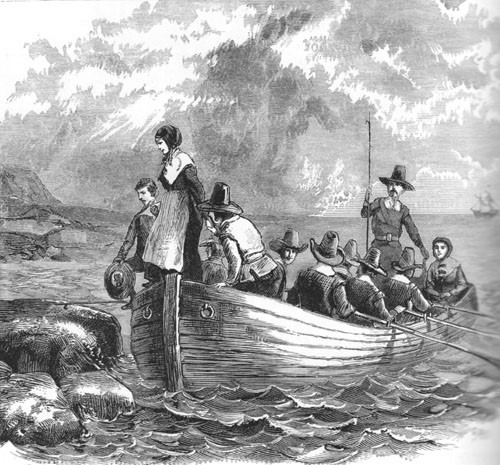
“Here is a stone which the feet of a few outcasts pressed for an instant, and the stone becomes famous; it is treasured by a great nation.”
– Alexis DeTocqueville, 1835
“The chronicle of the Mayflower Pilgrims has inspired millions of people from around the world to visit Plymouth, Massachusetts, the first English settlement in New England. For hundreds of years, latter-day pilgrims have come to gaze upon Plymouth Rock where ‘it all began’ in December, 1620.”
– James W. Baker, “I’ve Been There”: Souvenirs of Pilgrim Plymouth, An Exhibition at Pilgrim Hall Museum, 2013
For generations of Americans, a few famous moments in Plymouth Colony’s beginnings have become fixed in popular imagination– most notably the landing of the Mayflower Pilgrims in 1620 and the 1621 event known as the “First Thanksgiving.”
Although Plymouth was not the first American colony, the story of the Mayflower Pilgrims became a source of inspiration for many with its focus on ordinary families, religious faith, and perseverance in the face of hardship.
By the mid-19th century, the Pilgrim settlers at Plymouth and their famous arrival at Plymouth Rock were part of America’s national mythology. As the Pilgrims gained national recognition, their symbolic significance was shaped and reshaped to reflect changing generational values. Much of what we “know” about the Pilgrims is myth and memory.
The Rock, never mentioned in 17th-century sources, became a focal point of the Pilgrim Story. As a symbol of America’s beginnings and a host of attributed values, the Rock overshadows actual historical events. The Pilgrims did indeed land – first at Cape Cod (where they knelt down and kissed the ground for their safe arrival) and then at Plymouth to establish their settlement – though the choreography of those first steps ashore is not recorded.
What is the real story of Plymouth Rock and the Pilgrim settlers of early Plymouth? There are layers of both historical content and Pilgrim mythology to explore.