“I’ve Been There”
“I’ve Been There”: Souvenirs of Pilgrim Plymouth
Exhibition guest curated by James W. Baker
February 1-December 30, 2013
Sponsored by Northeast Community Bank
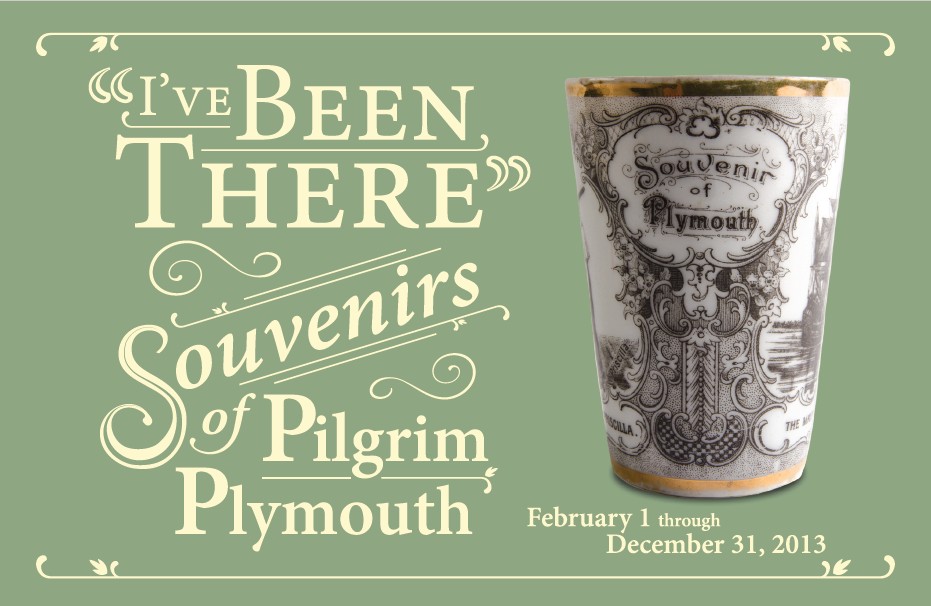
The chronicle of the Mayflower Pilgrims has inspired millions of people from around the world to visit Plymouth, Massachusetts, the first English settlement in New England. Latter-day pilgrims still come to gaze upon Plymouth Rock where “it all began” in December, 1620. Other attractions – natural, culinary, historical and recreational – have further enhanced the experience, so that almost every visitor has felt a compelling desire for some tangible commemoration of time in the Old Colony town.
It may be a simple memento – like a shell picked up on Plymouth Beach, or a flower from the local woods pressed in a book– but more likely, it is an object expressly created to meet this need, a souvenir that in some way symbolizes the emotive essence of the Pilgrim story that brought them here.
Souvenirs are generally dismissed as examples of commercial excess, or sentimental indulgence, or just kitsch, but everyone has keepsakes that embody the memories that evoke personal memories. A great variety of Plymouth souvenirs have been eagerly acquired over the years as personal treasures or gifts for others. Ranging from a “piece of the rock” itself to simple objects stamped with “Plymouth, Mass,” these tokens of remembrance have served generations as evidence and reminders that they indeed followed in Pilgrim footsteps.
In the Beginning
The Pilgrim story, with its inspirational focus on faith, family, and perseverance through hardship, grew from regional to national importance in the Early Republic, 1787-1820. Other colonial settlements were older than Plymouth, but their stories lacked the symbolic resonance of the humble Pilgrim experience. Plymouth Rock became Americans’ icon for the beginning of a new society separate from its English origins.
For Americans who made their own pilgrimages to Pilgrim Plymouth in the early 19th century, a piece of “The Rock” became the ultimate souvenir:
“This rock is become an object of veneration in the United States. I have seen bits of it carefully preserved in several towns of the Union. Does not this sufficiently show that all human power and greatness is in the soul of man? Here is a stone which the feet of a few outcasts pressed for an instant, and this stone becomes famous; it is treasured by a great nation, it’s very dust is shared as a relic; and what is become of the gateways of a thousand palaces?”
– Alexis de Tocqueville, Democracy in America, 1835
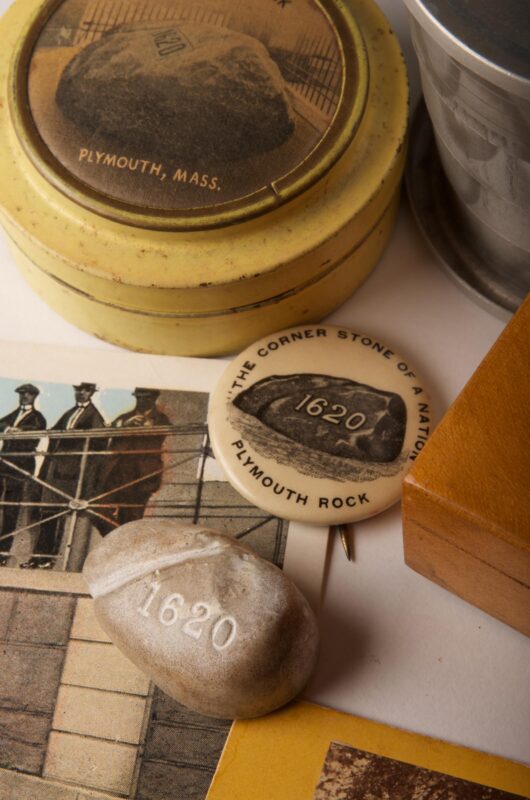
But not everyone could have their own piece of the Rock. Plymouth’s first commercially produced souvenirs were ceramicware ordered from Enoch Wood of Burslem, England. In 1820, following a stirring address by Daniel Webster in Plymouth’s First Church, a bicentennial dinner was held in the new court house. The court house’s builder, John Blaney Bates, served that dinner on the Wood chinaware.
Remembrance of Things Past
Americans developed a new sense of history following the American Revolution. Until then, the prevailing impression (among New Englanders in particular) was that they were living in the same era as the first colonists—even if there had been a sad falling away from the ideals of the initial settlers. Although the victorious revolutionary generation could sustain this emotional connection, rapid changes in life following industrial and social innovations altered the national composition and landscape. Americans felt their unified past was fast slipping away, and the heroic virtues that had made the new nation possible were no longer theirs. Nostalgia for the self-reliant and homespun strengths of earlier generations, when “life was simpler” and cultural proprieties self-evident, stimulated efforts to bridge the gap between the receding past and an uncertain present.
Americans sought to enhance their ties to the past as the personal memories for what previous generations had known first-hand with stronger, more tangible expressions of remembrance. Celebrations of history in art, literature, monuments, public anniversaries–and souvenirs– expressed in symbolic form what Americans feared was being forgotten. The 1876 Centennial resulted in a “colonial revival” in art and architecture, and a myriad of commemorative artifacts representative of “ye olden days.”
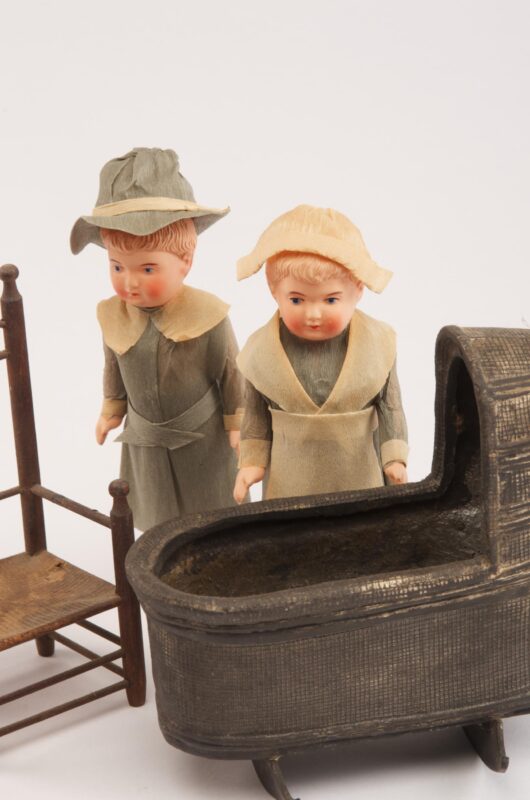
A glass model of Plymouth Rock and a miniature replica of Plymouth’s first governor John Carver’s chair were among the earliest souvenirs offered by Plymouth’s Alfred S. Burbank. The local Edes Manufacturing Company issued models of the Plymouth Rock canopy and Peregrine White’s Mayflower cradle. The originals of the Carver Chair and White Cradle are in Pilgrim Hall Museum’s collection.
Images of the Pilgrims
At the turn of the twentieth century, demand for souvenirs commemorating every possible tourist destination resulted in a flood of new products. In Plymouth, A. S. Burbank and others capitalized on the growing demand for commercial souvenirs by commissioning a wide variety of items representing both the town of Plymouth and the Pilgrims. Three primary themes were associated with the Pilgrims: the Mayflower crossing and Plymouth Rock, the Courtship of Myles Standish, and (probably most familiar) the First Thanksgiving. In 1900, however, only the first two—the heroic migration and Longfellow’s immensely popular love story were represented. Thanksgiving had yet to assume its later importance in the Pilgrim story and widespread popularity.
The Pilgrim images most widely reproduced in every medium were Plymouth Rock, William Halsall’s painting The Mayflower on Her Arrival in Plymouth Harbor, Forefathers’ Monument, and George Boughton’s well-known depictions of John Alden and Priscilla Mullins. Visitors were able to buy photos, illustrated guidebooks of Plymouth, and postcards of every description—the fad for such cards was then reaching tremendous proportions. Pieces of the Rock were no longer available, but these innumerable commoditized keepsakes memorialized a visitor’s pilgrimage to Plymouth by clearly stating “I’ve been there.”

Plymouth in Pictures
Plymouth’s Pilgrim memorials, ancient dwellings, and picturesque burying ground enchanted tourists and residents alike. But these sites were not the only appeal the town held for visitors. Plymouth had long been a destination for sportsmen looking to hunt and fish. Crowds of summer visitors were drawn to the dozens of woodland ponds and miles of seashore.
The visual experience of “sight-seeing,” viewing celebrated historic sites and natural landscapes, formed memories tourists wished to permanently preserve. Images of Plymouth’s attractions were recorded by artists and photographers and made available on stereopticon cards, cabinet photos, and in publications, enabling customers to re-experience the sights they had enjoyed.
A.S. Burbank produced a catalog of hundreds of Plymouth views created by local photographers and artists such as J.C. Barnes, Horace C. Dunham, and E.P. McLaughlin. These were available as mounted photographs, prints, lantern slides or postcards. He also published “view books”—albums of Plymouth scenes and places. Together with illustrated guide books, from W. S. Russell’s 1846 Guide to later examples published by Burbank and the Old Colony Railroad, these tangible representations of Plymouth’s many attractions were available to everyone.
Three Hundred Years and Counting
The Pilgrim story’s popularity as a defining event of America’s origin reached a high point with the 1920 Tercentenary. Elaborate plans to celebrate the anniversary were accompanied by an increase in the number and variety of souvenirs. Preparations began for many new physical memorials to the Pilgrims, such as the massive bronze statue of Massasoit, the Cole’s Hill Sarcophagus to house the bones of those who died in the first winter, and the classically-designed canopy over Plymouth Rock.
Each of these memorials added to the imagery available on souvenirs and post cards. The year-long Tercentenary extended from Forefather’s Day, December 21, 1920, through 1921. It attracted over 10,000 visitors a day during the production of George Baker’s massive “Pilgrim Spirit” pageant. Commemorative stamps and a special fifty-cent coin were issued by the United States government.
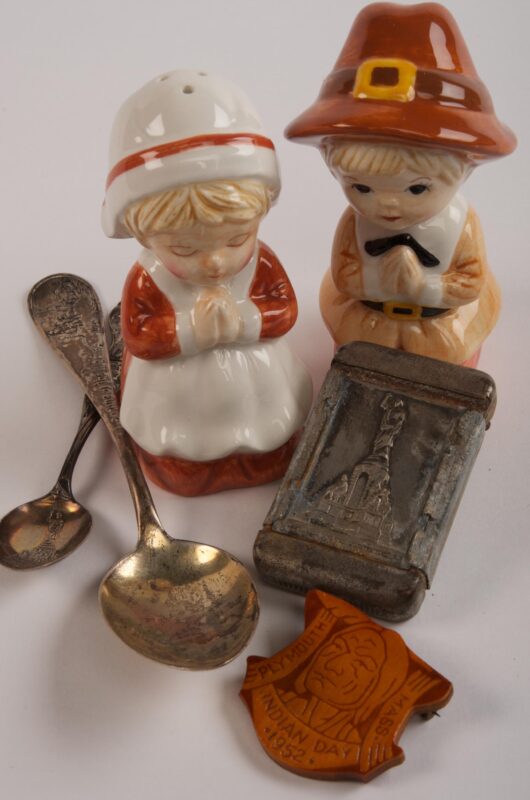
Germany had long been a major source for supplying Plymouth dry goods merchants such as C. T. Harris, H. E. Washburn and the Moore Brothers, with cheap transfer-ware and postcards. Important developments in the production of inexpensive souvenirs and post cards occurred during World War I. When the war ended this trade, production shifted to English and American manufacturers. A. S. Burbank had always favored these higher quality sources, and he included more book titles, miniature reproductions, and related items in the Pilgrim Bookstore catalogs of the 1920s and 1930s.
Plymouth Commoditized
Despite their universal appeal, souvenirs have long suffered a lack of cultural respectability. This became particularly evident in Modernism’s attack on popular culture following World War I. Dismissed by critics as mass-produced clutter or sentimental “kitsch” (cheap gaudy objects in bad taste), the souvenir trade nevertheless continues to flourish. More recently, the tackiness, tastelessness, and silliness factors in kitsch have been ironically embraced as a more honest expression of feeling than the pretensions of elite culture.
The cultural ambiguity that souvenirs embody has only increased their appeal, now that the gift shop has become an integral part of every cultural experience. Today images representing the Pilgrim story, combined in an inextricable amalgam with the Thanksgiving holiday, are eagerly sought out as cherished keepsakes of a Plymouth visit. Even museum gift shops offer a selection of kitschy souvenirs to meet tourists’ expectations. Quality items that attempt to recapture the past’s more reverent association of the Pilgrims with our national heritage are still available for serious customers, but for many tourists, kitschy souvenirs still retain their popularity and appeal.