
Indigenous Leadership & Governance
Wampanoag leaders governed by council and consensus. Sachems exercised authority through networks of kinship and reciprocity and as principal leaders were accorded respect. It was a sachem’s responsibility to care for their people, especially those in need, including elders, the disabled, and those who were widowed, orphaned or otherwise alone.
“Every Sachim taketh care for the widow and fatherless, also for such as are aged, and any way maimed, if their friends be dead or not able to provide for them.”
– Edward Winslow, Good Newes From New England (London, 1624)
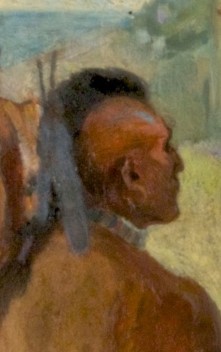
The sachem’s authority and obligation was to the people within their territory. They oversaw access to lands, settled disputes, administered justice, and supervised diplomatic relations.
Sachems formed alliances with neighboring and other sachems, and created confederations based on shared interests, kinship ties, and reciprocity. Great Sachems were regional leaders who commanded widespread respect and to whom other sachems gave tribute.
“Their Sachims cannot be all called Kings, but only some few of them, to who the rest resort for protection, and pay homage unto them, neither may they war without-out their knowledge and approbation, yet to be commanded by the greater as occasion serveth. Of this sort is Massasowat our friend, and Canonacus of Nanohiggenset our supposed enemy.”
– Edward Winslow, Good Newes From New England (London, 1624)
In 1620, the Great Sachem among the Wampanoag people was Ousamequin, usually called by his title “Massasoit” by the English colonists.
“Every Sachim knoweth how far the bounds and limits of his own Country extendeth, and that is his proper inheritance, out of that if any of his men desire land to set their corn, he giveth them as much as they can use, and sets them their bounds….the great Sachems or Kings, know their own bounds or limits of land, as well as the rest.”
– Edward Winslow, Good Newes From New England (London, 1624)
In exchange for their leadership and equitable distribution of resources, sachems like Ousamequin, the Massasoit, were given tribute from the communities within their boundaries.
Sachems were supported by trained, disciplined soldiers, “pnieses,” who served as a core leadership council.
“These are highly esteemed of all sorts of people, and are of the Sachims Council, without whom they will not war or undertake any weighty business….They are commonly men of the greatest stature & strength, and such as will endure most hardness, and yet are more discreet, courteous, and humane in their carriages than any amongst them, scorning theft, lying, and the like base dealings, and stand as much upon their reputation as any men.”
– Winslow, Good Newes From New England (London, 1624)
Pnieses organized the giving of tribute:
“….they appoint a certain time and place near the Sachims dwelling, where the people bring many baskets of corn, and make a great stack theorof. There the Pnieses stand ready to give thanks to the people on the Sachims behalf, and after acquainteth the Sachim therewith, who fetcheth the same, and is no less thankful, bestowing many gifts on them.”
– Winslow, Good Newes From New England
Individual villages had their own leadership; many had their own minor sachem. Relations between the sachems of villages and regional leaders were based on established trust. These relationships undergirded Indigenous diplomacy and governance.
The structure of Indigenous leadership was highlighted in the summer of 1621 during a diplomatic mission of the Plymouth colonists to Pokanoket, “the habitation of the great King Massasoit.” Stephen Hopkins and Edward Winslow, representing the Colony and accompanied by Tisquantum as their guide and interpreter, arrived to present a number of diplomatic requests to the Massasoit and to cement their new alliance with the Wampanoag.
During the visit, Ousamequin called the company together and addressed them:
“….his men gathered near to him, to whom he turned himself, and made a great speech; they sometimes interposing, and, as it were, confirming and applauding him in what he said.”
– Mourt’s Relation (London, 1622)
Ousamequin’s “great speech” was described by Edward Winslow, who witnessed the event:
“The meaning whereof was (as far as we could learn) thus: Was not he Massasoit, commander of the country about them? Was not such a town his, and the people of it? And should they not bring their skins to us? To which they answered, they were his and would be at peace with us, and bring their skins to us. After this manner he named at least thirty places, and their answer was as aforesaid to every one, so that as it was delightful, it was tedious unto us.
– Mourt’s Relation (London, 1622)
The speech was a powerful moment of community building as Ousamequin masterfully acknowledged who his people were for the benefit of his new allies, naming each place in his wide-ranging network of communities, and also affirming the consent of advisors for his leadership, including the forming of ties with the English newcomers.
Over time, Ousamequin faced greater challenges and fewer options in relations with Plymouth Colony. As the English solidified their settlements and became more aggressive, the advantages that the Wampanoag had held at the time of the Pilgrims’ arrival eroded.
Ousamequin’s diplomacy and gravitas were such that he remained respected and revered throughout his life. By the time of his death, however, the next generation of Indigenous leaders faced an increasingly hostile climate towards their people in their own land.