Early Provisions Lists
“ A Shippe of about 150 tunnes will be abl[e to car]-rye a 100 passengers with their provision of vi[ctuals] and about 30 or 40 tunnes of goods more, suc[h as] shall be needfull, and must be provided withall”
– Edward Winslow, in Caleb H. Johnson, The Brewster Book Manuscript (Caleb H. Johnson and The Massachusetts Society of Mayflower Descendants), 2019
Click on the name of a provisions list for a transcription of the original document.
Cupid’s Cove Provisions List, 1611
Newfoundland, established 1609, was the other early English colony in North America. Newfoundland boasted rich fishing grounds, but its colonies were not agriculturally profitable, as Lord Baltimore, and early proprietor discovered. Very detailed lists of provisions were required to sustain Newfoundland’s colonists during the long winters. A handful of small permanent settlements on Newfoundland’s Avalon Peninsula started with one at Cupid’s Cove in 1610.
Edward Winslow’s Advice, 1622
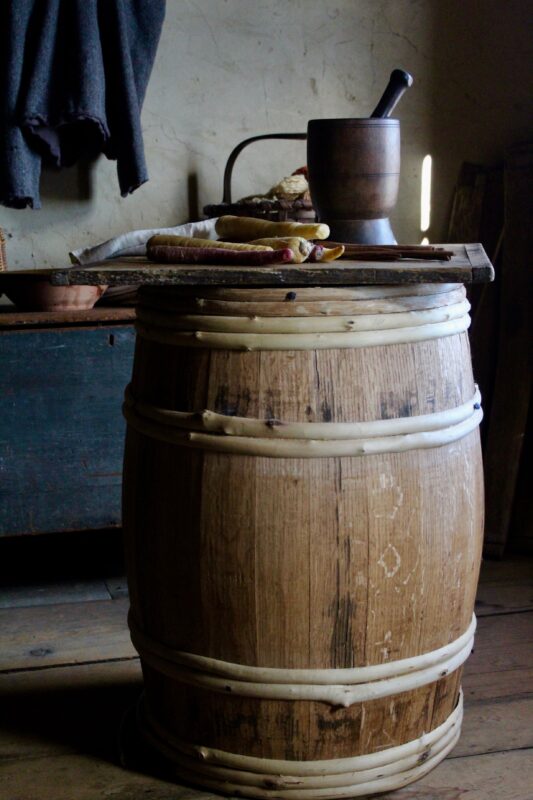
Plymouth’s earliest colonists had to bring most of their own manufactured goods with them. When the passengers of the Fortune arrived in late 1621 without enough provisions, the strain on the colony’s resources was dire. Provision lists were published to help prevent such circumstances by instructing would-be colonists on what they needed to bring across the Atlantic. Edward Winslow listed out exactly what prospective colonists should bring in Mourt’s Relation. Some of the items were basic staples, beer and water in ironbound casks, meal packed tightly into barrels, surplus clothes and bedding, long fowling muskets with powder and shot, lemon juice, butter, aniseed and salad oil, and most interestingly, paper and linseed oil for windows (in place of glass) and cotton yarn for lamps. Essential goods such as these were in demand in the new colony.
The Plymouth colonists, for the first few decades, were living in a world where they had to make, raise, or trade for most of what they needed.
Indigenous trade relations were crucial in the early years, but the settlers also imported many goods from home. All the iron tools necessary to build houses, tend crops and cook food had to be shipped in from Europe. Even in the Colony’s later years, many provisions still had to be imported to supplement locally raised crops. Oil, citrus fruits, and wine came from Spain and Portugal, sugar from the West Indies, and spices from around the globe. By its last years, Plymouth’s colonists were able to obtain even the most fashionable commodities of the Empire, delftware, Chinese porcelain, the new drinks of chocolate from South America, coffee from Arabia and tea from India.
Emigrant Ship Provisions List, 1630
Closer to Plymouth Colony, the Reverend Francis Higginson (1586-1630) was a Puritan minister from Leicester, England who arrived with his family at Naumkeag, now Salem, Massachusetts, in June 1629. He became the teacher for the Salem church in August but died of consumption one year later. While in Salem, Higginson wrote the manuscript for New England’s Plantation, or A Short and True Description of the Commodities and Discommodities of That Country. It was published in London in 1630 as “written by a reverend Divine now there [New England] resident.” Having witnessed Salem’s situation first-hand, Higginson included in the book a list of what provisions each person should bring with them to New England, divided into helpful categories.
Following the style of earlier lists, Higginson listed out the number of each item, such as three shirts and four pair of shoes, eight bushels of meal and two gallons of vinegar, one kettle, one shovel, twenty pounds of powder, and spices—sugar, cloves, nutmegs, mace, pepper. He finished his list with “Also there are divers other things necessary to bee taken over to this Plantation, as Bookes, Nets, Hookes and Lines, Cheese, Bacon, Kine, Goats, &c.”
William Wood’s Advice 1639
“Because the way to New England is over the sea,” wrote William Wood, “it will not be amiss to give you directions what is necessary to be carried.” Wood’s instructions were first published in London in 1634 in his New England’s Prospect, A True, Lively, and Experimentall Description of that Part of America Commonly Called New England. It is thought that Wood arrived in Salem in 1629 and returned to England in 1633.
In his book, Wood advised that more supplies than passengers should be sent, warning that each ship should not “carry many mouths and no meat, but rather much meat for a few mouths.”
Wood suggested victuals in the form of salt beef, pork, salt fish, butter, cheese, peas, biscuits, six-shilling beer, brandy (to ease seasickness), oil, malt, prunes, vinegar, bacon, rice, poultry and sheep, lemon juice to prevent scurvy, and a hogshead and half of meal. Small skillets and pans were suggested along with old and coarse bedding and clothing for use during the voyage across. Wood also suggested wool and linen cloth of all kinds, “grocery wares” such as sugar, cloves, candles and soap, “all manner of ironwares,” and tools, glass, and firearms. Above all Wood suggested sending colonists “of good working and contriving heads, who were “well-skilled and industrious.”
John Josselyn, Provisions List for New England, 1675
John Josselyn, a well-to-do gentleman from Essex, England with an interest in natural history, visited New England on two voyages, made 25 years apart. He first arrived at the Massachusetts Bay Colony in 1638 for a short stay of several months, then came back in 1663 and remained in the colony for eight years.
He returned to England in 1674 and died a year later. Josselyn published two books on his New England experiences: New Englands Rareties Discovered (London, Printed for G. Widdowes, 1672) and An Account of Two Voyages to New-England (London: Printed for Giles Widdows, 1674). In the later account, Josselyn details “the setting out of a Ship, with the charges, the prices of all necessaries for furnishing a planter and his family at his first coming,” as well as “A Description of the Countrey, Natives and Creatures, with their Merchantil and Physical use.”