
Burial Hill
Pilgrim Hall Museum and the Plymouth Antiquarian Society present a collaborative series of free public tours of historic Burial Hill on the first Saturday of each month (excepting January).
Burial Hill in Plymouth, Massachusetts, occupies a steep 5.12 acre site about 165 feet above sea level, overlooking the historic center of the town and Cape Cod Bay. These grounds were part of the early colonial village established in 1620 by the Mayflower Pilgrims.
Situated a quarter mile from the waterfront, the old burying ground is the final resting place of generations of Plymouth residents, including at least two Plymouth Colony governors, William Bradford and Thomas Prence, likely the colony’s first governor, John Carver and his wife, and possibly as many as 60 passengers who arrived on one of the first four ships to early Plymouth.
Burial Hill is one of New England’s earliest graveyards – but it is not Plymouth’s oldest burying place.
The wider area of Plymouth Colony’s first settlement, including the environs of Burial Hill, is the site of many unmarked burial places of the Indigenous Wampanoag people over thousands of years of habitation before the arrival of the Mayflower, and of Native burials during and after the period of colonization.
The English settlers who arrived in 1620 first interred their dead on another hill closer to the harbor, Cole’s Hill. It is not known precisely when the colonists began to use Burial Hill as a burying place. It was first known as Fort Hill and was identified as a place for fortification when the exploring party from the Mayflower reconnoitered the area and began laying out the town in December 1620.
“In one field is a great hill on which we point to make a platform and plant our ordnance, which will command all round about. From thence we may see into the bay, and far into the sea, and we may see thence Cape Cod.”
– Mourt’s Relation (originally published London, 1622), ed. Dwight B. Heath (Applewood Books, 1963), 41.
It is well known that its commanding position induced the erection of fortifications upon it at an early period, and that in the early deeds and records it is invariably called Fort Hill. The first known allusion to it as a burial-place is in the diary of Judge Sewall, under the date of March 10, 1698. On that day the judge, while holding court in Plymouth, says ‘I walk out in the morn to see the mill, then turn up to the graves, come down to the meeting-house, and seeing the door partly open went in and found a very convenient opportunity to pray.’
In the same year a reference is made to the burial-place as the westerly boundary of a lot sold by Nathaniel Howland to Francis LeBaron, and now occupied by Davis Building.
– William T. Davis, Ancient Landmarks of Plymouth (Boston, MA: A. Williams & Company, 1883), 129-130.
In the summer of 1622, a fort-meetinghouse was built on the Hill. Although there is no record as to the precise date, the colonists began to inter their dead near the meeting-house, as was the custom in English parishes.
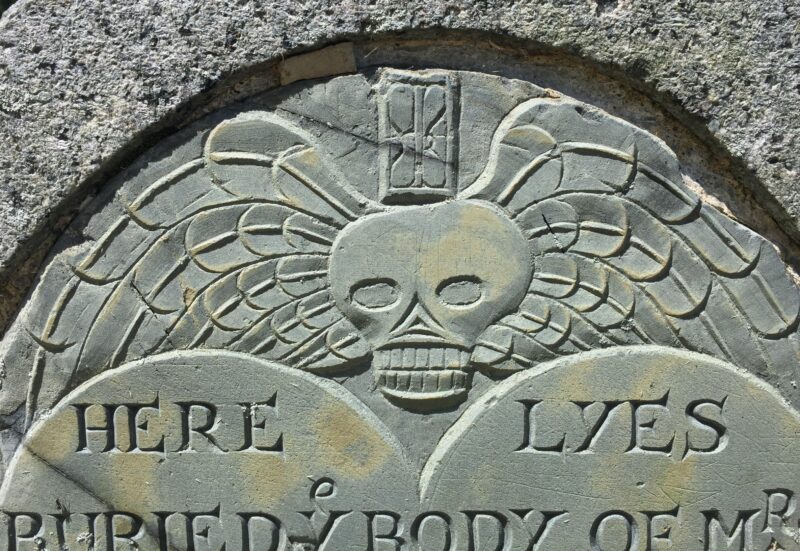
The earliest colonial graves on Burial Hill were likely either unmarked, or marked with simple wooden posts or plain stones that decayed or were swallowed by the earth over time. Of the existing carved gravestones, there are only 29 original markers dated 1715 or earlier. Only five original early markers are inscribed with 17th century dates: Edward Gray, 1681; William Crowe, 1683/4; Thomas Clarke, 1697; Josiah Cotton, 1699; Mary Allerton Cushman, 1699.
Later memorials were erected for some of the Pilgrims presumed to have been laid to rest on the Hill, or to commemorate those buried elsewhere.
According to a survey in the 1990s, there are 2220 surviving grave markers on Burial Hill, representing the names of 2995 individuals. This does not account for many unmarked burials, the number of which is unknown.
Learn More about Burial Hill
Recommended Sources:
Benjamin Drew, Burial Hill, Plymouth, Massachusetts, (Plymouth, MA: Avery & Doten Printers, 1894).
Bradford Kingman, Epitaphs from Burial Hill, from 1657 to 1892 (Brookline, Mass.: New England Illustrated Historical Publishing Company, 1892).
Barbara J. Bradford Robinson, Howard E. Robinson, and Cynthia L. Robinson, Burial Hill in the 1990s, Plymouth Massachusetts (Plymouth, MA: Plymouth Public Library Corporation, 1999).
James Blachowicz, From Slate to Marble: Gravestone Carving Traditions in Eastern Massachusetts, 1770-1870 (Evanston, IL: Graver Press, 2006).