
Archeology
Plymouth is richly layered in history. A place of human habitation for thousands of years, it is the site of the Wampanoag village of Patuxet and the early settlement of the Mayflower Pilgrims. The Plymouth area has been the subject of archeological investigation from the 19th century survey of Myles Standish’s homesite to the 21st century study of the downtown area by the University of Massachusetts Boston.
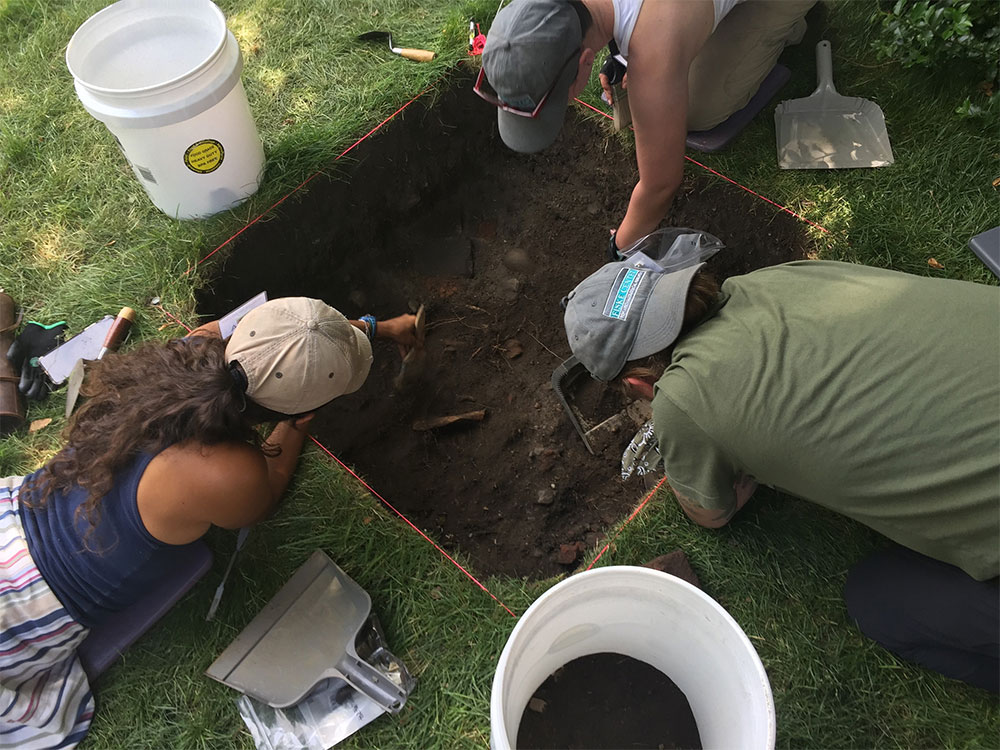
In 1856, the first controlled or scientific archaeological dig in the nation’s history was conducted at the Plymouth Colony site of Myles Standish’s home in Duxbury by Standish-descendant James Hall (1809-1869), a steel-engraver in Boston. Long before the development of modern archeology, Hall’s methodical excavation included drawing up a site plan and recording precise notes on artifacts recovered from the dig. The Standish site and collection of materials excavated by Hall dates from ca.1630 to ca.1710.
James Hall’s hand-drawn site plan and many surviving artifacts from the dig are preserved in Pilgrim Hall Museum’s collection.
Learn More about Myles Standish Archeology
Unlike James Hall’s early methodological approach, most 19th century “archeology” was conducted (often by enthusiasts and amateurs) without plans or documentation of the specific context in which the artifact was found, making accurate dating, identification, and the interpretation difficult.
Pilgrim Hall Museum’s collection includes hundreds of informally excavated or found objects that were collected from local fields, pastures, woods, and backyards in the 19th and early 20th centuries. The majority of these collections consist of Indigenous lithics, though there are also English colonial artifacts such as building materials, munitions, and household objects.
In the 1970s and 1990s, the Museum repatriated items of cultural significance and sensitivity to the Mashpee Wampanoag Tribe.
In the late 20th century as archeology evolved into a scientific discipline, a number of professional excavations were conducted in the Plymouth area. The influential anthropologist James Deetz, a director of Plimoth Plantation Inc. from 1959 to 1978 and professor at institutions including Brown University and the University of California Berkley, investigated Plymouth Colony sites in Kingston, Marshfield, and Plymouth in the 1960s-70s.
Historical institutions seeking to investigate Plymouth Colony history have independently sponsored archeological digs, including Plimoth Plantation (now Plimoth Patuxet Museums), and also the Alden Kindred, Pilgrim John Howland Society, Plymouth Antiquarian Society, and the Pilgrim Society (Pilgrim Hall Museum).
In 1994, the University of Massachusetts conducted a dig in Plymouth. The intriguing findings helped catalyze a more systematic series of digs decades later.
Despite these projects, Plymouth did not become a site of ongoing archeological research as did other, less disturbed colonial sites such as Jamestown and St. Marie’s City. There were long lapses between mostly isolated projects. It wasn’t until the development of modern urban archeology that Plymouth experienced a new period of archeological discovery in the early 21st century.
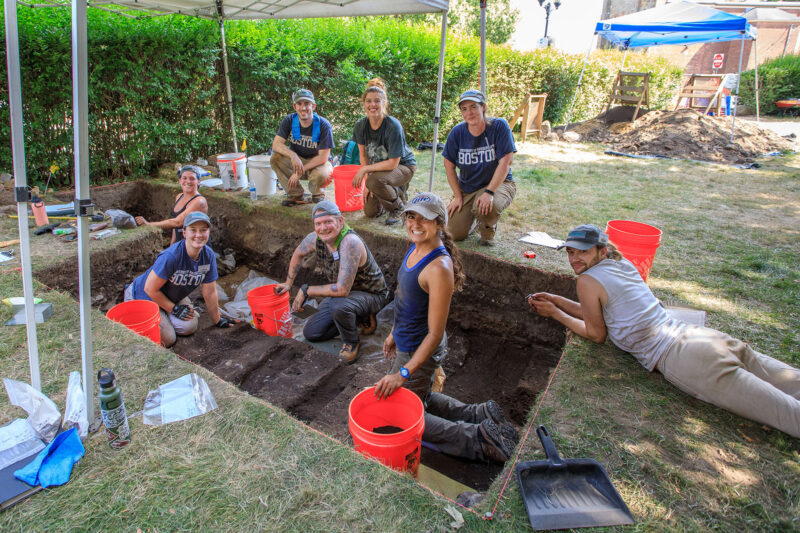
UMass Boston Summer Field School students in Plymouth.
Project 400: The Plymouth Colony Archaeological Survey, a multi-year archeological investigation, was a groundbreaking study for Plymouth directed by Dr. David D. Landon of the Andrew Fiske Memorial Center for Archaeological Research, University of Massachusetts Boston. From 2013 to 2021 (with the exception of 2020), Dr. Landon, with Dr. Christa Beranek and others, organized summer field schools in Plymouth for a series of excavations intended to provide cumulative data and insight into the history of aspects of early Plymouth Colony.
The team-based research was a collaborative project of UMass Boston’s Fiske Center, Plimoth Plantation (Plimoth Patuxet Museums), and the Town of Plymouth, focused on the excavation, analysis, and interpretation of new sites and existing artifact collections related to the 17th-century settlement of Plymouth, Massachusetts.
The Pilgrim Society (Pilgrim Hall Museum) partnered with the Project 400 survey team to conduct archeological testing on a small lot on Coles Hill owned by the Society. In 2016, the survey team conducted the Phase 2 Site Examination of the Coles Hill Lot. In 2021, additional excavations were carried out in preparation for a commemorative Quadricentennial Park (later known as Remembrance Park) to be created on the site in conjunction with Plymouth’s 400th anniversary. Contributions from individual “Luminary” donors helped to fund the archeological investigations.
The Quadricentennial Park Limited Data Recovery Project final report revealed the presence of intact Indigenous features from the time of European contact. As these features would be destroyed by the development of the proposed park, the Pilgrim Society halted the project but continues to consider a potential redesign that would preserve and highlight the site’s significant histories.