
Remembrance Park & Luminary Donors
Cole’s Hill overlooking Plymouth Bay is a site of deeptime Indigenous presence and colonial English settlement.
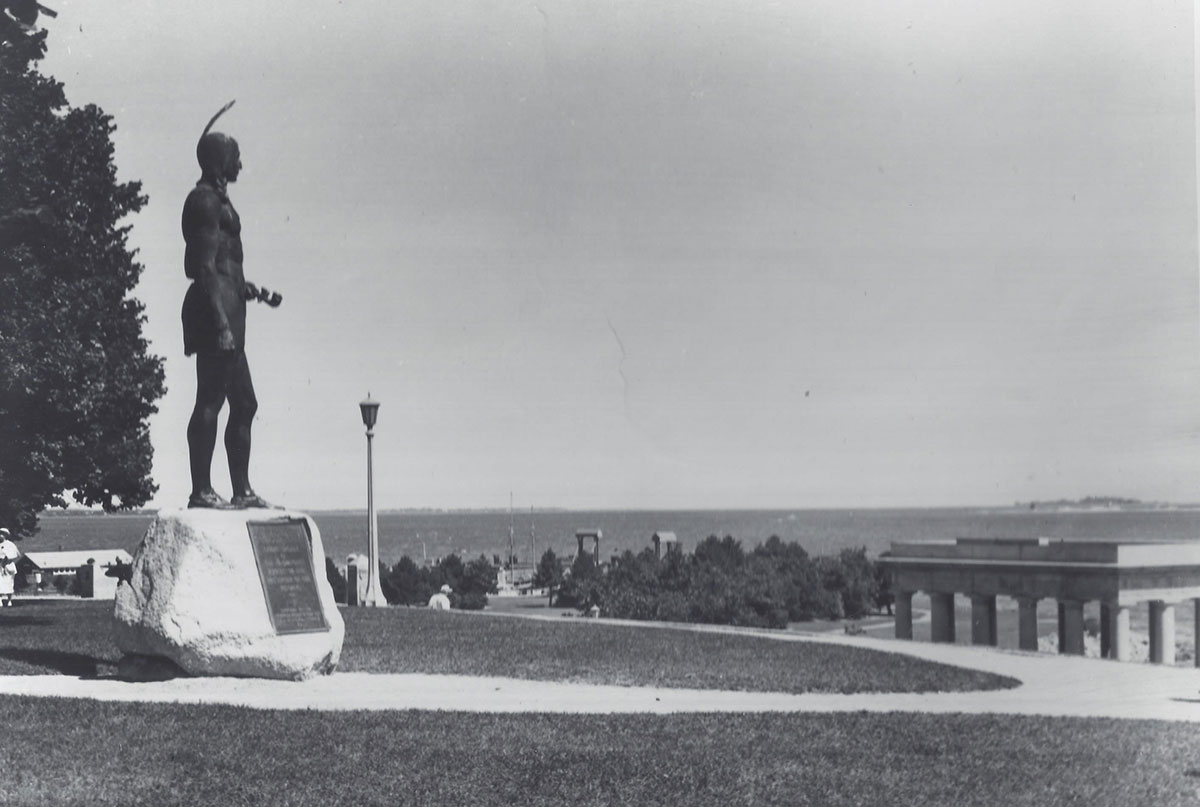
It is the area of the final resting places of many Mayflower passengers who died of illness during their first difficult winter in Plymouth. Located on original homelands of the Wampanoag people, the hill was part of the village of Patuxet, whose people suffered devastating mortality from European-introduced disease before the Mayflower’s arrival. The site also represents subsequent layers of Plymouth’s evolution from the colonial era into the 20th century.
The Pilgrim Society (Pilgrim Hall Museum) has a long history of involvement with Cole’s Hill. It once owned nearly all of the hill, as well as the area of State Pier where the Mayflower II is now anchored. The organization donated the land to the Commonwealth of Massachusetts to be part of Pilgrim Memorial State Park.
The Society retained a small lot on top of the hill to be used for future educational purposes. This lot at the corner of Carver and Middle Streets is one of the last undeveloped parcels of land on historic Cole’s Hill.
In 2018, in collaboration with Plymouth 400 Inc. and the Horsley Witten Group, Pilgrim Hall Museum began planning for a historical Quadricentennial Park to be created on the lot at the top of Cole’s Hill. The proposed park was part of Plymouth’s 400th anniversary or quadricentennial. A group of early donors, known as Luminaries, helped to fund the initial design for what was to be a permanent legacy of the 400th anniversary to commemorate America’s beginnings in early Plymouth.
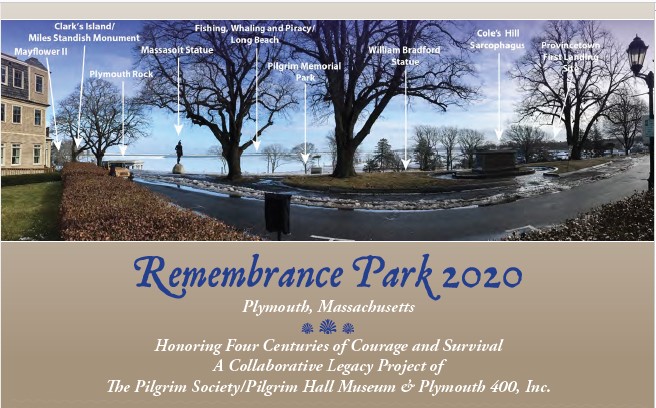
The Quadricentennial Park project was interrupted by the Covid pandemic. During the pandemic, the project was renamed Remembrance Park with the purpose of honoring three episodes of historical challenge:
- The Great Dying of 1616-1619 that afflicted the Wampanoag people
- The first winter of 1620-1621 during which half of the Mayflower colonists perished of contagious sickness
- The 2020 global pandemic that caused widespread mortality and disrupted the lives of people around the world
Cole’s Hill Archeology
Due to the historical significance and sensitivity of the location, an intensive level of archeological investigation was required before any development of the proposed park site.
Archaeologists from the University of Massachusetts Boston’s Fiske Center for Archaeological Research undertook site examination and data recovery in June 2021. It was the Fiske Center’s first on site and in person project since the pandemic outbreak. A team of graduate students led by Dr. David Landon and Dr. Christa Beranek conducted the dig, with volunteers from the Pilgrim Society and Plymouth 400 as educational guides to engage public visitors.
Building on previous archeological surveys of the site, including a test survey of the site by UMass in 2016, the Fiske Center team excavated additional test pits on the Pilgrim Society’s Coles Hill lot. Findings included significant materials related to the 18th and 19th century families associated with the property.
Only limited evidence of early Plymouth was uncovered. However, the early findings were significant. The archeology revealed the presence of Indigenous materials dating to the early, middle, and late woodland periods, and intact Indigenous features from around the time of European contact, including a capped hearth and emptied storage pit.
In order to preserve this rare Wampanoag site, the Pilgrim Society formally set aside plans for the proposed park.
The Society has acknowledged the future possibility of a fully redesigned project that would allow the park to be created without destroying part of the history it is intended to commemorate.